Showing posts with label caltrain incompetence. Show all posts

04 June 2023

BEMU Obsession

Barry the BEMU,
Caltrain's new mascot

"Don't tell me what you value. Show me your budget—and I'll tell you what you value."

There's a new obsession gripping Caltrain: the Battery EMU, an electric train that can travel without overhead wires using electricity drawn from a large battery on board the train. The BEMU features prominently in Caltrain's recently approved two-year budget, which offers the best way to understand the agency's values. We find allocations for:

  • $80M for a single BEMU prototype train (at a $25M premium over a regular EMU)
  • $3.7M for in-house BEMU research and development
  • $2.5M for operations planning (including BEMU operations)
  • $1.1M to develop a 10-year capital improvement plan
  • $1 million to develop a roadmap for level boarding
  • $0.5 million to study future grade separations

The bottom of this list combines to roughly $5M of planning for Caltrain's entire future, a critically important activity to ensure its continued viability. The top two items in this list are almost $30M to pursue a BEMU obsession that will cost much, much more to scale up to anything resembling a viable service pattern. Going by these numbers, Caltrain values BEMUs about six times more than planning for its entire future!

Going Green by Blowing Green

Recently enacted California air quality mandates will make Caltrain's entire diesel locomotive fleet illegal to operate by 2030. This includes the nine locomotives now being refurbished at great expense and retained to operate diesel service to Gilroy (numbers 920 - 928).

If you start from the premise that rail service to Gilroy must be maintained and expanded at any and all costs (regardless of the much ballyhooed fiscal cliff) then a solution must be found to run trains beyond the end of the wires in San Jose, and soon.

Here is the range of available options, from cheapest and most reasonable to most risky and profligate:

  1. Most obviously, purchase the same diesel passenger locomotive that almost every passenger rail operator now uses in California: the Siemens Charger, used by Amtrak, ACE and Coaster. This is a modern low-emission model that will not be outlawed, requires no R&D, and costs about $8M each.
     
  2. Slightly more ambitious is to purchase an upcoming version of the same Charger locomotive that will have zero emission capability to operate through densely populated areas, thanks to a bank of batteries built into a permanently coupled passenger car. This is a model known as the ALC-42E and has been ordered in large quantities by Amtrak. As a bonus, it can draw power directly from overhead wires where available. This option requires no R&D and likely costs closer to $12M each.

  3. Yet another possibility, if one accepts the idea of a seamless cross-platform transfer at San Jose Diridon, is to serve the low-ridership Gilroy branch with smaller trains that do not interline onto the peninsula rail corridor. Stadler has an existing BEMU product known as the FLIRT Akku, developed for remote branch lines in Germany that have similar ridership profiles as Gilroy. This option requires little R&D (beyond overcoming American "not invented here" syndrome and shepherding the technology through FRA approval) and likely costs about $20M per train.

  4. By far the most risky and expensive option is to apply the Akku technology to the Caltrain version of the Stadler KISS, turning it into a supersized BEMU to serve Gilroy and points beyond (Salinas, anyone?) with massively oversized 650+ seat trains. This requires new research and development to add very large batteries (likely in excess of 1 MWh) that will be lugged around as giant dead weights whenever the train operates under the wire. Adding massive batteries to the KISS EMU defeats the very purpose of this vehicle: to move huge numbers of people quickly even with lots of station stops. Costing $85M for the first example and likely north of $60M for each follow-on, this BEMU can rightly be described as "the wrong tool for the job."

You'd need at least six trains to run anything resembling a reasonable service pattern, so multiply accordingly: Caltrain is contemplating the expenditure of about 1/3 billion dollars to keep the Gilroy branch steadfastly served by steel wheels on steel rails. We all love Gilroy, but at any cost?

the right tool for the job
(original by Grendelkhan)
Considering that the Gilroy branch generates very little ridership (about 1% of Caltrain's total ridership before the pandemic), a better interim solution, until the HSR project electrifies the tracks, is to transfer the Gilroy branch to a mature, affordable and environmentally friendly rubber wheel technology: the express bus. This would have the added benefit of allowing Caltrain to quickly rid itself of all of its polluting and failure-prone diesel equipment by 2025, with enormous savings in operating and maintenance costs just as the agency reaches its purported "fiscal cliff." Caltrain should go 100% electric now.

Consultant Featherbedding

The root of this insanity is understandable: Caltrain has for many years retained the services of in-house vehicle consultant LTK, tasked with supporting the highly complex procurement and regulatory approval of a new fleet of electric vehicles. Now that the Stadler contract will be winding down as this new fleet enters service, these people's jobs will be finished. They desperately need to justify their continued existence, and an open-ended research and development project to send oversized bilevel BEMUs all the way to Gilroy, Salinas and beyond is the perfectly timed green-washing opportunity.

Sadly, the BEMU is an expensive solution looking for a problem.

02 January 2023

Deadly Caltrain Underpasses

The recent storms demonstrate once again that Caltrain underpass flooding is a clear and present danger to the public. Deadly is no understatement: while only harrowing water rescues occurred in the 31 December 2022 atmospheric river, two people lost their lives in the flooded Hillcrest Boulevard underpass in Millbrae on 23 December 2021.

Poor "split" grade separation designs that only marginally lower the height of the tracks compared to fully elevated tracks are sure to kill again if Caltrain and surrounding communities continue to build more of them. (lookin' at you, Redwood City!)

Harbor Boulevard, Belmont
 
Ralston Avenue, Belmont (M.M. Parden photo)

42nd Ave, San Mateo (M. Sly photo)

Hillcrest Boulevard, Millbrae (December 2021)

10 December 2022

Leaping Off the Fiscal Cliff

EMU jumping off cliff
One phrase we're going to hear a lot in the next couple of years is "fiscal cliff," a sudden disequilibrium between Caltrain's revenues and expenses caused by the withdrawal of the temporary federal subsidies instituted during the pandemic. The slow recovery of ridership, which until 2019 had funded ~70% of the railroad's operating expenses, is opening a $50 million/year hole in Caltrain's budget outlook through the rest of this decade, according to a draft Short Range Transit Plan (SRTP) recently submitted to the Metropolitan Transportation Commission (MTC).

The SRTP is a process that every four years requires each agency to project hypothetical near-term fiscal scenarios under a standard set of assumptions. Most interesting in Caltrain's draft is that the agency threw in a bonus scenario besides the prescribed hypothetical scenarios: the "Electrified Service scenario" a.k.a. Caltrain's actual plan.

This "Electrified Service scenario" makes zero effort to tackle operating costs, hiding behind a theory that Caltrain is inherently a high-fixed-cost operation, meaning that costs are not highly variable with the level of train service provided. All efforts are instead directed towards securing "funding opportunities," an approach that could very well succeed, as transit funding effectively grows on trees in California, no matter how inefficiently expended. Here are the scary numbers:

What if we blew up some long-held assumptions and attacked this fiscal cliff from the cost side?

Ditch Diesel Now and Go 100% Electric

Since time immemorial, the peninsula corridor electrification project has been sold as only a partial step towards electrification, anticipating that only 75% of the service would become electric with 25% remaining diesel, primarily to serve the non-electrified portion of the corridor south of San Jose. Operating a mixed fleet of diesel and electric trains blows up operating and maintenance costs, since many functions have to be duplicated (training, tools, spare parts, etc.). Revenue miles per vehicle are projected to drop by 10% when electrified service starts, which is a sure sign that your fleet is too big and isn't working hard enough.

How can Caltrain possibly operate with only the 19 EMU sets that will be delivered by 2024?

One certainly can't use all 19 in revenue service. Set one aside for maintenance downtime (grade crossing collisions will continue), and keep another two in reserve for timetable protection, essentially hot spares parked at each end of the line, crewed and ready to enter service at moment's notice to plug any delays during the peaks. That leaves just 16 sets to support a peak service level of six trains per hour per direction, a firm condition of Caltrain's funding agreement with the federal government.

That sounds downright impossible.

However, if you change the goals of a timetable to maximize equipment utilization, it turns out that it can be pulled off. Good service is just a side effect. Here is a new all-electric timetable that makes those shiny EMUs really earn their keep:

All EMU 6 tphpd
Score: 123 (relative to the benchmark score of 100 for the 2011 timetable)
Fleet: 16 EMU (zero diesel)
Utilization: 87% of train-minutes in revenue service

This is admittedly a slightly sporty timetable in that it requires aggressive 10-minute turns and a European level of padding of 7%, less than Caltrain is accustomed to dawdling with. The resulting risk of delay is mitigated by "protect" trains at each end of the line. There is also margin in the long station dwells (45 seconds) and the leisurely acceleration times built into the timetable, with power capped at only 2/3rds of the EMU's nominal rating.

The new EMUs would become highly productive assets by providing about 1.9 million revenue vehicle miles per year using just 133 cars, about 1.5x better utilization of these expensive depreciating capital assets than is currently contemplated.

The savings from disposing of the entire diesel fleet would be significant, and their residual resale value would only help Caltrain's balance sheet. The newer Baby Bullet fleet will have reached 20 years of revenue service, the minimum required by the FTA for federal funding assistance, so no penalties will arise from their early disposal. although its disposal would incur a small penalty reimbursement to the FTA since the equipment will not have reached its 25-year minimum useful life (according to FTA Circular 5010-1E, page IV-26.)

Divest the Gilroy Branch

One hitch: the overhead wire doesn't extend to Gilroy.

Gilroy service is a big weight on Caltrain's operational balance sheet because the ridership and revenue is minuscule compared to the high fixed cost of maintaining diesel service. Before the pandemic, ridership south of San Jose city limits (Blossom Hill) made up a negligible 0.8% of Caltrain's weekday ridership. South of Tamien was hardly better, at 1.2%. Until electrification is extended down to Blossom Hill (as it should be), it makes better sense to transfer this infrequent diesel service to an extended Capitol Corridor, with a direct cross-platform transfer to Caltrain in San Jose.

This can rid Caltrain of the entire diesel fleet, which is currently planned to remain at least 9 locomotives and 79 (!!) cars. It also frees Caltrain from another headache, having to comply with near-term diesel emissions mandates under consideration by the California Air Resources Board.

Reduce Conductor Over-staffing

Caltrain has too many assistant conductors. Assistant conductors are very expensive, costing about $15 million/year by FY25, about 1/3 of the operating deficit. Note this figure does not include conductors, only their assistants. The new EMUs relieve some of their duties, such as announcing station stops. The new fleet also has automatic passenger counters, giving precise real-time insights into passenger loads. While today's conductor staffing levels are determined by a formula from the number of cars, the formula should instead be revised to use recent passenger loads. This would ensure that all trains have a consistent staff/passenger ratio and that conductors have fair work loads.

Change the Operating Culture

With six electric trains per peak hour and at least 20-minute service at all stations, much better than is provided today, the conditions could be created for a robust recovery of ridership. Good service drives ridership, but if Caltrain is allowed to execute their mixed-fleet "Electrified Service scenario," as planned, we will barely achieve any service improvement as costs continue to spiral upwards.

Applying these cost-saving measures, Caltrain could close their operating deficit and erase any "fiscal cliff" without expending any energy to capture ever more "funding opportunities" to support entrenched and inefficient operating practices. The fleet does not need to grow, nor does the headcount. The operating culture needs to change: it's not enough to buy Swiss trains; you need to actually run them like the Swiss.

02 August 2020

PCEP: Farce Majeure

This post serves as a place to track monthly status updates of the Peninsula Corridor Electrification Program, peeling back the rosy pronouncements put forth by the managers of this deeply troubled project. Let's start off with our handy foundation & pole progress tracker, updated monthly


Now also, in the manner of this XKCD cartoon that summarizes the ongoing delays for another project, the James Webb Space Telescope, we offer a retrospective of the promised milestone date for the substantial completion of electrification, which gives a pretty good eyeball of where PCEP will end up:


 Monthly updates will be added here as they occur.
 
The FTA Perspective: The May 2020 PCEP quarterly monitoring report from the FTA PMOC provides some refreshing independent views of the project. The PMOC contractor evidently prepared this report as if it were their last quarterly monitoring report (it wasn't) and included a special Appendix I, a final summary of issues, hurdles, and lessons learned. This is a must-read.

For a northbound cab view of the corridor construction as it stood on July 18th, 2020, see this video by YouTube user Flat Train.

Notes from the April 2021 PCEP progress report
 
We are seeing an odd divergence of foundation and pole installation rates: only one pole was installed for the entire month, despite hundreds of foundations being ready for poles. Foundation installation is at 77% and poles at 60%. For EMU car shells, 59% have shipped from Switzerland.
 
The big schedule and budget update / re-baseline is again delayed, at least to July. There was a three-week slip in Segment 4, and a three-month slip in completion of the CEMOF work (not anywhere near the critical path). FTA independent oversight (PMOC) reports continue to be delayed, with the December 2020 report nowhere to be seen and the March 2021 report still in draft.
 
Notes from the March 2021 PCEP progress report
 
Foundations are picking up a bit, but poles are oddly lagging since there are roughly 800 completed foundations awaiting poles. Foundation installation is at 74% and poles at 60%. For EMU car shells, 56% have shipped from Switzerland.
 
The critical path has once again flip-flopped to the EMU contract, as we await a major schedule update now set for the June board meeting. Notable slips in the Appendix C program schedule include segment 1 overhead contact system (2 months), segment 4 testing (almost 3 months!), and large slips in EMU deliveries (up to 5 months). These big slips are overshadowed by signal work in segments 1 and 3, which haven't started yet and are slated for a lightning-fast installation of ~10 months each. We know from painful experience that signal work in segments 2 and 4 is taking over 30 months, so there may be a future ~20 month slip hiding under there if the work in segments 1 and 3 turns out to be similarly complex and drawn out. Also notable is the zero duration of segment testing for segments 1, 2 and 3. Overall signs still point to no sooner than 2024 for the first passenger service with EMUs.
 
Notes from the February 2021 PCEP progress report
 
New schedule slips reported this month change nothing to the overall trends for the project, which have held steady for a long time. Based on trend extrapolation in the graphs above, foundations are likely to complete in fall 2022 (a year later than reported by Caltrain) and the project will see passenger service no sooner than early 2024 (more than a year later than reported by Caltrain). The critical path has returned to the electrification contract. Notable slips in the Appendix C schedule include signal work, delayed by 2 months in every segment, and a 3-month slip to the PG&E interconnection to the traction power substation in South San Francisco, which will now be built underground.

If looking at a glass half-full, foundation installation is now at 71%, pole erection at 58%, and EMU car shell manufacture at 53%.

Notes from the January 2021 PCEP progress report
 
This month saw the completion of a grand total of 21 foundations and seven poles. The contractor appears to be slow-rolling the work as mediation continues. Caltrain still projects that all foundations will be completed this September, which is not remotely credible.
 
Notes from the December 2020 PCEP progress report
 
Another month, another slip. We learn in the schedule section that Caltrain and Balfour Beatty are engaged in a mediation process, which is the last stage before lawsuits fly. The substantial completion milestone has slipped again, maintaining the trend line plotted above that predicts the substantial completion milestone will realistically occur no sooner than November 2023, with RSD following around new year 2024.
 
Despite crowing about having completed all foundations in segments 3 (true) and 4 (not quite there yet: still 5 to go in 4B and 96 at CEMOF), the foundation installation rate remains pathetic with a monthly production of just 25 foundations versus 200 promised. Next month is promised at 206. Fool me once, ....
 
Appendix C schedule shows large slips in SCADA testing (3 months) and PG&E permanent power at the South San Francisco substation (7 months!)  With permanent power available only by 4/15/22, testing of segments 1 and 2 will certainly be impacted, although you wouldn't know it because the segment testing tasks (sneakily renamed "segment completion" last October) currently have a duration of zero.
 
Notes from the November 2020 PCEP progress report
 
The project's revenue service date has now slipped beyond the FTA funding deadline. The critical path has shifted back to Stadler, at least in Caltrain's reporting. Here's the funny thing: when Stadler reports a schedule slip, the dates seem to get copied straight into Caltrain's program schedule; when Balfour Beatty reports a substantial completion date of June 2024, the dates are quickly swept under the carpet and replaced with made-up "forecast" dates in Caltrain's program schedule that will "likely change." Nothing on the BBII front has changed in Appendix C since last month, so maybe they are saving the big reveal for the new administration, which will presumably look upon the spilled milk with less vindictiveness than the current regime. In the meantime, a linear curve fit of the above charts strongly and steadily indicates a revenue service date in early 2024. Only three more years to go!
 
For fun, here's a brief video from December 9th of a couple of Caltrain car shells on the road in Switzerland, where they are made. They are too tall and wide to go by rail.
 
Notes from the October 2020 PCEP progress report

Exactly as predicted, all scheduling tricks having been exhausted, the electrification work is now firmly on the schedule critical path. The substantial completion milestone just slipped 3 months to 7/22/2022, right up against the FTA revenue service demonstration (RSD) deadline. Looking back, this milestone has now slipped by over a  year since late 2018. It would have blown past the RSD deadline had the schedulers not deleted the pre-revenue testing task, and it almost certainly will: the contractor's schedule shows substantial completion in June 2024, that's right, twenty twenty-four. If we extrapolate the past rate of slippage of Caltrain's substantial completion milestone (~0.54 month/month) and assume the slippage will continue at the same rate (because why wouldn't it?) the milestone will slip to, surprise, 2024.
 
Foundation production continues to be anemic, with a deceleration to 38/month versus 69 planned. Even at a promised rate of 200/month, the foundation completion has pushed out from March into May 2021 per Caltrain's dashboard metrics. Without this unsubstantiated acceleration to 200/month, a straight extrapolation of the recent production rate indicates foundation completion in October of 2022.

The Appendix C schedule remains extremely compressed against the RSD deadline, despite the wholesale deletion of the pre-revenue testing span. Segments 1 and 2 completion dates have slipped to May 2022, leaving almost no margin for system-level testing against the deadline. Clearly, the schedulers had to apply extreme contortions this month to prevent the appearance of missing the RSD deadline: what used to be "segment testing" with a non-zero duration (43 days in segment 1; 43 days in segment 2; 34 days in segment 3) has suddenly morphed into a "segment completion" milestone with zero duration. As integrators of complex systems well know, the greatest risk to a success-oriented green-light schedule occurs during testing, so reducing the segment testing spans to zero is quite the shenanigan!
 
Expect these segment testing spans to return after Caltrain finally runs out to tricks to pretend that they will meet the FTA RSD deadline. Given how compressed against the deadline the schedule already is, the reckoning should occur very soon. And what better time is there to ask for FTA forgiveness than during a force majeure pandemic?

Notes from the September 2020 PCEP progress report

The schedule slips continue, despite best efforts on the part of the schedulers to hide the difficulties being experienced by the project by holding major milestone dates. The start of phased revenue service is in a month for month slip, now 4/23/22, and the task has been compressed by a month. Had this compression not occurred, the program critical path would now run through segment 3 signals and (surprise!) the SCADA system, which just slipped by more than 3 months. Pre-revenue testing can't be delayed much more, so this is it. It will take some serious creativity to claim the full revenue service date of July 2022 can be held.

Foundation production is still in the basement at 48 for September versus 168 planned. The plan is now 69 next month (under-promise, over-deliver) then rising to a never-achieved 212/month for the remainder of construction. Look for the foundation completion date to slip again soon.

Other assorted schedule slips: real estate acquisition (for miscellaneous dribs and drabs up and down the corridor, slipped by ~8 months); traction power in segments 3 and 4 (slipped by ~3 months, the former now just days from the critical path). Oddly, the testing of segment 4 is now scheduled to complete before traction power is done, which seems like a broken dependency.

The top risk is still the dual speed check grade crossing warning system.
 
Notes from the August 2020 PCEP progress report
 
Another month, another slip. Electrification substantial completion is delayed by a month to 3/26/22, for a nine-month slip over the last 18 months. That's just a milestone, and the tasks leading up to it are even more dramatically delayed, with Segment 2 OCS slipping by a whopping seven months! All the electrification tasks are now jammed up against the extremely compressed segment testing, itself slipping and pushing out integrating testing and pre-revenue service by a month. To prevent electrification from exploding onto the primary critical path, heroic schedulers have cut down phased revenue service by a month. The real story here is the secondary critical path, which runs through delayed signaling installation, testing and cut-over activities... and yet these bars are colored a soothing shade of green. Look for these to blow up very soon, with a 3-month slip having just occurred in Segment 4, the one furthest along.

Foundation production continues to flounder at 49 for the month versus 161 promised. The laughable end-of-year completion milestone has slipped by 3 months, allowing the absurdly high future production rates to drop to the merely never-achieved value of 168/month. Six foundations appear to have been "unbuilt" since last month, with completed totals dropping in Segment 2 Work Areas 4 and 5. This may be a bookkeeping error, so the graph shows 1940 completed versus 1934 in the report. Overall, foundation installation is still trending towards completion in late 2021.
 
Notes from the July 2020 PCEP progress report
 
This month, as expected, a mere 40 foundations were installed versus a promise of 186. The promised numbers keep going up to maintain the pretense of finishing before year's end, with 299 foundations/month promised in October and November, over seven times the actual July rate. Detailed accounting is slightly complicated by the fresh inclusion this month of 86 foundations previously constructed outside PCEP scope for the South San Francisco and Hillsdale projects. Since the report doesn't state when these were completed, we spread them out over Jan-Jun 2020. Extrapolating at the current 3-month trailing average production rate, foundations will be completed in November 2021, almost a year behind the advertised schedule. The long-promised acceleration of foundation production is not reflected in monthly actual totals for 2020, which casts doubt on whether such an acceleration will ever materialize.

Budget burn rates for the various contracts are also consistent with a one-year delay, and that is before any pandemic impacts. The dashboards show an overall deceleration of spending, with the past 3 month average burn rate trailing the past 12 month average. Burn rate would now have to double to finish on time, which is plain to see just won't happen.

In the Appendix C schedule, there is a 7-month slip for traction power in Segment 1, and smaller slips in all the other segments. These slips remove all the slack that remained before electrification becomes the critical path. It's now a horse race (or snail race?) between Stadler and BBII.

Expect your first EMU ride in mid-2023.

Notes from the June 2020 PCEP progress report

The pandemic and the words "force majeure" are starting to make a more prominent appearance in the report, providing useful cover for Balfour Beatty's woeful schedule performance. A pandemic-related day-for-day slip at Stadler continues to provide cover, under the theory that the schedule critical path still runs through EMU production-- a condition that remains true on paper only because the secondary critical path has been slashed to the bone by unreasonably compressing key testing and integration tasks at the very end of the program.

The dashboards in section 2.1 don't lie: to finish on time, Balfour would have to triple their burn rate from $5.7 million/month to $17.2 million/month. Overall, project spending is about $700 million behind plan, indicative of severe schedule under-performance. At current burn rates, PCEP will finish no earlier than mid-2023, close to a year behind the dates currently being promised.

Foundation production for June was promised 71 / actual 105, a rare over-performance. Now do July, when an unprecedented 186 foundations were promised. As of this report, the foundations are 56% installed, and poles are 44% installed.

As of this writing in August, 2020, none of the quarterly FTA PMOC oversight reports for 2020 have been posted by Caltrain. These usually provide an unsparing look at the internal challenges of the program, but with election season approaching there is surely a rising incentive to keep them out of the public eye.

Notes from the May 2020 PCEP progress report

Foundation production, despite the insistent promises of past months, has crashed back to the dismal level of 44/month. Undeterred, project managers project ever higher and unachievable future rates (nearly 300 foundations are planned for November) in order to finish within the current calendar year.

For the EMUs, a new change order was approved to defer the installation of interior wheelchair lifts, the final nail in the coffin of the high/low boarding solution. Platform interface-wise, the EMUs will now be configured exactly the same way as the existing Bombardier cars. While recent photos from Salt Lake City show the upper doors installed, these will soon be removed and replaced by plug panels.

In a bit of good news, the regulatory compliance documentation for EMU crashworthiness has been approved by FRA, which is no small feat. One hopes sufficient spares of fiberglass front cladding have been ordered to withstand the usual grade crossing carnage.

The pandemic has delayed testing of the first trainset in Salt Lake City, such that its trip to Pueblo, Colorado for dynamic testing is delayed to November and slipping day for day.

The milestone schedule has slipped again, with electrification substantial completion delayed to 2/26/2022, a slip of 8 months since late 2018. Revenue service has slipped 2.5 months to late July 2022, all but eliminating the margin against FTA's deadline of August 2022. The pandemic will surely be invoked to delay the deadline.

Stadler is still claimed to be on the critical path, now with a convenient day-for-day pandemic slip that provides a welcome fig leaf to the Balfour Beatty electrification work.

The Appendix C schedule finally shows signal construction work. Notably, this work has pushed out the testing of segments 1, 2 and 3 by up to 8 months, with compressed testing tasks taking place at the end of 2021. The testing of the entire electrification system has been compressed from ~6 months to less than 3 months. Pre-revenue testing has been further curtailed to six weeks. There is no discussion or justification of this extremely sporty schedule compression, other than it maintains the illusion that the critical path runs through Stadler.

In the risk list, three new risks have appeared to justify what is surely the consequence of Buy America procurement for the EMUs: quality issues, failed factory tests, and poor integration and control of new U.S. suppliers. These seem to be clear and present issues, rather than risks.

Notes from the April 2020 PCEP progress report

Foundation installation recovered a bit, and an explicit (if likely unachievable) plan was published for how many foundations would have to be completed in each of the remaining months of 2020 in order to finish within the year.

Shipping the first train to Colorado (for high-speed testing) continues to be delayed. This is an important "schedule hold point" where contingency budgets are re-evaluated, and we are now 14 months into a 19-month gap that has opened in the sequence of schedule hold points.

Speaking of contingency, $32 million of it was used this month alone, of which $25 million was shoveled over to PG&E for interconnection work. Why was the contingency budget not replenished by the amount not paid to the party formerly on the hook to perform the work?

New risks: #321 if PG&E makes trouble about the single-phase loading of their substations, then the system cannot be energized. #322 if substations aren't completed on time to get powered up, then testing will be delayed. And then the kicker: #323 "FRA concerns require redesign".... don't leave us hanging, be specific!

Finally, it's the beginning of June and none of the FTA PMOC reports for 2020 have yet showed up. Who is slow-walking these important oversight documents, the FTA or Caltrain?

Notes from the March 2020 PCEP progress report

Foundation installation continues to fall hopelessly behind. The average total for the entire first quarter of 2020 was eight foundations per month (that's right, you can count them on two hands!) and if that rate is sustained, all foundations should be complete by the year 2036. Of course, the report promises a significant acceleration, but the stated goal of completing another 1544 foundations within nine months to support the end-of-year foundation completion milestone has gone from ridiculous to downright laughable. The board and public should be insulted by such a dishonest status report, insisting that everything is on schedule. It's okay to be late, but it's not okay to be so nakedly dishonest about it.

Notes from the February 2020 PCEP progress report

1) Foundation production for February is again ZERO, despite repeated affirmations throughout the report that there is a schedule to finish everything by the end of this year. The required average production rate to reach this goal is 157/month (excluding foundations that are part of SSF and 25th Ave projects); this is higher than the all-time record of 151 set in November 2019. The likelihood of missing the end-of-year target is darn near one hundred percent.

2) The Appendix C schedule shows continuing month-for-month slips in the OCS and traction power tasks, with the selective exception of the segment 1 OCS task-- which if delayed would push the BBII work onto the critical path of the project. To avoid this, the task duration was shortened, using a well-known scheduling trick.

3) delivery of trainsets 2 and 3 is delayed nine months and six months, respectively. That sure is a long time to retrofit flip-up seats. Is there something else we aren't being told?

Notes from the January 2020 PCEP progress report

1) foundation production is at ZERO for the month, with the rate required to complete by the end of the year having increased from 131/month to 143/month. The stated reason for zero foundations is because the contractor "did not have the rebar cages", of which enormous stacks can plainly be observed rusting away at Burlingame, Redwood Junction, and possibly other locations. Something big has come up and Caltrain isn't being transparent about it.

2) Schedule milestones are said not to have budged, despite the latest FTA PMOC report (December 2019) stating that the contractor's schedule shows a substantial completion date of January 2024. That's right, twenty-twenty-FOUR.

3) The flip-up seats that will be added to the bike cars are the subject of a change order that costs $1.96 million, to buy 4 flip-up seats x 2 bike cars x 19 trainsets = $12,900 per flip-up seat. No word on what material these are made of, but solid gold is not out of the question.

4) The signal modifications and grade crossing Constant Warning Time tasks that underlie the contractor's major schedule slips still do not appear on Caltrain's tracking schedule. It's harder to track the progress of a task when it isn't even on your schedule.

5) The appendix C schedule shows a wave breaking in EMU deliveries, with early deliveries delayed by ~3 months and later-produced trainsets being delivered before the earlier-produced trainsets. Must be those flip up seats and door plug retrofits.

Notes from the December 2019 PCEP progress report

1) foundation production has faltered again. The goal posts stayed put this month, but the production rate required to complete by the end of this year has increased from 124/month to 131/month. This month: just 44.

2) appendix C schedule shows a large slip in SCADA (six months!) leaving just 1 month of slack before pre-revenue testing begins. This is shaping up to be yet another secondary critical path. Meanwhile, the completion of traction power construction in segments 1, 2 and 3 is in a month-for-month slip even after the large schedule slips recorded in last month's update. The tsunami buildup continues.

On the good news front: production photos posted on calmod.com appear to show that the door to the EMU cab compartment will have a railfan window affording a view into the cab and out the front of the train. Train nerds rejoice!

Notes from the November 2019 PCEP progress report

1) foundation production has accelerated to a record monthly total of 151, but the goalpost for target monthly average has moved again from 8/31/2020 out to 12/31/2020 (four months). For the old target of 8/31/2020, the required monthly productivity would have been 179 foundations/month. With the newly relaxed milestone it is 124 foundations/month.

2) Appendix C schedule continues to show "tsunami buildup" where a wave of delayed tasks compresses against an artificially held RSD milestone. Most notably, electrification system testing (schedule line 41) has compressed from 222 days to 183 days (18% shorter) and phased revenue service (schedule line 83) has compressed from 90 days to 69 days (23% shorter).

3) The date when you will be able to board an EMU as a passenger for the first time (i.e. the beginning of phased revenue service) has slipped by a month to February 1st, 2022.

4) While the critical path is still stated to go through vehicle manufacturing, ten EMUs will have been delivered by the start of phased revenue service. Is ten enough to begin phased revenue service? If so, EMU manufacturing isn't your critical path.

As observed with last month's notes, Caltrain is making increasingly desperate schedule modifications to maintain the appearance that electrification is not on the primary critical path. With reality biting, it is doubtful they will be able to keep this up for more than a couple of months longer. Expect fireworks by March or April 2020 board meeting.

Speaking of fireworks, Happy New Year 2020 to transit nerds everywhere!

Notes from the October 2019 PCEP progress report

1) Figure 2-5 (foundation production) shows a monthly target for the production rate required to meet the schedule. This monthly target has been stuck at 174 since they started publishing this metric, which is an error in whatever spreadsheet they are using to make this chart. The correctly calculated numbers for the last 5 months (foundations-to-go divided by months left) are: 174, 178, 191, 198, 221. In this latest report they moved the goalpost from 6/30/2020 to 8/31/2020, which bought them an extra two months but used up the schedule slack. By that metric, we're back to 1766 to go divided by 10 months = 177. Hopefully this error will be corrected in future reports.

2) The contractor has never reached 177 foundations/month. To date the record is November 2019, reportedly at 151. (Interestingly, even this record would further bump up the rate to complete from 177 to 179.) This figure of 179 would have to be sustained without interruption until completion. Given that on average, the more difficult foundations (where conflicts are found with existing utilities such as Caltrain's very own PTC fiber optic cables) are being delayed and left to be addressed later than the low hanging fruit, it will become increasingly difficult to maintain rate 179.

3) In the Appendix C schedule, OCS completion has just slipped by one month for three out of the four segments. OCS completion in segment 1 (San Francisco) is now on a secondary critical path, followed immediately by segment testing and system testing. The only reason this didn't become the primary critical path this month is that they compressed system testing by one month, holding the end of system testing at 12/31/21. Compression of testing periods is a red flag.

4) In the Appendix C schedule, the logic is constructed such that it is necessary to have 14 EMUs on hand by the end of "phased revenue testing" which means service is operated with a mix of diesels and EMUs. This is what makes the critical path go through EMU production. In reality, what is most important is the *beginning* of phased revenue testing, which is when you will be able to board an EMU for the first time. Right now this milestone is at 1/3/2022 and has zero slack (i.e. it is on the critical path).

5) The latest PMOC report (September 2019) reveals that the contractor's working schedule (so far rejected by Caltrain for various reasons) predicts substantial completion of electrification on 7/4/2022, six months later than carried in the Appendix C schedule or 12/31/2021.

I expect Caltrain to make increasingly desperate modifications to the program schedule, including further compression of the system test period, to maintain for as long as possible the appearance that electrification is not on the primary critical path. Let's see how long they can obfuscate before finally fessing up.

01 September 2019

Electrification Delayed

Caltrain's electrification project is showing ominous signs of falling badly behind schedule. There are at least five bearish indicators:

Slippery milestone
Slipping Milestones. One key milestone reported in the project's monthly progress reports is known as "Electrification Substantial Completion." From the December 2018 report to the July 2019 report (over a span of 7 months), the milestone has slipped from 6/23/2021 to 12/31/2021 (a bit over 6 months). When a major milestone slips almost day for day, you know the project has gone sideways. The latest PMOC report from the FTA shows that the contractor's date for this key milestone has slipped well into 2022, over a thousand days late relative to the milestone date promised when the contract was signed.

Severely under spend plan
Significant Under-Spending. The amount of money spent to date is about $640 million less than planned at the start of the project. If the value of the work accomplished is commensurate with the amount spent, then the project is 1.5 years behind schedule. However, there are strong indications of inefficiencies (such as "differing site conditions" disrupting foundation installation) and unplanned scope (such as the new grade crossing constant warning time solution) that make it exceedingly likely that the value earned so far is less than had been planned for the amount spent. From an earned value perspective, the CPI is likely under 1 (over budget) and the SPI below 0.6 (further behind schedule than the spend curve might imply).

The little engine that couldn't
Foundation Chaos. As is plainly obvious to anyone riding the train, foundation installation is not a spatially or temporally orderly process. Digging into the ground reveals old utilities, and often reveals the recently-installed CBOSS fiber optic cables, evidently placed by the contractor where it was easiest (right where foundations need to go) with the as-built configuration either incorrectly documented or not at all. This is another CBOSS issue that could end up in court. Conflict with these cables does not bode well for PTC testing or activation, or for the cost of foundation and pole redesign and relocation. Recent indicators show a slight uptick of foundation productivity, but it still lags well below the monthly average of 174 that must now be sustained every month to complete on time. The all-time record is 122, and indications are that August 2019 totals have slid back considerably below trend.

Missing tasks are delayed and
on the critical path
Missing Schedule Tasks. By all accounts, the long pole in the tent (the critical path of the Balfour Beatty schedule) is the design, installation and testing of the signal system modifications, including the new grade crossing warning system. However, such a task is nowhere to be found in the schedule published in Appendix C of the monthly report, which obscures any insight into the true status of the project. Having recently set $150 million on fire with CBOSS, Caltrain is understandably skittish about revealing further unforeseen costs and delays associated with signalling, but it seems inexcusable at this juncture that the public master schedule would show only "OCS," "Traction Power," and "Segment Testing" tasks for the electrification contract, when all the action is in the missing task "Signal System Modifications," which is very much on the critical path in Caltrain's internal schedule and the contractor's schedule.

Proliferation of Schedules. There is apparently no agreement between Caltrain and their contractor on what the real program schedule is. The public schedule in the monthly report is served with a cautionary statement that Balfour Beatty is reporting a significant delay, but the completion milestone is still optimistically set to 12/31/2021. When you end up with several schedules, there is effectively no longer a project schedule. It's anyone's guess when the project will be done, and chances are increasing rapidly that it won't be in 2022, despite Caltrain's increasingly desperate insistence that everything is fine.

Right now would be a good time to come clean about what's really going on. Total transparency is the only saving grace that can spare Caltrain from accusations of project management incompetence.

28 July 2019

Emergency Exit Fail

Caltrain's new EMU train cars have an unusual configuration with two sets of doors. The lower level doors will be used at existing Caltrain stations, while the intermediate level doors (above the wheels at the ends of each car) are intended to be used at an undetermined date in the 2030s once these trains begin sharing stations with California high-speed rail, which will use high-floor trains and high platforms with boarding at about 50" above the rail. The California High-Speed Rail Authority, which Caltrain cryptically refers to as "external stakeholders," required this design feature as a condition of funding Caltrain's modernization to the tune of $750M, to maintain the option of sharing platforms at future HSR stations in San Francisco, Millbrae and San Jose.

The Original Plan

To maximize the short-term seating capacity of the new trains until the 2030s, Caltrain specified that the intermediate level should have temporary flip-up seats installed in front of the unused doors, five per door vestibule, with the seating blocking off the doors like this:
Configuration of intermediate level in A, B, C, E, and G cars
Because EMU cars are filled with electrical cabinets (labeled with yellow lightning bolts), the seating capacity of the train is reduced compared to a conventional train. This is the price you pay for not having a locomotive; all the bits that make the train go still need to find a place, which makes for a challenging packaging problem in a bi-level train. The reduced seating capacity of the train has been controversial and makes these temporary seats quite important. For each 7-car train, there are 70 of these intermediate level flip-up seats that make up a non-trivial 10% of the overall seating capacity of 667.

At some undetermined future date when the intermediate doors would be needed for compatibility with high platforms, the blue flip-up seating modules would be removed from the intermediate level.

A Regulatory Conundrum

In the design of any new train, federal safety regulations require that any passenger seating compartment be fitted with at least two emergency exit windows (for passenger egress) and two rescue access windows (for first responder ingress). The intermediate level counts as a passenger compartment because these flip-up seats are located within it. However, the intermediate level does not have what regulations consider to be a window; the only opening to the outside is through the doors. This set up a conflict with safety regulations.

In late 2017, Caltrain petitioned the Federal Railroad Administration for a waiver (docket FRA-2018-0003) by arguing that the emergency release feature of the doors would provide an equivalent level of safety, despite not meeting the letter of the regulation, allowing emergency access by climbing over the seat backs.

In June 2018, the FRA denied Caltrain's request because the flip-up seating installed longitudinally such that it blocks the doors could impede egress and access and therefore did not meet the intent of the regulation. The FRA stated that "the absence of need for these intermediate level doors to support current revenue boarding and alighting requirements does not negate the necessity for an unobstructed path in the event of an emergency." Curiously, this unobstructed path requirement applies only to doors, not to windows!

Implicitly, Solution A is to remove all seating from the intermediate level of the affected cars, which effectively sidesteps the emergency window requirement. But given that seating in Caltrain's EMUs is already quite limited, this solution seems like a non-starter as it would reduce seating capacity of a 7-car train by 9% from 667 seats to just 617 seats.
Solution A: not a passenger seating compartment
The FRA helpfully suggested some other possibilities.

Solution B: equip the intermediate level doors with a regulation-size emergency window of minimum dimensions 26" wide by 24" high. Unfortunately, that is too large for the dual-leaf design of the train doors; in other words, the window in each door leaf is too narrow to function as an emergency window.
Solution B: the minimum clear opening is too big for dual-leaf doors
Solution C: replace the intermediate level doors with a plug panel (essentially, a structural wall panel that does not function as a door) fitted with a regulation-size emergency window of minimum dimensions 26" wide by 24" high, until such time as the door-blocking seating is removed, the panel is removed, and the doors and platform bridge plates are re-installed.

Solution C: doors replaced by plug panels
Caltrain is now in the process of pursuing Solution C, plug panels. This change order is expected to cost about $4 million total up front, about $30000 per car, or $7000 per door. When intermediate-level doors are required a decade or more from now, a net sum of approximately another $10 million ($14 million future installation cost to be set aside, minus $4 million of door maintenance savings) would be needed to retrofit them. That is a LOT of money for a change that fundamentally reduces and complicates compatibility with HSR stations and platforms.

Other Solutions

There are other solutions that strike a better balance of functionality and simplicity without a seven-figure cost impact.

Solution D: short of removing all the seating from the intermediate level vestibule, the regulations require only one emergency window (instead of two) if there are four or fewer seats in the compartment. Removing seats from one side only and applying for a new waiver to allow unobstructed use of one of the doors in lieu of a single emergency window could work, addressing the FRA's stated concern with door obstruction. This would reduce seating capacity of a 7-car train by just 22 seats or 3% (5 seats lost in cars A and B, and 4 seats lost in cars C, E and G).
Solution D: reduced seating with unobstructed emergency access
Solution E: reconfigure the mounting bracket for the flip-up seating so that seats flip up and out of the way of the doors when not used, allowing the unimpeded use of both doors in lieu of emergency windows. This solution requires applying for a new waiver to allow the use of doors in lieu of emergency windows, but also addresses the FRA's stated concern with door obstruction. Placing the flip up seats in this manner would reduce the clear width of the door opening by a couple of inches on each side, from 51" to about 47", with no reduction to seating capacity.
Solution E: change flip-up seating orientation to provide unobstructed door access
(flip-up seats are shown in use; they fold flush against wall when not occupied)
Solution E would require no modifications whatsoever when the intermediate level doors are needed in the future, and could be implemented at all doors throughout the train including the lower level, adding seating capacity. Seats placed in doorways may sound like a bad idea, but in a crowded train, social signaling fairly quickly communicates to occupants of these seats that it's time to stand up and make way. This is the French "strapontin" seating in common use on some of the busiest rail lines in Paris:

Flip-up seats in a doorway of a brand new Bombardier EMU on Paris RER line D.
(foreground at left) credit: Wikipedia / KiHa 52
Indeed, the photo above, taken inside the same Bombardier EMU often vaunted in front of the Caltrain board by a certain member of the public as having so much more seating than Stadler's EMU, shows one of the secrets of achieving very high seating densities: flip-up seating in all doorways. The other three secrets are five-abreast seating, not having as much space dedicated to bikes, and lower acceleration performance that requires fewer electrical cabinets, leaving more space for seats. After adjusting for these four factors, it turns out that the Bombardier EMU provides no higher seating density than the Stadler EMU.

Ultimately, it is entirely possible that Caltrain simply does not wish to interface with high-speed rail in any station as a matter of policy, because it would require sharing and collaborating with another agency, and solving a somewhat complicated ADA compliance problem. Which agency would voluntarily bring that upon itself? Caltrain already took the HSR money, and installing plugs will "erase" the clunky and unpalatable concession they made in the name of compatibility, with the further bonus of not requiring another run at the FRA for a new waiver. The complicated ADA compliance issues associated with interior lifts are kicked as far down the road as possible!

No matter how you look at it, Caltrain's chosen approach is a ~$15 million mistake that reduces and complicates compatibility with HSR stations and platforms. There are cheaper, simpler and easier ways to achieve compliance with emergency window regulations. It's not too late to change course.

08 September 2018

Still Dithering on Level Boarding

EMU low door configuration
Recent documents seeking regulatory relief from certain FRA requirements for Caltrain's new EMU fleet reveal details of the interface between the train and a station platform.

The lower doors of the EMUs will feature a deploying step at 15 inches (measured above the top of the rail), halfway between the 8-inch platform and the 22-inch train floor. The resulting step arrangement, when deployed, is similar to the existing Bombardier cars, although the floor height of the Bombardiers is 3 inches higher.

So far, so good.

A closer examination of the step mechanism (see Stadler engineering drawing, as submitted to FRA) shows that the step module retracts upward from its 15 inch deployed height, using a cam mechanism, and stows with the step tread 2.5 inches below the door sill. This makes the step unusable for an ADA-compliant level boarding interface, where it might have been configured to close the gap with a 22" platform, at the same height as the train floor. Recall that ADA regulations for unassisted level boarding require a platform gap less than 3 inches, with vertical discontinuity less than 5/8".

One faction of Caltrain staff evidently envisions level boarding using the low doors of the new EMUs, but the engineering drawing proves this is out of the question without a complete redesign and replacement of the door step mechanism. Even then, there are serious questions about the feasibility of a gradual transition to level boarding where the train fleet must serve a slowly evolving mix of 8-inch and raised level platforms.

As per usual with level boarding, the end goal is clear, but getting there is the hard part and often involves lots of hand waving.

Consultant Still Doesn't Get It

Not only is the lower level door step mechanism unsuited for future level boarding, but Caltrain's vehicle engineering consultant, LTK Engineering Services, states that low platforms will be used indefinitely. On page 1 (PDF page 5) of the recent FRA waiver application, we read:
Initially, Caltrain will utilize only the lower level doors to serve their existing 8-inch platforms. Once CHSRA service begins in the corridor, there will be a station or two that will have high level platforms and will be served by the Caltrain EMUs via the intermediate level doors. Other Caltrain stations will remain low level and will be served by the lower level doors.
No! Continued use of 8-inch platforms means long dwell times and time-consuming conductor-assisted boarding for persons of reduced mobility using a manually emplaced bridge plate. This antiquated state of affairs cannot be allowed to persist. Blithely ignoring the minutes that can be saved while the train is at rest is unacceptable, especially after spending two billion dollars to save minutes while the train is in motion.

It is time to adopt a policy on level boarding, and to push Caltrain's staff and consultants to reach agreement on the technical approach to get there. Here we are in 2018 and there is still obvious disagreement about whether to implement level boarding at all (a no-brainer if you look at the big picture) and at what height, using what doors on the new EMU fleet. Stop dithering and do it!

Footnote: there are multiple waiver petitions relating to EMU design details.
FRA-2009-0124 Tier I Alternative Vehicle Technology crashworthiness (approved)
FRA-2017-0104 Position of bathroom car emergency exit window (approved)
FRA-2018-0003 Use of upper doors in lieu of emergency exit windows (denied)
FRA-2018-0067 Emergency brake handles, grab irons and steps, clearances (pending)

24 February 2018

The End of CBOSS

The rosy view, from 2011
Caltrain's troubled positive train control solution, known as CBOSS, has now been completely abandoned, to be replaced by the de-facto standard freight PTC technology known as I-ETMS. That's mostly good news, since Caltrain will no longer be stranded with a globally unique PTC system. I-ETMS is being deployed by numerous other commuter rail operators in the U.S., allowing some economies of scale and standardization.

Notwithstanding, CBOSS easily rates as the most spectacular contract failure and biggest lawsuit in Caltrain's entire history, since the Peninsula Corridor Joint Powers Board was formed in 1985.

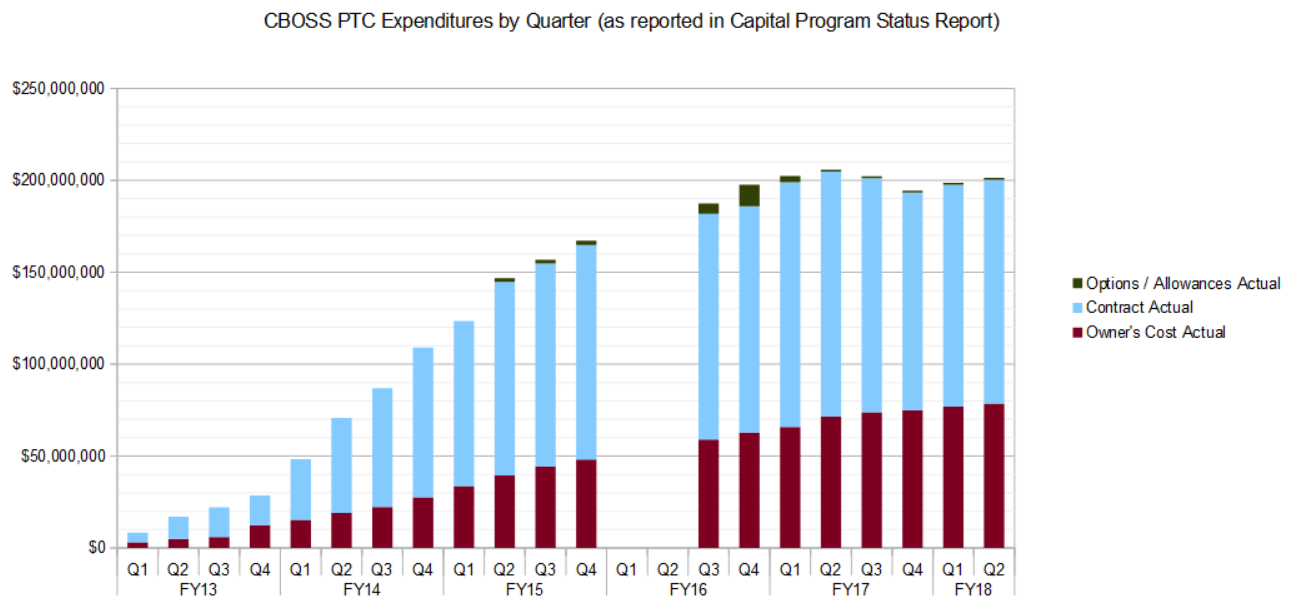
Project expenditure history, by fiscal quarter. Fluctuations in
recent quarters are unexplained, presumably related
to termination of the Parsons contract in 2017 Q2.
Gap reflects two missing quarterly reports.
The sums expended are staggering, especially when considering that just 52 route-miles are to be fitted with PTC. To date, according to the latest quarterly capital projects report, Caltrain has expended $201 million out of $240 million budgeted for the project.

The March 2018 board packet includes a new item awarding a $49.5 million contract to Wabtec to deploy I-ETMS on the peninsula rail corridor, presumably re-using some of the hardware and communications infrastructure already installed under the CBOSS contract. The "owner's cost," borne by Caltrain to cover program management and testing, has averaged $1.2 million/month over the past five years, and should stretch well into 2019 until PTC is fully deployed and activated. (Note the December 2018 statutory deadline only requires a "revenue service demonstration" over a limited portion of the corridor). Caltrain staff estimates that owner's costs will grow the I-ETMS deployment to $59.5 million, pushing the PTC project total to at least $261 million. The board packet hints at additional future program costs, beyond the $59.5 million "switching cost" from CBOSS to I-ETMS.

How much money did Caltrain waste on CBOSS?

To estimate how much money Caltrain wasted on CBOSS, we can examine the PTC project finances of other commuter rail systems deploying I-ETMS, but without the wasteful detour into research and development of globally unique alternative solutions. These PTC-related expenses are variously reported to each operator's board of directors, in press releases, or to the FRA.

OperatorCityRoute Miles EquippedVehicles EquippedPTC Cost
MetrolinkLos Angeles249112$216M
CoasterSan Diego6017$87M
SounderSeattle1032$37M
RTDDenver2966~$115M
ACESan Jose06$10M

A linear regression analysis on three variables (cost per route mile, cost per vehicle, and a fixed cost allowance for control facilities) for these five commuter rail I-ETMS installations reveals that equipping one route mile of track costs on average $0.36M, equipping one locomotive or cab car costs $1.0M, and the fixed cost is $21M. These are simplistic approximations, but they do give a reasonable ballpark estimate for the underlying cost of a commuter rail I-ETMS deployment.

We then apply these estimated regression factors to Caltrain. With 52 route miles and 67 vehicles, the cost of I-ETMS deployment for Caltrain, had this solution been pursued from the beginning, would have been approximately 52 x 0.36 + 67 x 1 + 21 = $107M. This tells us two things.

First, we can infer from the $59.5M switching cost to I-ETMS that 107 - 60 = approximately $50M or just one quarter of the CBOSS sunk cost (including the fiber communications backbone and a subset of the control facilities and wayside/vehicle hardware) is salvageable for I-ETMS.

Second, since the total cost of Caltrain's PTC project is expected to reach at least $261M, we can infer that Caltrain wasted 261 - 107 = approximately $150 million on the egregious failure that was CBOSS.

$150 million flushed down the toilet. Heckuva job, Caltrain!

25 December 2017

CBOSS Dumpster Fire Update

The CBOSS development lifecycle,
as anticipated in 2009 on this blog.
Today we are at "point of no return."
The deadly crash of an Amtrak train near Tacoma, Washington, which would likely have been prevented if a PTC (Positive Train Control) system had been in place, has renewed the discussion of the status of PTC systems in the Bay Area. Caltrain officials say everything will be OK with CBOSS, Caltrain's very own flavor of PTC. Despite those assurances, a potent brew of ingredients is mixing together.

Bonfire of Lawsuits: After a well-chronicled program failure involving delays, cost overruns, and failure to meet milestones, Caltrain terminated the CBOSS prime contractor, Parsons Transportation Group, in February 2017. PTG and Caltrain promptly sued each other, with PTG claiming wrongful termination and Caltrain seeking up to $98 million in damages. A rich trove of documents can be accessed online under San Mateo Superior Court case number 17CIV00786, and chronicles in detail everything that went wrong with the CBOSS program. With Caltrain likely to recover some damages, PTG has now sued Alstom (formerly PTG's subcontractor and the supplier of CBOSS hardware and software) for failure to deliver a working solution. One is left to wonder how this motivates Alstom to finish the CBOSS project, since delivering a working solution to Caltrain would undermine the claim that Alstom was given an impossible task.

Dying Product: The hardware and software underlying CBOSS is known as I-ITCS, a product originally developed by GE Transportation Systems Global Signalling. While a precursor known as ITCS briefly operated on Amtrak corridors in Illinois and Indiana, it is now being displaced by the de-facto standard freight PTC system known as I-ETMS, with ITCS relegated to controlling only the grade crossing functionality in these corridors. Alstom, which acquired GE Transportation Systems in 2015, is not likely to see a future in the I-ITCS product, leaving Caltrain with a globally unique hardware and software solution. This does not bode well for product support over the lifetime of CBOSS.

Looming Deadline: the deadline imposed by Congress and the Federal Railroad Administration to successfully complete a PTC revenue service demonstration is just a year away, at the end of 2018. One year is not enough to finish, and Caltrain will almost certainly blow this deadline. Will FRA grant another extension and allow Caltrain to continue operating without PTC?

Sole Source Savior: in July 2017, avionics firm Rockwell Collins' subsidiary ARINC was awarded a sole source contract to figure out what it will take to pick up the pieces and complete the CBOSS project. ARINC completed this assessment in September, and will soon (by sheer programmatic necessity, since failure is not an option) be awarded a name-their-price sole source contract to finish a minimally working version of CBOSS that passes FRA muster. With the leverage that ARINC enjoys under these circumstances, the "re-procurement" of CBOSS will likely be (1) expensive and (2) structured such that Caltrain bears all of the risk of continued failure, i.e. cost-plus-fixed-fee rather than fixed price. With the clock ticking, the re-procurement effort has already fallen behind the planned fall 2017 schedule.

Budget Crunch: To date, Caltrain has spent over $200 million (yes, one fifth of a billion dollars!) on CBOSS with nothing to show for it. All the money allocated for CBOSS is spoken for, and a lot more (several tens of millions) will be needed to finish the project. Some of that will come from damages, but it is quite likely that 2018 will bring emergency financial maneuvers to throw more good money after bad.

Descoping of Functionality: while the first 'I' in Caltrain's I-ITCS solution stands for "Interoperable," which was one of the original selling points of CBOSS, this feature is now being thrown over the transom. Interoperability requirements contributed to the scope creep that triggered a re-design of the supposedly off-the-shelf ITCS software. It didn't help that Union Pacific was (as per usual) actively non-cooperative in helping to develop an interoperable solution, leading to Caltrain throwing in the towel and spending an additional $21.7 million (from an FRA "interoperability grant," no less!) to dual-equip seven diesel consists with the I-ETMS freight PTC system for operating on the Gilroy branch owned by UPRR. How I-ETMS freight trains will be accommodated on the peninsula corridor in I-ITCS territory is a burning question, for which the range of answers includes ditching I-ITCS and replacing it with the more viable I-ETMS, following the Amtrak example.

System Integration and Testing is Hard: while Caltrain never fails to remind us that all of the components of CBOSS are physically installed on the trains and the tracks, that is the easy part. The hard part is getting everything to operate together reliably every day, and Caltrain and their shifting band of contractors are barely getting started on this most difficult phase of the development of a new and complex safety-critical system. Integration and Testing is where the best design intentions meet cold harsh reality, and all the mistakes and omissions made during the design phase become painfully apparent. While PTG claimed in court filings that they were 90% done with CBOSS when their contract was abruptly terminated, that last 10% of troubleshooting commonly takes far more than 10% of the budget or schedule.

PTC is Hard: the legal declarations from PTG managers who ran the CBOSS program (see 17CIV00786) reveal a long list of underlying factors that caused much acrimony and remain unchanged today: (1) the specifications and standards for PTC continue to evolve, triggering continued changes and penalty testing; (2) Caltrain and its in-house consultants (the so-called "owner's team") are woefully ill-equipped and uncoordinated in their approach to complex safety-critical avionics technology development; (3) the formal contractual interactions between the "owner's team" and the vendor are complicated and delay-prone; (4) working with UPRR is a huge pain in everyone's caboose; (5) the underlying systems over which CBOSS is supposed to "overlay" are kludged-together stove pipes that, incidentally, will require nearly total re-design for the electrification program; (6) testing PTC on an operating railroad requires extensive coordination that has been demonstrated to be lacking; and so on. Strike PTG and substitute ARINC.

These ingredients will produce a situation where CBOSS does less than was promised, later than planned, and for a lot more money. No crystal ball is needed to predict that CBOSS will continue to "fail forward" to a finish line somewhere beyond 2018.