Showing posts with label CBOSS. Show all posts

28 October 2022

News Roundup, October 2022

CBOSS Dumpster Fire Update: the CBOSS case is still making its way through San Mateo County Superior Court (under case file 17CIV00786). The trial was held in April through June of this year, and closing briefs are due in December. Closing arguments are currently scheduled to be made in court on the 5th of January 2023. The latest kerfuffle is over a post-trial Caltrain/Parsons motion to seek punitive damages from Alstom for intentionally, not just negligently, lying about the status of the project based on testimony given during the trial.

Trains Without Wires: Caltrain held a VIP invitation-only unveiling of the new EMUs in San Francisco on September 24th. Four trainsets (serial production #2 - #5) have now been delivered and will collect dust (graffiti?) for a couple of years because the electrification of the corridor is far from done. The new trains were hauled to San Francisco by diesel power.

New Palo Alto downtown
grade separation

Stirring Things Up In Palo Alto: Caltrain recently briefed the city on their plan to replace the ancient bridge over the San Francisquito Creek. This is precipitating a sudden change to the city's years-long policy of kicking the can down the road on what to do about a future grade separations at downtown Palo Alto. While everybody seems to assume the bridge and grade separation projects are necessarily linked, they are not! The solution is pretty darn obvious: replace the Palo Alto Ave crossing with a new grade separation at Everett Ave, which would connect downtown to El Camino as shown in the sketch at right.

  1. Permanently close and demolish the Alma bridge over University Ave, instead connecting Alma to University via the existing cloverleaf ramps reconfigured as a signalized intersection.
  2. Build a new downtown elevated grade separation viaduct and platforms through the existing station parking lots, along the original track alignment that existed before the University Ave grade separation was opened in 1940. This viaduct would be open underneath, providing station parking, bus platforms, pick-up/drop-off areas, and other station amenities. Bonus: the new straightened track alignment removes a speed-limiting double reverse curve in the tracks.
  3. Cut over the trains to the new viaduct and elevated station. 
  4. Extend Everett Ave under the elevated tracks to the existing intersection at El Camino Real and Quarry Rd, also picking up a new connection to the convoluted and inefficient bus loop. Bonus: bus service is greatly sped up to/from El Camino, Stanford and downtown by avoiding time-consuming looping routes.
  5. Permanently close the grade crossing at Palo Alto Ave.
  6. Demolish the old University Ave rail bridge, remove the old cloverleaf ramps, and bring the University Ave / Alma intersection back up to a grade level signalized intersection.

This grade separation approach is completely decoupled from whatever happens with the San Francisquito bridge.

More CEQA Lawsuits Flying: the recent certification of the HSR San Francisco to San Jose EIR precipitated several new CEQA lawsuits. Brisbane and a private developer are upset about the sprawling HSR "light" maintenance facility planned in the city, and its impact on the planned Brisbane Baylands development. Millbrae also got in on the action due to a clash between its development plans and the planned expansion of the station footprint for HSR. Unfortunately, the Sacramento Superior Court does not allow free access to case files, so details are hard to obtain.

24 February 2018

The End of CBOSS

The rosy view, from 2011
Caltrain's troubled positive train control solution, known as CBOSS, has now been completely abandoned, to be replaced by the de-facto standard freight PTC technology known as I-ETMS. That's mostly good news, since Caltrain will no longer be stranded with a globally unique PTC system. I-ETMS is being deployed by numerous other commuter rail operators in the U.S., allowing some economies of scale and standardization.

Notwithstanding, CBOSS easily rates as the most spectacular contract failure and biggest lawsuit in Caltrain's entire history, since the Peninsula Corridor Joint Powers Board was formed in 1985.

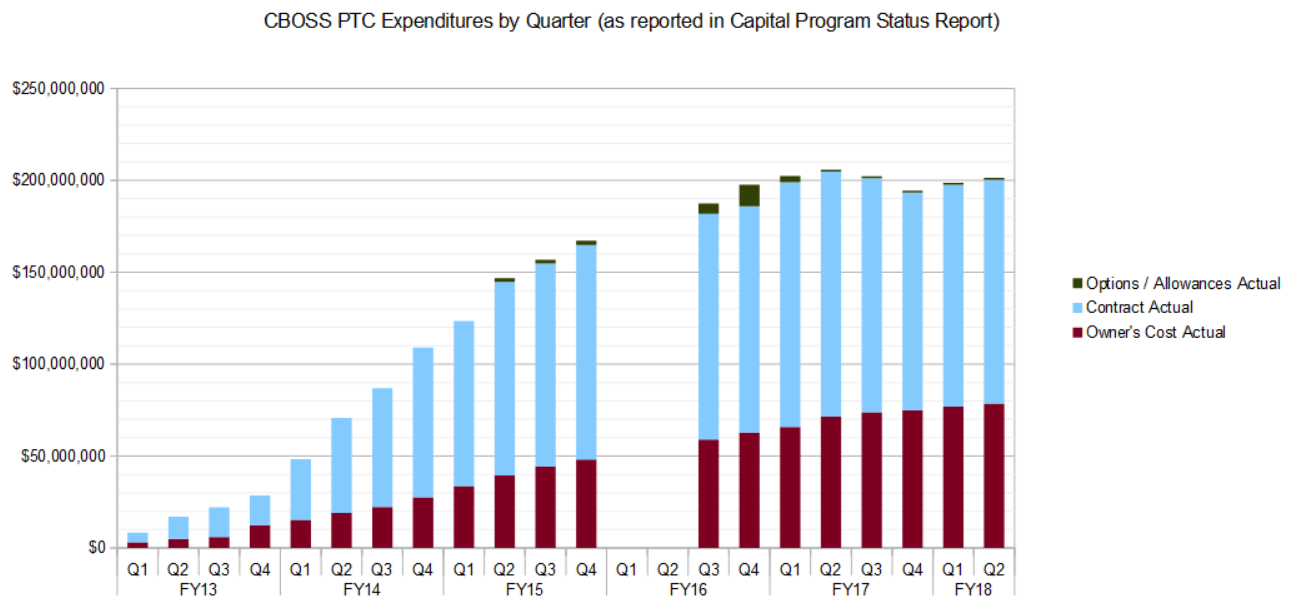
Project expenditure history, by fiscal quarter. Fluctuations in
recent quarters are unexplained, presumably related
to termination of the Parsons contract in 2017 Q2.
Gap reflects two missing quarterly reports.
The sums expended are staggering, especially when considering that just 52 route-miles are to be fitted with PTC. To date, according to the latest quarterly capital projects report, Caltrain has expended $201 million out of $240 million budgeted for the project.

The March 2018 board packet includes a new item awarding a $49.5 million contract to Wabtec to deploy I-ETMS on the peninsula rail corridor, presumably re-using some of the hardware and communications infrastructure already installed under the CBOSS contract. The "owner's cost," borne by Caltrain to cover program management and testing, has averaged $1.2 million/month over the past five years, and should stretch well into 2019 until PTC is fully deployed and activated. (Note the December 2018 statutory deadline only requires a "revenue service demonstration" over a limited portion of the corridor). Caltrain staff estimates that owner's costs will grow the I-ETMS deployment to $59.5 million, pushing the PTC project total to at least $261 million. The board packet hints at additional future program costs, beyond the $59.5 million "switching cost" from CBOSS to I-ETMS.

How much money did Caltrain waste on CBOSS?

To estimate how much money Caltrain wasted on CBOSS, we can examine the PTC project finances of other commuter rail systems deploying I-ETMS, but without the wasteful detour into research and development of globally unique alternative solutions. These PTC-related expenses are variously reported to each operator's board of directors, in press releases, or to the FRA.

OperatorCityRoute Miles EquippedVehicles EquippedPTC Cost
MetrolinkLos Angeles249112$216M
CoasterSan Diego6017$87M
SounderSeattle1032$37M
RTDDenver2966~$115M
ACESan Jose06$10M

A linear regression analysis on three variables (cost per route mile, cost per vehicle, and a fixed cost allowance for control facilities) for these five commuter rail I-ETMS installations reveals that equipping one route mile of track costs on average $0.36M, equipping one locomotive or cab car costs $1.0M, and the fixed cost is $21M. These are simplistic approximations, but they do give a reasonable ballpark estimate for the underlying cost of a commuter rail I-ETMS deployment.

We then apply these estimated regression factors to Caltrain. With 52 route miles and 67 vehicles, the cost of I-ETMS deployment for Caltrain, had this solution been pursued from the beginning, would have been approximately 52 x 0.36 + 67 x 1 + 21 = $107M. This tells us two things.

First, we can infer from the $59.5M switching cost to I-ETMS that 107 - 60 = approximately $50M or just one quarter of the CBOSS sunk cost (including the fiber communications backbone and a subset of the control facilities and wayside/vehicle hardware) is salvageable for I-ETMS.

Second, since the total cost of Caltrain's PTC project is expected to reach at least $261M, we can infer that Caltrain wasted 261 - 107 = approximately $150 million on the egregious failure that was CBOSS.

$150 million flushed down the toilet. Heckuva job, Caltrain!

25 December 2017

CBOSS Dumpster Fire Update

The CBOSS development lifecycle,
as anticipated in 2009 on this blog.
Today we are at "point of no return."
The deadly crash of an Amtrak train near Tacoma, Washington, which would likely have been prevented if a PTC (Positive Train Control) system had been in place, has renewed the discussion of the status of PTC systems in the Bay Area. Caltrain officials say everything will be OK with CBOSS, Caltrain's very own flavor of PTC. Despite those assurances, a potent brew of ingredients is mixing together.

Bonfire of Lawsuits: After a well-chronicled program failure involving delays, cost overruns, and failure to meet milestones, Caltrain terminated the CBOSS prime contractor, Parsons Transportation Group, in February 2017. PTG and Caltrain promptly sued each other, with PTG claiming wrongful termination and Caltrain seeking up to $98 million in damages. A rich trove of documents can be accessed online under San Mateo Superior Court case number 17CIV00786, and chronicles in detail everything that went wrong with the CBOSS program. With Caltrain likely to recover some damages, PTG has now sued Alstom (formerly PTG's subcontractor and the supplier of CBOSS hardware and software) for failure to deliver a working solution. One is left to wonder how this motivates Alstom to finish the CBOSS project, since delivering a working solution to Caltrain would undermine the claim that Alstom was given an impossible task.

Dying Product: The hardware and software underlying CBOSS is known as I-ITCS, a product originally developed by GE Transportation Systems Global Signalling. While a precursor known as ITCS briefly operated on Amtrak corridors in Illinois and Indiana, it is now being displaced by the de-facto standard freight PTC system known as I-ETMS, with ITCS relegated to controlling only the grade crossing functionality in these corridors. Alstom, which acquired GE Transportation Systems in 2015, is not likely to see a future in the I-ITCS product, leaving Caltrain with a globally unique hardware and software solution. This does not bode well for product support over the lifetime of CBOSS.

Looming Deadline: the deadline imposed by Congress and the Federal Railroad Administration to successfully complete a PTC revenue service demonstration is just a year away, at the end of 2018. One year is not enough to finish, and Caltrain will almost certainly blow this deadline. Will FRA grant another extension and allow Caltrain to continue operating without PTC?

Sole Source Savior: in July 2017, avionics firm Rockwell Collins' subsidiary ARINC was awarded a sole source contract to figure out what it will take to pick up the pieces and complete the CBOSS project. ARINC completed this assessment in September, and will soon (by sheer programmatic necessity, since failure is not an option) be awarded a name-their-price sole source contract to finish a minimally working version of CBOSS that passes FRA muster. With the leverage that ARINC enjoys under these circumstances, the "re-procurement" of CBOSS will likely be (1) expensive and (2) structured such that Caltrain bears all of the risk of continued failure, i.e. cost-plus-fixed-fee rather than fixed price. With the clock ticking, the re-procurement effort has already fallen behind the planned fall 2017 schedule.

Budget Crunch: To date, Caltrain has spent over $200 million (yes, one fifth of a billion dollars!) on CBOSS with nothing to show for it. All the money allocated for CBOSS is spoken for, and a lot more (several tens of millions) will be needed to finish the project. Some of that will come from damages, but it is quite likely that 2018 will bring emergency financial maneuvers to throw more good money after bad.

Descoping of Functionality: while the first 'I' in Caltrain's I-ITCS solution stands for "Interoperable," which was one of the original selling points of CBOSS, this feature is now being thrown over the transom. Interoperability requirements contributed to the scope creep that triggered a re-design of the supposedly off-the-shelf ITCS software. It didn't help that Union Pacific was (as per usual) actively non-cooperative in helping to develop an interoperable solution, leading to Caltrain throwing in the towel and spending an additional $21.7 million (from an FRA "interoperability grant," no less!) to dual-equip seven diesel consists with the I-ETMS freight PTC system for operating on the Gilroy branch owned by UPRR. How I-ETMS freight trains will be accommodated on the peninsula corridor in I-ITCS territory is a burning question, for which the range of answers includes ditching I-ITCS and replacing it with the more viable I-ETMS, following the Amtrak example.

System Integration and Testing is Hard: while Caltrain never fails to remind us that all of the components of CBOSS are physically installed on the trains and the tracks, that is the easy part. The hard part is getting everything to operate together reliably every day, and Caltrain and their shifting band of contractors are barely getting started on this most difficult phase of the development of a new and complex safety-critical system. Integration and Testing is where the best design intentions meet cold harsh reality, and all the mistakes and omissions made during the design phase become painfully apparent. While PTG claimed in court filings that they were 90% done with CBOSS when their contract was abruptly terminated, that last 10% of troubleshooting commonly takes far more than 10% of the budget or schedule.

PTC is Hard: the legal declarations from PTG managers who ran the CBOSS program (see 17CIV00786) reveal a long list of underlying factors that caused much acrimony and remain unchanged today: (1) the specifications and standards for PTC continue to evolve, triggering continued changes and penalty testing; (2) Caltrain and its in-house consultants (the so-called "owner's team") are woefully ill-equipped and uncoordinated in their approach to complex safety-critical avionics technology development; (3) the formal contractual interactions between the "owner's team" and the vendor are complicated and delay-prone; (4) working with UPRR is a huge pain in everyone's caboose; (5) the underlying systems over which CBOSS is supposed to "overlay" are kludged-together stove pipes that, incidentally, will require nearly total re-design for the electrification program; (6) testing PTC on an operating railroad requires extensive coordination that has been demonstrated to be lacking; and so on. Strike PTG and substitute ARINC.

These ingredients will produce a situation where CBOSS does less than was promised, later than planned, and for a lot more money. No crystal ball is needed to predict that CBOSS will continue to "fail forward" to a finish line somewhere beyond 2018.

11 January 2017

UPRR Leaves, Sort Of

Caltrain and Union Pacific have recently agreed on the terms of a deal for UPRR ceasing to operate freight trains on the peninsula, between Santa Clara (CP Coast) to San Francisco. This is not the end of freight, however. The Deal Terms Sheet (2MB PDF) outlines the process by which a smaller "Short Line" operator would take over the rights and obligations to continue serving rail freight customers on the peninsula. It also unravels a laundry list of contentious issues that pitted UP and Caltrain against each other. In summary, there are three phases to the deal:

  1. The agreement recently entered into by Caltrain and Union Pacific, stipulating that:
    • UP will start looking for a new short line freight service provider.
    • Caltrain will ensure that short line locomotives with freight PTC can operate throughout CBOSS territory, a condition described as "unconstrained interoperability," a great pretext for more CBOSS program blowouts
    • Caltrain will ensure that Caltrain rolling stock can operate on UP's freight PTC equipped Gilroy branch, or cease operating on the Gilroy branch.
    • Caltrain agrees to never electrify UP's Main Track 1 from CP Coast (Santa Clara) through San Jose to CP Lick (south of Tamien), the land under which Caltrain owns.
    • UP agrees not to object to the CPUC safety requirements (1.4 MB PDF) formally adopted on 10 November 2016 for Caltrain's electrification project.
    • UP allows Caltrain's SSF station reconfiguration project to proceed, trading some old yard tracks and a loading dock for $2 million plus a new Caltrain-funded freight yard track at Newhall in Santa Clara.
    • UP settles some old claims by Caltrain for track maintenance.
       
  2. In the coming months, 
    • UP will select a Short Line and obtain Caltrain's approval.
    • Caltrain will sign a new trackage rights agreement with the short line.
    • Caltrain will sign a new trackage rights agreement with UP that replaces the current trackage rights agreement, concerning the "South Terminal Area" around San Jose.
    • The Surface Transportation Board will hopefully approve the whole deal, which is the entry criterion into phase 3.
       
  3. Upon STB approval,
    • Caltrain will own the "common carrier" obligations and be on the hook legally and financially for abandonment of freight service, should that ever be contemplated.
    • The Short Line will own the common carrier obligations on the sidings and lead tracks not owned by Caltrain.
    • UP will transfer to Caltrain the rights for intercity passenger service north of CP Coast in Santa Clara, but not south of there.
    • UP will agree not to pursue legal action against the electrification project.
This agreement could open a tiny sliver of hope for building grade separations that are both cheaper and more community-friendly without stubborn opposition from UP. On the other hand, it gives no hope for relief from freight PTC interoperability, justifying additional costs that have not already been sunk in the bottomless pit that is CBOSS.

25 July 2016

Steaming Pile of CBOSS

CBOSS, the Communications Based Overlay Signal System, is a Positive Train Control (PTC) system being developed by Caltrain to prevent human error from killing or maiming passengers or rail workers.  It is a deeply troubled project.  Caltrain recently requested a peer review of the project from APTA, the American Public Transportation Association, whose subject matter experts were given access to personnel and documents.

Download the final report from the peer review here (500 kB PDF).

It's fair to say our worst fears have come true:
  • the project manager does not have the requisite technical experience
  • there is no project schedule, and October 2016 is just another month on the calendar
  • inter-operability requirements and test methods are not defined or agreed upon
  • configuration management is not just out of control, but completely lacking as a process
  • software and network security is an afterthought
  • animosities between project management and the contractor are impeding the resolution of technical issues
  • operator training has not started, and the materials for such do not yet exist
  • weekly top-level status meetings between Caltrain management, the program management consultant, and the contractor had not been occurring
The list of documents reviewed by the panel in Appendix C would make a juicy FOIA request.

A little bird overheard some discussions that do not appear in the APTA final report, because the report is intended to provide only constructive criticism to help Caltrain out of this mess.  It's even uglier than you could have imagined:
  • Parsons Transportation Group (PTG), Caltrain's prime contractor, does not have the right skills mix to manage complex system integration on 13 different subcontracts
  • PTG is fearful that the commercial terms of the CBOSS contract expose them to legal action by Caltrain, contributing to the lack of transparency
  • Subcontractor General Electric (now Alstom) discovered that simply re-using the existing ITCS product wasn't going to work.  The inter-operable version of the product is incurring massive increases of scope that were not accounted for in the original contract
  • Because of the extent of the changes made to ITCS, the FRA is requiring the same certification and type approval process as for a new PTC system, undermining Caltrain's claim to reusing an off-the-shelf technology
  • The FRA has taken the position that Caltrain is really installing two PTC systems, requiring full testing of both I-ITCS and IETMS (the system that will be used by Union Pacific freight trains on the peninsula corridor)
  • Inter-operability means not only allowing IETMS equipment to operate in CBOSS territory, but also allowing CBOSS equipment to operate in IETMS territory, something that Union Pacific has been concerned about testing thoroughly
  • Poor coordination for accessing an operating railroad for system installation and testing has been and continues to be a bottleneck
  • Additional funding is going to be needed, but nobody knows how much more
  • A change of contract operator (currently Transit America Services, Inc, soon coming up for re-bid) would introduce significant program execution risk
  • Getting all the CBOSS-equipped trains into revenue service could take up to 5 months
The already egregious sum of $231 million to cover a measly 51 route-miles with PTC is about to increase significantly, something you would never guess from the latest CBOSS update provided to Caltrain's laissez-faire board of directors.
Fast forwarding to whatever year it eventually takes place, the RSD (Revenue Service Demonstration) will consist of flipping the "on" switch and transforming rush hour into an epic cascade of software glitches reminiscent of the 1998 MUNI Meltdown.  On that day, we will all know that this CBOSS turkey has finally come home to roost, as was foretold way back in 2009.

13 February 2016

Train Control Update

There have been two recent and important developments in the area of train control systems, the safety systems known in U.S. parlance as "Positive Train Control" or PTC.  Both of them have a direct impact on the future of the peninsula rail corridor.

CBOSS Goes Sideways

Caltrain's CBOSS project, criticized for years on this blog, is in ever deeper trouble.  According to Caltrain's latest project update, the $231 million previously allocated for this project are nearly spent, but the project is way behind schedule and struggling in the most perilous and delay-prone phase of all: testing of the integrated system.

Not Ready for FRA
Testing is where it all finally comes together, not in the carefully controlled environment of a lab test bench, but in the real world with all its ugly imperfections, annoying glitches, and external influences.  In each segment of the railroad, three things have to happen in sequence: (1) everything has to be fiddled with until it works; (2) when everything works, a dry-run of the official acceptance test, known as "Pilot Testing," is performed; and (3) the system is formally accepted after passing the official FRA-witnessed test of all its functions.  Caltrain's project is stuck in the "fiddle with it until it works" phase, helpfully diagrammed as an infinite loop in the test flow diagram at right, extracted from a CBOSS Verification, Testing and Inspection Plan filed with the FRA.  This is where the schedule and budget are blowing up, with Caltrain's next step described as "Complete Segment #3 Pilot Testing and FRA Witness Testing," coming as soon as they are "Ready for FRA," whenever that may actually be.

Caltrain's update mentions "software release delays" relating to the I-ITCS product that CBOSS is based on.  There are worrying signs that I-ITCS may become a technological dead end: the company that makes it, GE Signalling, was recently acquired by French rail giant Alstom.  Alstom's mainline signaling product portfolio does not give it top billing.  Furthermore, the FRA process is described as being "in flux", meaning that the goal posts are moving.

What we have here is a classic foundering IT project, and it isn't clear if throwing more money at it (at a burn rate of about $50M/year) is going to save it.  With the federal PTC implementation deadline now pushed out to 2018, this is a good time to stop and re-assess the project before escalating the commitment.

HSR Buys Radio Spectrum

Meanwhile, the California HSR Authority is about to spend $50 million to secure the rights to a key chunk of radio frequency spectrum.  The frequency bands being purchased are 757-758 MHz and 787-788 MHz, not the usual 220 MHz band used for freight PTC systems.  Instead, the CHSRA has documented its intent to deploy ERTMS, an increasingly mature and proven train control standard that originated in Europe and is increasingly in worldwide use.  The two bands purchased for HSR are not sufficiently wide to deploy GSM-R, the obsolescent communications standard currently used as part of ERTMS.  It is more likely that California's deployment of ERTMS will use a more modern, secure and spectrum-efficient LTE communications layer, following the evolutionary path beyond GSM-R already being planned for ERTMS.

Connecting the Dots

Suppose the following conditions come to pass:
  1. CBOSS proves unworkable (increasingly likely)
  2. HSR shifts its focus to Northern California (possible)
  3. HSR finalizes plans for ERTMS as its high-speed train control standard (very likely)
  4. Due to construction delays, HSR needs new and productive ways to spend federal funds that expire by 2017 (possible)
Then an opportunity exists to deploy a train control pilot project on the peninsula rail corridor, using ERTMS with LTE communications in the 700 MHz band.  This scenario recognizes an important fact so far disregarded by Caltrain, that HSR will become by far the largest tenant railroad on the peninsula.  Ignoring this fact is an odd position to take for a railroad that hangs its future on "blending" with HSR.  Caltrain will surely dislike the idea, bleating about closer headways, crossing signal integration, station stop enforcement and other completely unproven bells and whistles--as they have since 2009--but events are now quite clearly bearing out the relative technological merits of ERTMS and CBOSS.  It's just sad that it took a quarter of a billion dollars to settle the question.

In the unforgiving world of system integration testing, reality always wins.

17 May 2015

CBOSS Headed for Trouble?

The button we may soon have
to press. Photograph by
Sander van der Vel
Caltrain's new Positive Train Control (PTC) system, known as CBOSS, appears to be running into serious technical difficulties just as the program enters its most challenging phase: testing and commissioning.

The system was originally proposed to be built on top of GE Transportation's Interoperable Incremental Train Control System (I-ITCS) technology, an approach that was touted as advantageous for being "off the shelf."  There are subtle signs that things aren't going so well:
  • This month's CBOSS project status update states rather cryptically that the top challenge for the project is GE software release delays.  These delays could be related to the recent purchase of GE's Transportation arm by the French firm Alstom, which already offers a range of PTC technologies that could make the ITCS product line redundant.
  • The technical requirements for the electrification RFP state (see PDF p. 251 of 2,840) that CBOSS is built on Wabtec's Interoperable Electronic Train Management System (I-ETMS), the main competitor to GE's I-ITCS.  Switching from ITCS to ETMS would be like changing the foundation of a house after the roof is completed.
  • Section 4.13.1 of the electrification RFP document describes the electrification project scope, stating that "The Contractor shall provide the signal, train control and grade crossing systems"... a definition of scope that overlaps significantly with the CBOSS project.
  • Section 4.13.3.1 of the electrification RFP document further describes items that are in the scope of the electrification program, including:
    • System-wide track circuit replacement
    • Manufacturing and assembly of signal enclosures, including installation and wiring
    • Installation of signal enclosures, wayside signals, cables, and cable infrastructure
    • Field testing of the signal system and integrated testing with the electrification, EMU, CBOSS/PTC and other interdependent systems
    • All work associated with the modification of the signal system required for the Project, including the CBOSS/PTC system as necessary and as required by all regulatory agencies, including the FRA, MUTCD and CPUC. The Contractor shall ensure that its wayside CBOSS/PTC systems are 100% compatible with the existing CBOSS/PTC systems that its systems will interface with.
  • The electrification RFP document continues for dozens of pages, describing how an almost entirely new signaling system will have to be installed as part of the electrification project.  What CBOSS was supposed to "overlay" will be largely replaced.
Is there a major architectural change in the CBOSS project that Caltrain staff failed to disclose to the board?  The entire CBOSS budget of $231 million (an astronomical sum for just 50 route-miles of railroad) having already been appropriated and mostly spent, are we about to see large cost overruns get squirreled away in the small print of the electrification RFP?  Is the respective scope of the CBOSS and electrification projects sufficiently well delineated to preclude spending money twice on the same item under two separate contracts?

A faint odor of fish wafts over the whole affair.

20 July 2013

2013 Q2 Corridor Roundup

original photo by afagen
There's been no shortage of developments in recent months on the peninsula rail corridor.

The Caltrain/HSR Blended Service Plan/Operations Considerations Analysis was published on the Caltrain website.  This document aims to flesh out the 2012 Caltrain/HSR Blended Operations Analysis with more detail requested by stakeholders.  While the comment period for this document is now closed, it has a number of weaknesses that should be addressed.
  1. Strange assumptions about service to San Francisco's Transbay Transit Center.  For some obscure reason (agency turf?) all of Caltrain's simulations (see string charts in appendix, starting at page 29) send just two out of six trains per hour into Transbay, where essentially all the ridership will be.  Most Caltrain traffic is assumed to terminate outside the financial district, at 4th and King.  The string charts do not show any conflicts that would prevent sending at least four (if not all six) trains per hour to Transbay, making full use of the triple tracks in the downtown extension tunnels.

    If you accept that Caltrain isn't trying to spite its customers or diminish its own fare revenue, it's hard to imagine why any train would still terminate at 4th and King when it doesn't absolutely have to.
     
  2. Strange assumptions about Caltrain station dwell times.  While the station dwell times of today's Caltrain service have been studied in excruciating detail, the way the dwell time statistics were incorporated into the simulation model may leave something to be desired.  Dwell times are the only randomized input to the model, and the specific random distribution used to calculate them can have enormous impact on the results.

    Because of Caltrain's 8-inch platforms and inefficient passenger flows, dwell times can occasionally exceed two minutes, for example if a wheelchair user needs to board a train.  The resulting dwell time random distribution has a long tail that reflects the "Russian Roulette" nature of today's operations.  These occasional outliers can easily ruin a tight timetable by setting off a domino effect of delays to other trains, resulting in poor on-time performance.  This is especially important because on-time performance (measured in minutes of delay), the figure of merit used to evaluate different operating scenarios, becomes sensitively dependent on the choice of dwell time random distribution.

    Consider level boarding, an improvement that Caltrain hasn't yet discovered how badly it needs.  The lack of steps and abundance of doors makes dwell times shorter and, more importantly, far more predictable.  The dwell time random distribution for level boarding does not have the long tail used in Caltrain's simulations, and we can finally stop playing Russian Roulette.  Look no further than BART to get representative dwell time data.

    What is the effect of the long tail in the dwell time random distribution?  Would level boarding be a better investment than building more passing tracks?  We'll never know, unless the model is re-run with a different dwell distribution that simulates level boarding.
     
  3. Strange assumptions about the "hold out" rule.  This operational rule mandates that when a train stops at an old, narrow center-boarding platform, no other train may enter the station until the first train has departed (otherwise bad things can happen).  The practical effect of this rule is that trains operating on separate tracks can delay each other.  The hold-out rule is slowly turning into an exception as stations are modernized, and today applies at only three stations: South San Francisco, Broadway in Burlingame, and Atherton.

    In a cute computational flourish, the hold-out rule was accounted for in all operational simulations in the Caltrain report, but nobody bothered to ask if it would make any sense to invest billions (with a 'B') in the peninsula corridor to build HSR passing tracks, all the while not spending a few million (with an 'M') to rebuild the three remaining platforms to retire the hold-out rule forever.  Worse, Caltrain's analysis made no attempt to tease out the effect of the hold-out rule on minutes of delay, to quantify its effect relative to other sources of delay.

    This shortcoming could easily be remedied by re-running the model with and without the hold-out rule.
Finally, the document reveals a stunning discovery in its analysis of Dumbarton service:
It is important to note that the feasibility of operating Dumbarton Rail Corridor service on the Caltrain corridor in addition to the Caltrain and HSR blended system does not equate to having the capacity to add another Caltrain or HSR train during the peak hour. DRC service fits because it uses only portions of the corridor and does not require an end-to-end corridor operating slot.
This is the exact same reason why all HSR service should enter the corridor at Redwood City from Altamont Pass, rather than gumming up the entire length of the peninsula corridor.  The blended system would be easier to plan, cheaper to build, and provide far better service to passengers.
The Caltrain/HSR Blended Grade Crossing Traffic Analysis was published on the Caltrain website and concluded the following:
Additional analysis is necessary. However, before doing so, speculation should be minimized. A better understanding of the schedule and decision on passing tracks should be advanced before further traffic analysis is conducted.
That's a fancy way of saying that grade crossing conditions will depend heavily on what the eventual timetable will be, so that a timetable needs to be developed first.  Perhaps Caltrain will some day see that everything revolves around timetable planning.  The timetable is where it starts from, to determine infrastructure needs and grade crossing impacts, and also where it all ends up, to quantify service quality improvements for each community along the peninsula corridor.  Timetable planning is precisely where Caltrain is not spending a lot of effort, because they think they already know the answer, in the form of a general class of "peak period skip stop zone express" timetables described in the 2012 Caltrain/HSR Blended Operations Analysis (see page 34).  There's a lot of work left to be done in this area, starting with undoing Caltrain's mistaken fixation on "peak period skip stop zone express" timetables.  As far as this grade crossing traffic analysis is concerned, Caltrain put the cart before the horse.

The CBOSS train control project chugged along, with a couple of recent puff pieces in the local newspapers. This project is where the lion's share of Caltrain's capital budget is going these days:
Design work is about 50 percent complete, said Karen Antion, who is essentially the boss of CBOSS and a highly-experienced and highly-paid consultant. [...] The design of CBOSS should be complete by September, Antion said.
Is this the same design work that leads up to the Critical Design Reviews that were supposed to have been completed last March?  If so, CBOSS is now a year behind the original plan, and that's before the really hard task of integrating and testing a system that is so proudly proclaimed to be "unique to Caltrain."  It sure is comforting to hear that we've got such a wide spectrum of on-call consultants to get us out of any trouble.

Meanwhile, staff has already softened up the board for the impending Option 2 (Phase 3) contract, to be rubber-stamped at the August board meeting.  The status of key milestones in the scope of Option 1 (Phase 2) is artfully avoided.  This $86.5 million contract is the "final" increment of funding for CBOSS, before the need for an Option 3 (Phase 4) makes itself known, most likely in late 2014.

Remember SuperVia, of Rio de Janeiro?  They are already well into testing.  Their consultants must be absolutely stellar.

The San Carlos Transit Village project is inexorably nearing approval later this month despite strong (and legitimate) NIMBY opposition.  Apparently piqued by claims that SamTrans is sabotaging the modernization of the peninsula rail corridor by selling off land that will be needed for new passing tracks, both SamTrans and Caltrain have issued letters disavowing any ill effect to the rail corridor or to the adjacent Old County Road, essentially by claiming that nothing has been decided yet:
The blended system is undefined at this time and we cannot predict its impact
This is a strange claim to make, given that all the analysis reports commissioned by Caltrain in the last couple of years point towards additional passing tracks (the "midline overtake") being built right through San Carlos and the new Transit Village.

The San Bruno grade separation opened to train traffic, even if the project is far from complete.  Trains now use the tracks built atop a mechanically stabilized earth embankment (basically walls held together by the weight of the dirt fill in between) that could be representative of future grade separations elsewhere on the corridor.

01 January 2013

CBOSS Falls Behind

In October 2011, the Caltrain board of directors approved the first increment of a contract with Parsons Transportation Group to deploy the CBOSS train control system on the peninsula rail corridor.  The contract scope presented then was as follows:
  • $16.3M for the base contract, up through critical design (a government contracting buzzword with a very specific definition)
  • $35.3M for Option 1, for final design, factory acceptance testing, and the fiber communications backbone installation
  • $86.5M for Option 2, including procurement, installation, testing, training, certification, commissioning, final acceptance, and a one-year warranty.
The agenda for the January 3rd board of directors meeting shows that the goal posts have already been moved, and the criteria for whether to exercise Option 1 are as fuzzy as ever, namely "staff now deems it appropriate to exercise Option 1."

The work accomplished for $16.3 million includes:
  • Completed Project Execution Planning (PEP).
  • Obtained approval of Project PEP.
  • Obtained approval of Project Baseline Schedule.
  • Completed Project Contract Deliverable Requirements List.
  • Completed co-location of PTG project personnel at SF Caltrain Field Office.
  • Completed Project Preliminary Design & Approval.
  • Submitted Project PTC Development Plan to Federal Railroad Administration (FRA).
  • Commenced Back-up Central Control Facility Real Estate search.
  • Developed Caltrain Interoperability Coordination Plan for FRA and other railroads’ review and comments. Met with Union Pacific Railroad and other tenant railroads for establishing Interoperability coordination plan process and working groups.
  • Conducted monthly project reviews with California High Speed Rail Authority (CHSRA)-designated consultant.
  • Submitted deliverable packages as required by the JPB’s agreement with CHSRA. Met with FRA/CHSRA to discuss project status and addressed FRA comments in September 2012.
  • Commenced system and subsystem critical design.
The last item in this laundry list is the big one.  It was supposed to have been completed in September 2012 under the base contract, and "commenced" doesn't sound very done.  Passing a Critical Design Review is the milestone traditionally associated with completing critical design, and doing so successfully is certainly no picnic.  The latest project status briefing (2 months ago) shows this milestone in March of 2013, six months later than was planned just 14 months ago.

CBOSS is already late and over-budget.  Will anybody on the Caltrain board of directors notice as they vote unanimously to exercise Option 1?

27 September 2012

CBO$$

Today another $40 million was pumped into Caltrain's CBOSS project, a unique reinvention of the wheel that is nearly certain to fail based on the past track record of similar projects in the Bay Area.

The cheerful press release contains the following gem:
The system, which costs $231 million, is fully interoperable with freight traffic using the Caltrain corridor and future High Speed Rail trains.
This one sentence could easily make one choke twice on the same pretzel.  First, the astronomical cost of more than $4 million per route mile is more than triple the world standard for similar projects.  Second, the claim of interoperability with HSR is an outright lie according to Caltrain's own contracting documents.

Interoperability, in this context, means spending additional millions to outfit each and every high-speed train in California (in a fleet that will dwarf Caltrain's) with CBOSS on-board signaling equipment.  Under this definition, CBOSS is no more interoperable with future "High Speed Rail trains" than it is interoperable with the red rail-cycle pictured above.

26 May 2012

U.S. Supplier Enters ERTMS Market

In a move that amounts to a clear acknowledgement of the increasing worldwide supremacy of the ERTMS ("European" Railway Traffic Management System) technology standard, General Electric Transportation Systems recently became the first U.S. signaling supplier to enter the ERTMS market.

GE Transportation Systems is the same company slated to supply the on-board and wayside components of CBOSS, Caltrain's new-fangled train control system that will be paid for with HSR funding while being technically incompatible with the HSR train control system.

One could briefly entertain the illusion that common sense might prevail, and that with a minimum of contractual upheaval CBOSS could evolve into the first U.S. installation of ERTMS, a solution that could eventually be extended to the entire California HSR system.  Unfortunately, in the blinkered world of parochial agency interests, spending money (over $200 million of it for SF - SJ alone!) is a higher aspiration than providing a good technical solution.  Compatibility is for sissies; why do it right when you can do it twice?

18 November 2011

ERTMS Coming To California

The CHSRA recently added to its collection of technical memos a White Paper on train control technology for California's high-speed rail system.  The selected train control system will likely be deployed on the peninsula rail corridor later this decade or in the early 2020's, regardless of what "solution" Caltrain may pursue in the interim.  The CHSRA's experts looked far and wide for the best technical solution, and as longtime readers of this blog may have guessed, they conclude as follows:
The sole technology that is fully compliant with all of the CHSRA project and technical requirements is the European Rail Traffic Management System (ERTMS) European Train Control System (ETCS) Level 2 with Global System for Mobile Communications – Railway (GSM-R). ERTMS is service-proven and its attributes are highly applicable to CHSTP automatic train control (...)
The biggest technical obstacle for importing ERTMS to the U.S. is the lack of available radio frequency spectrum.  The White Paper delves into great detail about possible ways to overcome this, making several important policy statements along the way:
  • The choice of train control technologies will be limited to solutions that have been successfully demonstrated at high speeds for a period of at least 5 years, to minimize implementation risk and enable a strong safety case to be made to the FRA.
  • The CHSRA requires that it not be locked into a single source for procurement, bidding, and supply. Interoperable, interchangeable, open standard and multi-vendor solutions are required and will provide the CHSRA with several sources of supply for extensions, upgrades, and maintenance spare parts in the present and future, thereby lowering risk and cost. (Are you listening, Caltrain?)
  • Other alternatives to ERTMS are not technically compliant, not compliant with the project requirements, or present too much risk to implementation.
As it happens, the coveted ERTMS / ETCS Level 2 is transparently compatible with ERTMS / ETCS Level 1, which the White Paper describes as follows:
ETCS level 1 is designed as an add-on to or as an overlay on a conventional line already equipped with wayside signals, and possibly as a fallback solution from ETCS level 2. Communication from the track to the train is ensured by dedicated balises located on the trackside adjacent to the wayside signals at required intervals, and connected to the nearby interlocking and/or wayside signals.. The balises have a data connection to the ATC equipment which provides movement authorities for transfer to the train. Receiving the movement authority through balises, the ETCS onboard equipment automatically calculates and indicates to the train engineer maximum permitted speeds of the train and the next braking points if needed, taking into account the train braking characteristics and the track description data. This information is displayed to the train engineer through a dedicated screen in the cabin. The speed of the train is continuously supervised by the ETCS onboard equipment.
This is of course precisely the same thing as CBOSS, which Caltrain and their vendor Parsons Transportation Group are now kludging together for us for a hefty wheel-reinvention fee.

We've already seen Caltrain work with FRA bureaucrats to avoid re-inventing a double-deck EMU train.  Why can't they also work with CHSRA, FRA and FCC bureaucrats to avoid re-inventing a train control system?  The CHSRA is already putting together a plan for scaling the regulatory mountain, with more detail on radio frequency spectrum acquisition provided in TM 300.03 EMT Radio Frequency (RF) Spectrum Acquisition Strategy.

It's no longer just a blogger saying it (bloggers don't know what they're talking about): the high-speed rail project is now firmly on the record as preferring ERTMS as the sole solution, and is already working with government and private entities to obtain the necessary radio spectrum to deploy GSM-R in California.  ERTMS is the best solution for the peninsula, because it would allow high-speed trains to use Caltrain tracks with no special equipment or modifications.  As a side benefit, it would also allow Caltrain to meet their PTC requirement at minimal cost and risk.

ERTMS is coming.  Your move, Caltrain.

09 October 2011

Meanwhile, in Rio...

It finally happened.

Last Thursday, Caltrain's board authorized the award of the first phase of a $138,135,673 contract to Parsons Transportation Group to design, procure and install the Caltrain-specified CBOSS train control system (see staff presentation).  This Parsons contract forms the lion's share of a total project budget variously reported as $231 million to $251 million, or a whopping $5 million per route-mile.  According to a project schedule, the final acceptance of the system is planned for February of 2016 (52 months from now), but that assumed contract award at the May board meeting (5 months ago).

Viewed in the framework of the U.S. transportation industrial complex, where public agencies such as Caltrain transfer huge sums of taxpayer dollars to large private corporations that thrive on custom-engineering, re-engineering and over-engineering everything, this contract is business as usual, and Caltrain will probably end up, years late and millions over budget, with a partially functional PTC system.  That sets the stage for more years and millions spent to make it work with high-speed rail.

Meanwhile, in Rio...

Meet SuperVia, a commuter rail operator in Rio de Janeiro, Brazil.  SuperVia is one busy system, even busier than BART.  Here's a quick comparison between Caltrain and SuperVia:


Caltrain SuperVia
Route Miles


77140
Routes 15
Trains about 25 about 160
Stations31 89

Weekday Ridership ~45,000 ~540,000


Like Caltrain, SuperVia is modernizing.  Among other improvements, SuperVia is installing a sophisticated positive train control system to enforce speed limits, prevent collisions, and reduce the headways between trains.  Unlike Caltrain, SuperVia chose to adapt their requirements to what suppliers already had on the shelf, and is procuring an ERTMS Level 1 overlay system from Bombardier Transportation through a contract worth 125 million Real, or about US $70 million.  (Note that the unknown scope of this contract makes it difficult to compare directly to CBOSS; for example, Bombardier's contract is unlikely to include the train-borne components.)  ERTMS, to remind everyone, is a train control standard that is quickly catching on worldwide, except here in the protected U.S. signaling market.

ERTMS Level 1 is exactly the sort of standardized train control system that would be transparently compatible with high-speed rail, which will most likely operate on its own dedicated high-speed trackage using ERTMS Level 2, a much more sophisticated version of the standard that does away with wayside signals.

The kicker?  Bombardier promises to put this new overlay signaling system into service on SuperVia's various lines from November 2012 to July 2013.  Here's how that stacks up against Caltrain's CBOSS:


Caltrain CBOSS SuperVia ERTMS
Contract award


October 2011May 2011
Initial service entry October 2015November 2012
Final deliveryFebruary 2016July 2013
Time from award to initial service48 months18 months

Time from award to final delivery52 months26 months


It's too late now to do anything about CBOSS, but it sure will be interesting to see what PTG and Bombardier will deliver for each respective rail system.  Can PTG and Caltrain come up with an ersatz-ERTMS by 2015 for the promised sum?

20 August 2011

CBOSS vs. Metrolink PTC

UPDATE 8/22 - There are a couple of additional points that require clarification.

(1) It is claimed that Caltrain's CBOSS budget is so high because it is a turn-key system provided entirely by the vendor, whereas Metrolink's PTC is being done partly in-house. But Metrolink's in-house PTC costs are included in the $202 million estimate (see page 7: $77M Metrolink, $90M vendor, $30M contingency). This does not make the comparison any more favorable to Caltrain.

(2) It is claimed that the standards for high-speed rail PTC are immature. Not so; the requirements are found in pages 723 to 825 of the HSR system requirements report (as of August 2010) as well as in HSR technical memoranda TM-3.3.1 ATC System Concept and others in the 3.3.x series. The kicker (as far as Caltrain is concerned) is that those documents clearly state that "the technology must already exist as part of an operating system with proven experience worldwide on at least one high speed passenger railway"... in other words, CBOSS need not apply, and ERTMS (now being installed by sensible commuter rail operators in places like Rio de Janeiro and Auckland) is most welcome.

ORIGINAL POST - The FRA's push to impose positive train control on all U.S. passenger railroads was triggered by the 2008 Chatsworth collision on Metrolink, in which 25 people died and 135 were injured. Not surprisingly, Metrolink's effort to meet the FRA's December 2015 deadline for PTC implementation is in the national spotlight. If a PTC success story was ever needed, it would surely have to be in Los Angeles.

Metrolink is very much like Caltrain, in that it operates diesel-powered double-decker commuter trains that occasionally intermingle with freight trains. Weekday ridership is similar at about 40,000 trips. Being in the same state, Metrolink's regulatory environment is the same as Caltrain's. One struggles to think of "unique local conditions" that might make Caltrain materially different from Metrolink.

According to Metrolink's funding plan for the project, the total budget for Metrolink's PTC system is $202 million, an amount now fully funded. Not to be outdone, Metrolink plans to complete the system a year before the federal deadline.

Here is a summary comparison table of Caltrain and Metrolink.


Metrolink
Caltrain
System Route Miles


51277
Fleet Size (Locomotives + Cab Cars)
11265
Weekday Ridership
~41,000
~41,000
PTC Total Budget
$202 million

$250 million
PTC Planned Completion
end 2014
end 2015
PTC Funding Status
$202M (100%)
<$100M (<40%)
PTC Interoperable with Freight
yes
yes


You might think that for the quarter-billion dollar price tag of CBOSS (Caltrain's PTC project), one would get something extra, like future-proof compatibility with high-speed rail. But alas, no. At a recent Friends of Caltrain meeting, deputy CEO Chuck Harvey confirmed that due to schedule pressure, CBOSS development would forge ahead without any regard to high-speed rail, and that HSR would have to "pay to play," with a possible requirement of "dual fitment," i.e. two separate PTC installations on-board each high-speed train in all of California. Never mind that the statewide HSR fleet would dwarf Caltrain's.

So, if HSR compatibility is not on the agenda, then what makes Caltrain any different than Metrolink? Why is CBOSS going to cost millions more than a PTC system for six times the route length and nearly twice the fleet size, to be delivered a year earlier? Why not realize economies of scale and pattern Caltrain's PTC project after Metrolink's, which has far more stakeholders in a successful outcome?

That is a quarter-billion dollar question.

25 June 2011

The Truth About CBOSS

$16 million was recently awarded by the FRA for the CBOSS project, Caltrain's Communications-Based Overlay Signal System. Caltrain CEO Michael Scanlon states in a Caltrain press release: "This initial federal investment will enable Caltrain to take an important step forward in our efforts to provide Bay Area communities with a modernized, sustainable commuter rail system that is fully compatible with future high-speed rail service". His counterpart at the California High-Speed Rail Authority, Roelof van Ark, intones in a CHSRA press release: "This latest step forward in federal support for California’s project means that we’ll be able to improve safety and service in the near term and integrate our project with local systems in the long term."

Fully compatible with high-speed rail service? Integrate HSR with local systems? Really?

Let's take a closer look.
As regular readers know, CBOSS has often been criticized on this blog. Rather than rehash extensive previous commentary on CBOSS, let's rely on cold, hard facts obtained solely from primary source documents. You get to decide!

The Evidence

Exhibit A: Caltrain CBOSS Request For Proposal Package, Questions Received and Answers No. 3, dated 6 October 2010. Question #20 from a prospective bidder: "What assumptions should me made in terms of HSR? (Interoperability, Operations, sharing track, etc.)" The answer from Caltrain: "Under current RFP Scope of work, HSR Operations is not considered for this phase of PTC implementation."

Exhibit B: Caltrain CBOSS Request for Proposal Package, Questions Received and Answers No. 4, dated 9 October 2010. Question #16 from a prospective bidder: "Part 2, Section 3, Exh B, Spec 21001, 1.03D requires the system to be interoperable with California HSR signaling. HSR is undefined at this stage. As this solution is not known, Contractor cannot assess any effort associated with this interoperability requirement. Please clarify how Contractor should assess." The answer from Caltrain: "Interoperability with HSR signaling is not part of the Scope of work for Caltrain PTC system RFP."

Exhibit C: Caltrain CBOSS Request for Proposal Package, Questions Received and Answers No. 6, dated 15 October 2010. Question #31 from a prospective bidder: "The RFP addresses HSR. What assumptions should the proposer make in order to address HSR requirements?" The answer from Caltrain: "Evaluation of the potential for the proposed solution to meet future HSR needs will not be part of the proposal evaluation."

Exhibit D: Caltrain's Positive Train Control Implementation Plan, a 183-page document required by law to be submitted to the FRA and detailing how Caltrain will implement its new signaling system, mentions HSR exactly once in the introduction on page 1-1. That's a slight improvement over a previous revision of the document, rejected by the FRA, which did not mention HSR at all. Section 5.1 of the document, discussing Interoperability with other railroads, does not mention or discuss HSR. Appendix D, containing letters of understanding to coordinate PTC implementation with other rail entities, does not include the CHSRA.

Exhibit E: Caltrain's Positive Train Control Notice of Product Intent, a 50-page document that describes how CBOSS will operate, explains in Appendix A section 12 the interoperability with other rail entities. Out of five paragraphs, four mention the Union Pacific, and zero mention California high-speed rail.

Exhibit F: The California High-Speed Rail Authority's extensive collection of technical memos includes Technical Memo 3.3.1, released 25 June 2010, detailing the concept of the system that will be used to control trains on the high-speed rail network. Section 1.2.4, Automatic Train Control Specification Requirements, states "The prime requirement for the CHSTP ATC system is that the technology must already exist as part of an operating system with proven experience worldwide on at least one high speed passenger railway." CBOSS clearly does not fall into this category, which means CHSRA will necessarily use another train control system than CBOSS on its own tracks.

Serious Questions

In light of all this evidence, the happy talk about CBOSS paving the way for HSR rings hollow, and raises some serious questions:
  • Is the Caltrain leadership (board and CEO) even aware of the details of the program being carried out by staff and consultants? Do they know that interoperability with HSR is explicitly excluded from the CBOSS RFP?

  • What is the plan for making CBOSS interoperable with HSR? Might it make sense to develop such a plan before awarding the CBOSS implementation contract, which may happen in the next couple of months?

  • Does the $251 million budget for CBOSS include the cost to make CBOSS interoperable with high-speed rail, as specifically excluded in the current RFP, or will taxpayers be asked for even more money?

  • Does the Caltrain and CHSRA leadership (respective CEOs and Boards) know that California HSR is slated to use a different train control system than CBOSS?

  • If California high-speed trains will use another train control system than CBOSS, why is federal HSR money being spent on the development of CBOSS? Can or should Caltrain expect HSR monies to cover the remaining 90% of the CBOSS cost that is not yet funded?

  • How, why and when were existing train control technologies, such as ERTMS, the standard that shows the strongest signs of being favored for HSR in California (see TM-3.1.1 section 6.1), eliminated from consideration on the peninsula corridor?
The local press has spent numerous column-inches, sometimes even two-page spreads, covering the Caltrain CEO's compensation package. But this is $16 million we're talking about, heading rapidly for $251 million. And not a peep from the press.

30 March 2011

News Roundup

Rubber Stamp

Mike Rosenberg pens a scathing indictment of the Peninsula Corridor Joint Powers Board that runs Caltrain, calling out the board for rubber-stamping everything that is submitted to it by Caltrain staff (including, presumably, the MOU with high-speed rail). The number of Yes votes since the last dissenting vote: 1,591. With only 9 board members, that's 176 consecutive unanimous Yes votes!

One of the dangers of having staff run the show is that an organization will pursue projects for their own sake, to perpetuate its own bureaucratic existence. Case in point: Caltrain's CBOSS train control project, where a small back-and-forth transit operation runs amok with a $230 million technology research and development project that is almost certainly doomed to development failure. Speaking of train control...

ERTMS on the Peninsula?

The CHSRA staff memo for the recent board meeting happens to tally the money currently allocated for HSR in California. One of the items is $16 million of ARRA stimulus money, previously requested as an ear-mark for CBOSS, but now described as funding the "design/implementation of the first Positive Train Control/ERTMS interface implementation on the Peninsula." Say what?

(to find out what the acronyms CBOSS and ERTMS describe, please read here.)

An optimist would note this is the first time that 'ERTMS' and 'Peninsula' are mentioned in the same sentence in official agency materials, rather than just a blog. That much is encouraging.

A pessimist would note that "interface implementation" means an interface between the existing ERTMS and Caltrain's proposed CBOSS, assuming they would co-exist. This is the worst of both worlds: not only is CBOSS 100% functionally redundant with ERTMS, i.e. it will do the exact same thing that ERTMS already does, but interfaces between multiple complex safety-critical systems are astonishingly expensive to implement successfully. If CBOSS wasn't enough of a promise of years of delay and cost blowouts, then kludging ERTMS on top of CBOSS is an absolute guarantee.

The high-speed rail project has very strongly implied that ERTMS would someday be installed on the peninsula. The recent train control technical memos (see TM-3.3.x) explicitly state that the selected technology must already exist as part of an operating system with proven experience worldwide on at least one high-speed passenger railway. That leaves exactly two solutions: (1) the ERTMS standard supported by the world's biggest names in train control, being deployed in dozens of countries worldwide, and (2) the Japanese Digital-ATC product by Hitachi, deployed in Japan and Taiwan. Wanna place bets?

Show Some Teeth, For Once!

One thing the Caltrain board of directors might consider sinking its teeth into (if it has any?) is the CBOSS fiasco-in-the-making. The correct answer, for a small fiscally-vulnerable operation like Caltrain, is to use tried and true solutions whenever they are available. When the wheel already exists (ERTMS) you don't take the risk of re-inventing the wheel (CBOSS), especially when HSR has already telegraphed its intent to deploy ERTMS and might even pay for it!

At this point, a few wrong moves like CBOSS can quite literally end Caltrain's chances of survival.

01 November 2010

News Roundup, World Series Edition

Supplemental AA Supplement: The CHSRA posts the latest round of tweaks to the peninsula alternatives analysis. The updated report is due in November. (Note: this briefing was abridged by the CHSRA, shortly after being posted. The link is to the original slides that were removed from the CHSRA website.)

The Money Goes Poof: since the Feds have specifically ear-marked $715 million in HSIPR funding for the Central Valley, the winner-take-all, four-way horse race between Merced - Fresno, Fresno - Bakersfield, Los Angeles - Anaheim, and San Francisco - San Jose is for all intents and purposes decided before the CHSRA board even gets to vote. Bottom line: SF - SJ is out of the running and will not receive any of the $2.25 billion in ARRA stimulus funds. That has huge implications on process: the rush to beat a 2012 shovels-in-the-dirt deadline is gone.

Ray Writes Anna: the Secretary of Transportation writes a letter to assure Congresswoman Eshoo and concerned peninsula residents that "no final decision has been made regarding the design of this segment, and DOT must approve any final alternative in order for it to receive Federal funds. As long as this process is underway, we cannot prejudge the final outcome." In short, he claims there is adult supervision and the mad rush (now moot--see above) for early federal funding will not preempt due environmental process.

Anna Writes Ray: the Congresswoman
replies, profusely thanking the Feds for their oversight and the few crumbs thrown our way (a paltry $16 million, nominally ear-marked for re-arranging the platforms at San Francisco's 4th & King station) ...

... and asks for CBOSS Pork: Eshoo asks that the $16 million be re-allocated to the CBOSS project. She pointedly states "We can assure you that the PTC project is not a "throwaway" that would benefit only Caltrain and require replacement or costly upgrade when HSR is built."

If only that were true.

If only the secretary could hear from people who didn't drink the CBOSS Kool-Aid... for example, by reading Caltrain's own crystal-clear statements that the design of CBOSS will not take HSR into account. Or simply typing "CBOSS Caltrain" into Google. Recall that CBOSS is (a) an overlay system (that's what the 'O' stands for) that cannot function on its own as a stand-alone HSR-capable signaling system, (b) is designed primarily for freight trains, not HSR, and (c) is currently vaporware. For the $230 million they are trying to marshall for this science project (a massive sum with an elastic upper bound, to be exercised via contractual engineering change orders) they could simply install ERTMS, the emerging worldwide HSR standard, at very little cost or schedule risk.

Message to LaHood and Eshoo: now that wouldn't be a throwaway.

06 October 2010

Juicy CBOSS Tidbits

UPDATE: the Q&A with prospective bidders continues. The latest round includes these gems:
Q #31: The RFP addresses HSR. What assumptions should the proposer make in order to address HSR requirements?

A: Evaluation of the potential for the proposed solution to meet future HSR needs will not be part of the proposal evaluation.

Q #43: [Caltrain] states that "the system will be required to be interoperable with the train control system selected for HSR operation throughout the California High Speed network." Since this train control system has not been identified, how can the contractor ensure that their system will be interoperable by the 2015 implementation date?

A: The Caltrain PTC system must be interoperable with existing tenant railroads by Dec 2015. HSR is not an existing tenant railroad.
There. Just in case there remained even the shadow of a doubt: Caltrain couldn't care less about interoperability with HSR, but is focused like a laser on interoperability with Union Pacific freight trains, a.k.a. "tenant railroad."

Caltrain is betting all its chips on the AAR's Interoperable Train Control (ITC) project, an industry-wide consortium effort to stonewall and delay the federal PTC mandate. If there is any doubt about what the AAR (representing the big freight railroads) thinks about PTC, read their litany of complaints and ask yourself just how likely it is that ITC will be completed on time--regardless of the law. Expect the AAR to slow-walk PTC just as the Europeans run rings around us worldwide!

ORIGINAL POST: Caltrain's planned Positive Train Control system (known as CBOSS) has been out to bid for a little while now, and the Request For Proposal process is continuing with some back-and-forth Q&A between Caltrain and prospective bidders in advance of the November 3rd deadline.

The latest volley of questions and answers includes question #20 from an astute prospective bidder:
What assumptions should me made in terms of HSR? (Interoperability, Operations, sharing track, etc.)
Caltrain's official response:
Under current RFP Scope of work, HSR Operations is not considered for this phase of PTC implementation. Public information is available via HSR webisite. (sic)
It's October 2010, and Caltrain still considers high-speed rail as an afterthought. Shall we give them another raise?

Also, just where is the funding for CBOSS going to come from, and is the undetermined funding source why Caltrain refuses to change the wording of the contract payment terms from "will endeavor to pay" to "shall pay" (see question #11) ?