Showing posts with label the sky is falling. Show all posts

10 December 2022

Leaping Off the Fiscal Cliff

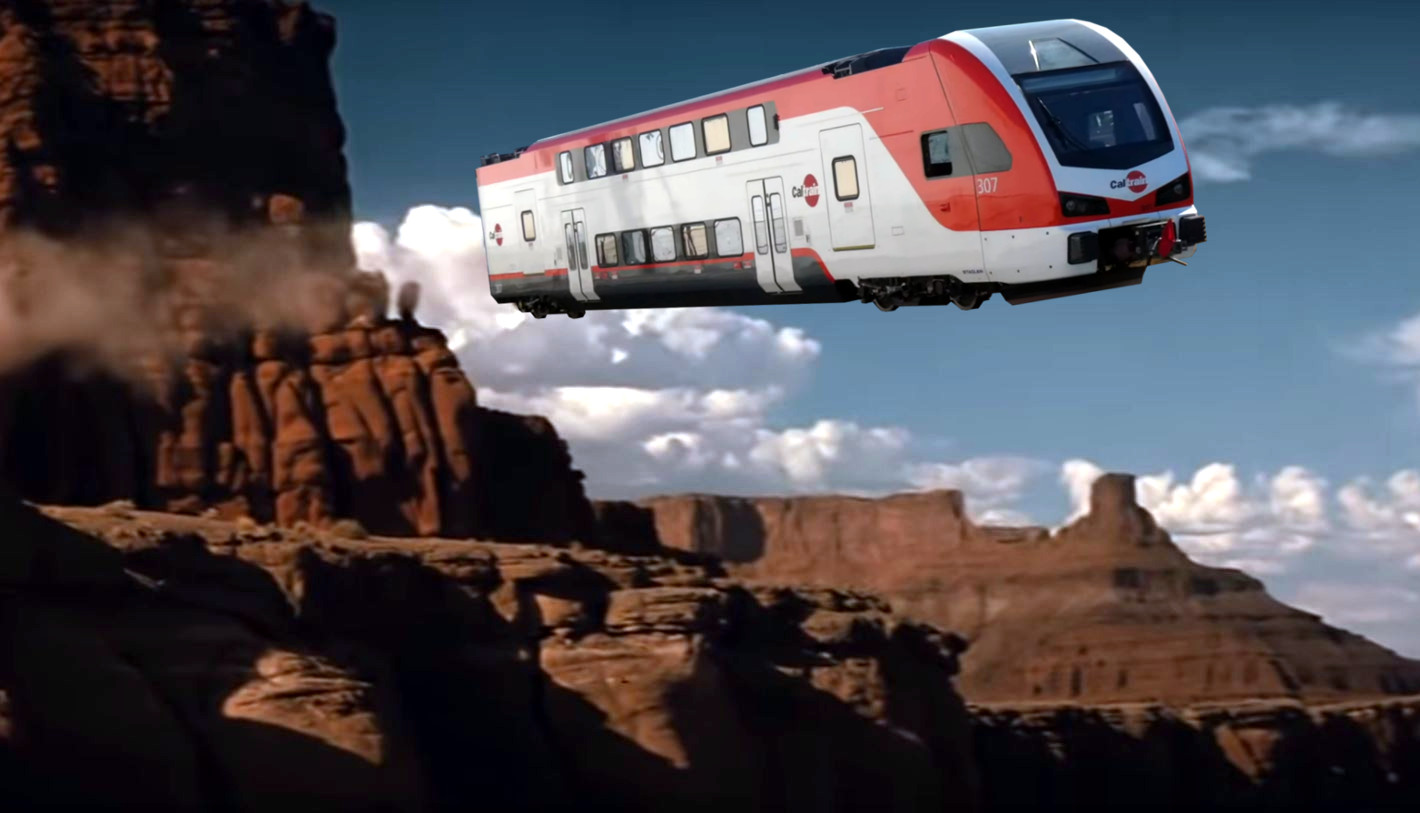
EMU jumping off cliff
One phrase we're going to hear a lot in the next couple of years is "fiscal cliff," a sudden disequilibrium between Caltrain's revenues and expenses caused by the withdrawal of the temporary federal subsidies instituted during the pandemic. The slow recovery of ridership, which until 2019 had funded ~70% of the railroad's operating expenses, is opening a $50 million/year hole in Caltrain's budget outlook through the rest of this decade, according to a draft Short Range Transit Plan (SRTP) recently submitted to the Metropolitan Transportation Commission (MTC).

The SRTP is a process that every four years requires each agency to project hypothetical near-term fiscal scenarios under a standard set of assumptions. Most interesting in Caltrain's draft is that the agency threw in a bonus scenario besides the prescribed hypothetical scenarios: the "Electrified Service scenario" a.k.a. Caltrain's actual plan.

This "Electrified Service scenario" makes zero effort to tackle operating costs, hiding behind a theory that Caltrain is inherently a high-fixed-cost operation, meaning that costs are not highly variable with the level of train service provided. All efforts are instead directed towards securing "funding opportunities," an approach that could very well succeed, as transit funding effectively grows on trees in California, no matter how inefficiently expended. Here are the scary numbers:

What if we blew up some long-held assumptions and attacked this fiscal cliff from the cost side?

Ditch Diesel Now and Go 100% Electric

Since time immemorial, the peninsula corridor electrification project has been sold as only a partial step towards electrification, anticipating that only 75% of the service would become electric with 25% remaining diesel, primarily to serve the non-electrified portion of the corridor south of San Jose. Operating a mixed fleet of diesel and electric trains blows up operating and maintenance costs, since many functions have to be duplicated (training, tools, spare parts, etc.). Revenue miles per vehicle are projected to drop by 10% when electrified service starts, which is a sure sign that your fleet is too big and isn't working hard enough.

How can Caltrain possibly operate with only the 19 EMU sets that will be delivered by 2024?

One certainly can't use all 19 in revenue service. Set one aside for maintenance downtime (grade crossing collisions will continue), and keep another two in reserve for timetable protection, essentially hot spares parked at each end of the line, crewed and ready to enter service at moment's notice to plug any delays during the peaks. That leaves just 16 sets to support a peak service level of six trains per hour per direction, a firm condition of Caltrain's funding agreement with the federal government.

That sounds downright impossible.

However, if you change the goals of a timetable to maximize equipment utilization, it turns out that it can be pulled off. Good service is just a side effect. Here is a new all-electric timetable that makes those shiny EMUs really earn their keep:

All EMU 6 tphpd
Score: 123 (relative to the benchmark score of 100 for the 2011 timetable)
Fleet: 16 EMU (zero diesel)
Utilization: 87% of train-minutes in revenue service

This is admittedly a slightly sporty timetable in that it requires aggressive 10-minute turns and a European level of padding of 7%, less than Caltrain is accustomed to dawdling with. The resulting risk of delay is mitigated by "protect" trains at each end of the line. There is also margin in the long station dwells (45 seconds) and the leisurely acceleration times built into the timetable, with power capped at only 2/3rds of the EMU's nominal rating.

The new EMUs would become highly productive assets by providing about 1.9 million revenue vehicle miles per year using just 133 cars, about 1.5x better utilization of these expensive depreciating capital assets than is currently contemplated.

The savings from disposing of the entire diesel fleet would be significant, and their residual resale value would only help Caltrain's balance sheet. The newer Baby Bullet fleet will have reached 20 years of revenue service, the minimum required by the FTA for federal funding assistance, so no penalties will arise from their early disposal. although its disposal would incur a small penalty reimbursement to the FTA since the equipment will not have reached its 25-year minimum useful life (according to FTA Circular 5010-1E, page IV-26.)

Divest the Gilroy Branch

One hitch: the overhead wire doesn't extend to Gilroy.

Gilroy service is a big weight on Caltrain's operational balance sheet because the ridership and revenue is minuscule compared to the high fixed cost of maintaining diesel service. Before the pandemic, ridership south of San Jose city limits (Blossom Hill) made up a negligible 0.8% of Caltrain's weekday ridership. South of Tamien was hardly better, at 1.2%. Until electrification is extended down to Blossom Hill (as it should be), it makes better sense to transfer this infrequent diesel service to an extended Capitol Corridor, with a direct cross-platform transfer to Caltrain in San Jose.

This can rid Caltrain of the entire diesel fleet, which is currently planned to remain at least 9 locomotives and 79 (!!) cars. It also frees Caltrain from another headache, having to comply with near-term diesel emissions mandates under consideration by the California Air Resources Board.

Reduce Conductor Over-staffing

Caltrain has too many assistant conductors. Assistant conductors are very expensive, costing about $15 million/year by FY25, about 1/3 of the operating deficit. Note this figure does not include conductors, only their assistants. The new EMUs relieve some of their duties, such as announcing station stops. The new fleet also has automatic passenger counters, giving precise real-time insights into passenger loads. While today's conductor staffing levels are determined by a formula from the number of cars, the formula should instead be revised to use recent passenger loads. This would ensure that all trains have a consistent staff/passenger ratio and that conductors have fair work loads.

Change the Operating Culture

With six electric trains per peak hour and at least 20-minute service at all stations, much better than is provided today, the conditions could be created for a robust recovery of ridership. Good service drives ridership, but if Caltrain is allowed to execute their mixed-fleet "Electrified Service scenario," as planned, we will barely achieve any service improvement as costs continue to spiral upwards.

Applying these cost-saving measures, Caltrain could close their operating deficit and erase any "fiscal cliff" without expending any energy to capture ever more "funding opportunities" to support entrenched and inefficient operating practices. The fleet does not need to grow, nor does the headcount. The operating culture needs to change: it's not enough to buy Swiss trains; you need to actually run them like the Swiss.

13 March 2022

News Roundup, March 2022

It's been a while since the last post, but fear not this blog is still alive.

Caltrain's First Major Accident: on Thursday 10 March 2022, a southbound train was unable to stop before ramming into at least two rail-going flatbed crane trucks being used by an electrification construction crew. 13 people were injured with five requiring hospital treatment; thankfully there was no loss of life. With the new positive train control (PTC) system in place, this collision should never have happened. The fact that it did has drawn scrutiny from the National Transportation Safety Board, which dispatched an investigation team to the site of the accident in San Bruno. The causes of such accidents are often multiple, subtle, and complex, and it will take more than a year to assemble the evidence, identify root causes, and draw out lessons learned. NTSB staff reported some preliminary points at a press conference on March 11th:

  • The impact occurred at approximately 60 mph and the train came to a stop over a distance of over 500 feet.
  • The PTC system is designed to prevent train incursions into established work zones.
  • The PTC system was on and active on the accident train.

While we should be wary of speculation, it is possible to discuss additional relevant points:

  • Train 506 was due to depart Millbrae at 10:34 AM. If as stated the accident occurred just before 10:40 AM, then the train was several minutes behind schedule.
  • The head end of the train stopped at milepost 11.9, so impact occurred at about milepost 11.8.
  • Milepost 11.8 is adjacent to a staging area on the west side of the tracks that is used by the electrification contractor.
  • The location is less than a mile south of San Bruno curve, one of the sharpest curves on the entire peninsula rail corridor. The train would have traversed this curve no faster than the PTC-enforced maximum speed of 65 mph before accelerating again towards 79 mph after the curve.
  • The humped vertical profile of the San Bruno grade separation would have obstructed the train crew's view of the work crew's trucks until about milepost 11.1, at San Bruno Avenue.
  • At an average of 65 mph, the 0.7 miles from the point of initial visibility to the point of impact would have gone by in just under 40 seconds.
  • The 1.25% downhill grade towards the impact point would not have helped the train's emergency braking performance.

Unanswered questions include why were the construction vehicles and the train on the same track, why did the PTC system not prevent the collision, and whether there have ever been other near misses over the past several years of electrification construction. The NTSB report will tell.

May everyone hurt by this accident make a full recovery.

More Electrification Delays: while pole foundations are done, everything else is behind and slipping even from the new delayed schedule. The monthly reports for the project have been significantly abbreviated. The long pole in the tent is the grade crossing warning system, and it just so happens that the new program manager at Caltrain previously managed Denver's electrification project and has direct and personal experience with overcoming the great Denver grade crossing fiasco. From the December report to January, overhead contact system completion has slipped by 4 months. Oddly, after years of study and paying a nine-figure amount to PG&E for substation upgrades, the project is still embroiled in back-and-forth with the utility over how the large single-phase loads of accelerating and braking electric trains might throw the electric grid out of balance. One thing is clear, PG&E knows just how hard to squeeze Caltrain.

Electric Train Modifications: feature by feature, the EMUs are being downgraded to act like an old Bombardier bilevel train. The first EMU trainsets, numbers 3 and 4, are due in California sometime in April March 19th. They will sport two noteworthy changes not seen in any official photos or renderings. The upper set of doors have been sealed off (likely permanently) with window plug panels, and the automatic couplers have been downgraded to old-school AAR knuckle couplers.

Governance Politics: the three-county custody fight over Caltrain rages unabated, sucking all the oxygen away from critical planning for what comes after electrification. Momentum for the business plan effort seems to have stalled entirely. The two key upgrades yet to come are level boarding and a four-track elevated grade separation throughout downtown Redwood City, neither of which are being sufficiently attended to while the board's attention is fixated on questions of power and influence.

CBOSS Dumpster Fire Update: speaking of fires and PTC, the CBOSS case is still making its way through San Mateo County Superior Court (under case file 17CIV00786). Last year, Caltrain and Parsons (the CBOSS prime contractor) agreed to stop fighting each other and ganged up against Alstom (formerly GE Transportation Systems), the supplier of the flawed CBOSS software. Ten years after contract award, six years after breach of contract, and five years after lawsuits started flying, the case is coming close enough to trial that the parties have each prepared a trial brief that very nicely summarizes the making of this fiasco from their respective viewpoints. Here are hot-off-the-press direct links to the Caltrain & Parsons Trial Brief and the Alstom Trail Brief.

Update 3/19 - Board Workshop on Caltrain Finances: the slide deck for the upcoming board workshop to discuss what to do about the railroad's new fiscal reality (high fixed costs and only ~1/3 of the usual farebox revenue) is now posted. What is most remarkable is what is not in the slides, which are basically a giant shrug ¯\_(ツ)_/¯ in the face of the deficit forecasts shown in slide 46. If this is truly an existential fiscal emergency, one wonders why the cost of assistant conductors is not on the budget negotiating table. In 2019, the cost of assistant conductors was $7 million/year, and has since grown proportionally with more train service and annual pay raises, likely to about $8.5 million/year for 2022. With a further service increase to 116 trains/day when electrification begins, the cost of assistant conductors will exceed $10 million/year in 2025. While Caltrain is vulnerable to its labor unions and reluctant to raise such a sensitive matter, the time has come for the second conductor to follow the fate of other redundant and obsolete train crew positions such as fireman and brakeman.

Battery EMUs: from the "are you insane?" department comes a minor bullet point on slide 59 of the same packet, where an area of focus for FY23 is to "Advance sustainability through completion of PCEP and further exploration of potential for battery EMUs." Please don't. The whole point of PCEP and EMUs is to not be seduced by world-unique technical solutions and to not haul around many tons of battery dead weight. The only area that needs focus is to further explore the provenance of this shockingly idiotic idea.

02 August 2020

PCEP: Farce Majeure

This post serves as a place to track monthly status updates of the Peninsula Corridor Electrification Program, peeling back the rosy pronouncements put forth by the managers of this deeply troubled project. Let's start off with our handy foundation & pole progress tracker, updated monthly


Now also, in the manner of this XKCD cartoon that summarizes the ongoing delays for another project, the James Webb Space Telescope, we offer a retrospective of the promised milestone date for the substantial completion of electrification, which gives a pretty good eyeball of where PCEP will end up:


 Monthly updates will be added here as they occur.
 
The FTA Perspective: The May 2020 PCEP quarterly monitoring report from the FTA PMOC provides some refreshing independent views of the project. The PMOC contractor evidently prepared this report as if it were their last quarterly monitoring report (it wasn't) and included a special Appendix I, a final summary of issues, hurdles, and lessons learned. This is a must-read.

For a northbound cab view of the corridor construction as it stood on July 18th, 2020, see this video by YouTube user Flat Train.

Notes from the April 2021 PCEP progress report
 
We are seeing an odd divergence of foundation and pole installation rates: only one pole was installed for the entire month, despite hundreds of foundations being ready for poles. Foundation installation is at 77% and poles at 60%. For EMU car shells, 59% have shipped from Switzerland.
 
The big schedule and budget update / re-baseline is again delayed, at least to July. There was a three-week slip in Segment 4, and a three-month slip in completion of the CEMOF work (not anywhere near the critical path). FTA independent oversight (PMOC) reports continue to be delayed, with the December 2020 report nowhere to be seen and the March 2021 report still in draft.
 
Notes from the March 2021 PCEP progress report
 
Foundations are picking up a bit, but poles are oddly lagging since there are roughly 800 completed foundations awaiting poles. Foundation installation is at 74% and poles at 60%. For EMU car shells, 56% have shipped from Switzerland.
 
The critical path has once again flip-flopped to the EMU contract, as we await a major schedule update now set for the June board meeting. Notable slips in the Appendix C program schedule include segment 1 overhead contact system (2 months), segment 4 testing (almost 3 months!), and large slips in EMU deliveries (up to 5 months). These big slips are overshadowed by signal work in segments 1 and 3, which haven't started yet and are slated for a lightning-fast installation of ~10 months each. We know from painful experience that signal work in segments 2 and 4 is taking over 30 months, so there may be a future ~20 month slip hiding under there if the work in segments 1 and 3 turns out to be similarly complex and drawn out. Also notable is the zero duration of segment testing for segments 1, 2 and 3. Overall signs still point to no sooner than 2024 for the first passenger service with EMUs.
 
Notes from the February 2021 PCEP progress report
 
New schedule slips reported this month change nothing to the overall trends for the project, which have held steady for a long time. Based on trend extrapolation in the graphs above, foundations are likely to complete in fall 2022 (a year later than reported by Caltrain) and the project will see passenger service no sooner than early 2024 (more than a year later than reported by Caltrain). The critical path has returned to the electrification contract. Notable slips in the Appendix C schedule include signal work, delayed by 2 months in every segment, and a 3-month slip to the PG&E interconnection to the traction power substation in South San Francisco, which will now be built underground.

If looking at a glass half-full, foundation installation is now at 71%, pole erection at 58%, and EMU car shell manufacture at 53%.

Notes from the January 2021 PCEP progress report
 
This month saw the completion of a grand total of 21 foundations and seven poles. The contractor appears to be slow-rolling the work as mediation continues. Caltrain still projects that all foundations will be completed this September, which is not remotely credible.
 
Notes from the December 2020 PCEP progress report
 
Another month, another slip. We learn in the schedule section that Caltrain and Balfour Beatty are engaged in a mediation process, which is the last stage before lawsuits fly. The substantial completion milestone has slipped again, maintaining the trend line plotted above that predicts the substantial completion milestone will realistically occur no sooner than November 2023, with RSD following around new year 2024.
 
Despite crowing about having completed all foundations in segments 3 (true) and 4 (not quite there yet: still 5 to go in 4B and 96 at CEMOF), the foundation installation rate remains pathetic with a monthly production of just 25 foundations versus 200 promised. Next month is promised at 206. Fool me once, ....
 
Appendix C schedule shows large slips in SCADA testing (3 months) and PG&E permanent power at the South San Francisco substation (7 months!)  With permanent power available only by 4/15/22, testing of segments 1 and 2 will certainly be impacted, although you wouldn't know it because the segment testing tasks (sneakily renamed "segment completion" last October) currently have a duration of zero.
 
Notes from the November 2020 PCEP progress report
 
The project's revenue service date has now slipped beyond the FTA funding deadline. The critical path has shifted back to Stadler, at least in Caltrain's reporting. Here's the funny thing: when Stadler reports a schedule slip, the dates seem to get copied straight into Caltrain's program schedule; when Balfour Beatty reports a substantial completion date of June 2024, the dates are quickly swept under the carpet and replaced with made-up "forecast" dates in Caltrain's program schedule that will "likely change." Nothing on the BBII front has changed in Appendix C since last month, so maybe they are saving the big reveal for the new administration, which will presumably look upon the spilled milk with less vindictiveness than the current regime. In the meantime, a linear curve fit of the above charts strongly and steadily indicates a revenue service date in early 2024. Only three more years to go!
 
For fun, here's a brief video from December 9th of a couple of Caltrain car shells on the road in Switzerland, where they are made. They are too tall and wide to go by rail.
 
Notes from the October 2020 PCEP progress report

Exactly as predicted, all scheduling tricks having been exhausted, the electrification work is now firmly on the schedule critical path. The substantial completion milestone just slipped 3 months to 7/22/2022, right up against the FTA revenue service demonstration (RSD) deadline. Looking back, this milestone has now slipped by over a  year since late 2018. It would have blown past the RSD deadline had the schedulers not deleted the pre-revenue testing task, and it almost certainly will: the contractor's schedule shows substantial completion in June 2024, that's right, twenty twenty-four. If we extrapolate the past rate of slippage of Caltrain's substantial completion milestone (~0.54 month/month) and assume the slippage will continue at the same rate (because why wouldn't it?) the milestone will slip to, surprise, 2024.
 
Foundation production continues to be anemic, with a deceleration to 38/month versus 69 planned. Even at a promised rate of 200/month, the foundation completion has pushed out from March into May 2021 per Caltrain's dashboard metrics. Without this unsubstantiated acceleration to 200/month, a straight extrapolation of the recent production rate indicates foundation completion in October of 2022.

The Appendix C schedule remains extremely compressed against the RSD deadline, despite the wholesale deletion of the pre-revenue testing span. Segments 1 and 2 completion dates have slipped to May 2022, leaving almost no margin for system-level testing against the deadline. Clearly, the schedulers had to apply extreme contortions this month to prevent the appearance of missing the RSD deadline: what used to be "segment testing" with a non-zero duration (43 days in segment 1; 43 days in segment 2; 34 days in segment 3) has suddenly morphed into a "segment completion" milestone with zero duration. As integrators of complex systems well know, the greatest risk to a success-oriented green-light schedule occurs during testing, so reducing the segment testing spans to zero is quite the shenanigan!
 
Expect these segment testing spans to return after Caltrain finally runs out to tricks to pretend that they will meet the FTA RSD deadline. Given how compressed against the deadline the schedule already is, the reckoning should occur very soon. And what better time is there to ask for FTA forgiveness than during a force majeure pandemic?

Notes from the September 2020 PCEP progress report

The schedule slips continue, despite best efforts on the part of the schedulers to hide the difficulties being experienced by the project by holding major milestone dates. The start of phased revenue service is in a month for month slip, now 4/23/22, and the task has been compressed by a month. Had this compression not occurred, the program critical path would now run through segment 3 signals and (surprise!) the SCADA system, which just slipped by more than 3 months. Pre-revenue testing can't be delayed much more, so this is it. It will take some serious creativity to claim the full revenue service date of July 2022 can be held.

Foundation production is still in the basement at 48 for September versus 168 planned. The plan is now 69 next month (under-promise, over-deliver) then rising to a never-achieved 212/month for the remainder of construction. Look for the foundation completion date to slip again soon.

Other assorted schedule slips: real estate acquisition (for miscellaneous dribs and drabs up and down the corridor, slipped by ~8 months); traction power in segments 3 and 4 (slipped by ~3 months, the former now just days from the critical path). Oddly, the testing of segment 4 is now scheduled to complete before traction power is done, which seems like a broken dependency.

The top risk is still the dual speed check grade crossing warning system.
 
Notes from the August 2020 PCEP progress report
 
Another month, another slip. Electrification substantial completion is delayed by a month to 3/26/22, for a nine-month slip over the last 18 months. That's just a milestone, and the tasks leading up to it are even more dramatically delayed, with Segment 2 OCS slipping by a whopping seven months! All the electrification tasks are now jammed up against the extremely compressed segment testing, itself slipping and pushing out integrating testing and pre-revenue service by a month. To prevent electrification from exploding onto the primary critical path, heroic schedulers have cut down phased revenue service by a month. The real story here is the secondary critical path, which runs through delayed signaling installation, testing and cut-over activities... and yet these bars are colored a soothing shade of green. Look for these to blow up very soon, with a 3-month slip having just occurred in Segment 4, the one furthest along.

Foundation production continues to flounder at 49 for the month versus 161 promised. The laughable end-of-year completion milestone has slipped by 3 months, allowing the absurdly high future production rates to drop to the merely never-achieved value of 168/month. Six foundations appear to have been "unbuilt" since last month, with completed totals dropping in Segment 2 Work Areas 4 and 5. This may be a bookkeeping error, so the graph shows 1940 completed versus 1934 in the report. Overall, foundation installation is still trending towards completion in late 2021.
 
Notes from the July 2020 PCEP progress report
 
This month, as expected, a mere 40 foundations were installed versus a promise of 186. The promised numbers keep going up to maintain the pretense of finishing before year's end, with 299 foundations/month promised in October and November, over seven times the actual July rate. Detailed accounting is slightly complicated by the fresh inclusion this month of 86 foundations previously constructed outside PCEP scope for the South San Francisco and Hillsdale projects. Since the report doesn't state when these were completed, we spread them out over Jan-Jun 2020. Extrapolating at the current 3-month trailing average production rate, foundations will be completed in November 2021, almost a year behind the advertised schedule. The long-promised acceleration of foundation production is not reflected in monthly actual totals for 2020, which casts doubt on whether such an acceleration will ever materialize.

Budget burn rates for the various contracts are also consistent with a one-year delay, and that is before any pandemic impacts. The dashboards show an overall deceleration of spending, with the past 3 month average burn rate trailing the past 12 month average. Burn rate would now have to double to finish on time, which is plain to see just won't happen.

In the Appendix C schedule, there is a 7-month slip for traction power in Segment 1, and smaller slips in all the other segments. These slips remove all the slack that remained before electrification becomes the critical path. It's now a horse race (or snail race?) between Stadler and BBII.

Expect your first EMU ride in mid-2023.

Notes from the June 2020 PCEP progress report

The pandemic and the words "force majeure" are starting to make a more prominent appearance in the report, providing useful cover for Balfour Beatty's woeful schedule performance. A pandemic-related day-for-day slip at Stadler continues to provide cover, under the theory that the schedule critical path still runs through EMU production-- a condition that remains true on paper only because the secondary critical path has been slashed to the bone by unreasonably compressing key testing and integration tasks at the very end of the program.

The dashboards in section 2.1 don't lie: to finish on time, Balfour would have to triple their burn rate from $5.7 million/month to $17.2 million/month. Overall, project spending is about $700 million behind plan, indicative of severe schedule under-performance. At current burn rates, PCEP will finish no earlier than mid-2023, close to a year behind the dates currently being promised.

Foundation production for June was promised 71 / actual 105, a rare over-performance. Now do July, when an unprecedented 186 foundations were promised. As of this report, the foundations are 56% installed, and poles are 44% installed.

As of this writing in August, 2020, none of the quarterly FTA PMOC oversight reports for 2020 have been posted by Caltrain. These usually provide an unsparing look at the internal challenges of the program, but with election season approaching there is surely a rising incentive to keep them out of the public eye.

Notes from the May 2020 PCEP progress report

Foundation production, despite the insistent promises of past months, has crashed back to the dismal level of 44/month. Undeterred, project managers project ever higher and unachievable future rates (nearly 300 foundations are planned for November) in order to finish within the current calendar year.

For the EMUs, a new change order was approved to defer the installation of interior wheelchair lifts, the final nail in the coffin of the high/low boarding solution. Platform interface-wise, the EMUs will now be configured exactly the same way as the existing Bombardier cars. While recent photos from Salt Lake City show the upper doors installed, these will soon be removed and replaced by plug panels.

In a bit of good news, the regulatory compliance documentation for EMU crashworthiness has been approved by FRA, which is no small feat. One hopes sufficient spares of fiberglass front cladding have been ordered to withstand the usual grade crossing carnage.

The pandemic has delayed testing of the first trainset in Salt Lake City, such that its trip to Pueblo, Colorado for dynamic testing is delayed to November and slipping day for day.

The milestone schedule has slipped again, with electrification substantial completion delayed to 2/26/2022, a slip of 8 months since late 2018. Revenue service has slipped 2.5 months to late July 2022, all but eliminating the margin against FTA's deadline of August 2022. The pandemic will surely be invoked to delay the deadline.

Stadler is still claimed to be on the critical path, now with a convenient day-for-day pandemic slip that provides a welcome fig leaf to the Balfour Beatty electrification work.

The Appendix C schedule finally shows signal construction work. Notably, this work has pushed out the testing of segments 1, 2 and 3 by up to 8 months, with compressed testing tasks taking place at the end of 2021. The testing of the entire electrification system has been compressed from ~6 months to less than 3 months. Pre-revenue testing has been further curtailed to six weeks. There is no discussion or justification of this extremely sporty schedule compression, other than it maintains the illusion that the critical path runs through Stadler.

In the risk list, three new risks have appeared to justify what is surely the consequence of Buy America procurement for the EMUs: quality issues, failed factory tests, and poor integration and control of new U.S. suppliers. These seem to be clear and present issues, rather than risks.

Notes from the April 2020 PCEP progress report

Foundation installation recovered a bit, and an explicit (if likely unachievable) plan was published for how many foundations would have to be completed in each of the remaining months of 2020 in order to finish within the year.

Shipping the first train to Colorado (for high-speed testing) continues to be delayed. This is an important "schedule hold point" where contingency budgets are re-evaluated, and we are now 14 months into a 19-month gap that has opened in the sequence of schedule hold points.

Speaking of contingency, $32 million of it was used this month alone, of which $25 million was shoveled over to PG&E for interconnection work. Why was the contingency budget not replenished by the amount not paid to the party formerly on the hook to perform the work?

New risks: #321 if PG&E makes trouble about the single-phase loading of their substations, then the system cannot be energized. #322 if substations aren't completed on time to get powered up, then testing will be delayed. And then the kicker: #323 "FRA concerns require redesign".... don't leave us hanging, be specific!

Finally, it's the beginning of June and none of the FTA PMOC reports for 2020 have yet showed up. Who is slow-walking these important oversight documents, the FTA or Caltrain?

Notes from the March 2020 PCEP progress report

Foundation installation continues to fall hopelessly behind. The average total for the entire first quarter of 2020 was eight foundations per month (that's right, you can count them on two hands!) and if that rate is sustained, all foundations should be complete by the year 2036. Of course, the report promises a significant acceleration, but the stated goal of completing another 1544 foundations within nine months to support the end-of-year foundation completion milestone has gone from ridiculous to downright laughable. The board and public should be insulted by such a dishonest status report, insisting that everything is on schedule. It's okay to be late, but it's not okay to be so nakedly dishonest about it.

Notes from the February 2020 PCEP progress report

1) Foundation production for February is again ZERO, despite repeated affirmations throughout the report that there is a schedule to finish everything by the end of this year. The required average production rate to reach this goal is 157/month (excluding foundations that are part of SSF and 25th Ave projects); this is higher than the all-time record of 151 set in November 2019. The likelihood of missing the end-of-year target is darn near one hundred percent.

2) The Appendix C schedule shows continuing month-for-month slips in the OCS and traction power tasks, with the selective exception of the segment 1 OCS task-- which if delayed would push the BBII work onto the critical path of the project. To avoid this, the task duration was shortened, using a well-known scheduling trick.

3) delivery of trainsets 2 and 3 is delayed nine months and six months, respectively. That sure is a long time to retrofit flip-up seats. Is there something else we aren't being told?

Notes from the January 2020 PCEP progress report

1) foundation production is at ZERO for the month, with the rate required to complete by the end of the year having increased from 131/month to 143/month. The stated reason for zero foundations is because the contractor "did not have the rebar cages", of which enormous stacks can plainly be observed rusting away at Burlingame, Redwood Junction, and possibly other locations. Something big has come up and Caltrain isn't being transparent about it.

2) Schedule milestones are said not to have budged, despite the latest FTA PMOC report (December 2019) stating that the contractor's schedule shows a substantial completion date of January 2024. That's right, twenty-twenty-FOUR.

3) The flip-up seats that will be added to the bike cars are the subject of a change order that costs $1.96 million, to buy 4 flip-up seats x 2 bike cars x 19 trainsets = $12,900 per flip-up seat. No word on what material these are made of, but solid gold is not out of the question.

4) The signal modifications and grade crossing Constant Warning Time tasks that underlie the contractor's major schedule slips still do not appear on Caltrain's tracking schedule. It's harder to track the progress of a task when it isn't even on your schedule.

5) The appendix C schedule shows a wave breaking in EMU deliveries, with early deliveries delayed by ~3 months and later-produced trainsets being delivered before the earlier-produced trainsets. Must be those flip up seats and door plug retrofits.

Notes from the December 2019 PCEP progress report

1) foundation production has faltered again. The goal posts stayed put this month, but the production rate required to complete by the end of this year has increased from 124/month to 131/month. This month: just 44.

2) appendix C schedule shows a large slip in SCADA (six months!) leaving just 1 month of slack before pre-revenue testing begins. This is shaping up to be yet another secondary critical path. Meanwhile, the completion of traction power construction in segments 1, 2 and 3 is in a month-for-month slip even after the large schedule slips recorded in last month's update. The tsunami buildup continues.

On the good news front: production photos posted on calmod.com appear to show that the door to the EMU cab compartment will have a railfan window affording a view into the cab and out the front of the train. Train nerds rejoice!

Notes from the November 2019 PCEP progress report

1) foundation production has accelerated to a record monthly total of 151, but the goalpost for target monthly average has moved again from 8/31/2020 out to 12/31/2020 (four months). For the old target of 8/31/2020, the required monthly productivity would have been 179 foundations/month. With the newly relaxed milestone it is 124 foundations/month.

2) Appendix C schedule continues to show "tsunami buildup" where a wave of delayed tasks compresses against an artificially held RSD milestone. Most notably, electrification system testing (schedule line 41) has compressed from 222 days to 183 days (18% shorter) and phased revenue service (schedule line 83) has compressed from 90 days to 69 days (23% shorter).

3) The date when you will be able to board an EMU as a passenger for the first time (i.e. the beginning of phased revenue service) has slipped by a month to February 1st, 2022.

4) While the critical path is still stated to go through vehicle manufacturing, ten EMUs will have been delivered by the start of phased revenue service. Is ten enough to begin phased revenue service? If so, EMU manufacturing isn't your critical path.

As observed with last month's notes, Caltrain is making increasingly desperate schedule modifications to maintain the appearance that electrification is not on the primary critical path. With reality biting, it is doubtful they will be able to keep this up for more than a couple of months longer. Expect fireworks by March or April 2020 board meeting.

Speaking of fireworks, Happy New Year 2020 to transit nerds everywhere!

Notes from the October 2019 PCEP progress report

1) Figure 2-5 (foundation production) shows a monthly target for the production rate required to meet the schedule. This monthly target has been stuck at 174 since they started publishing this metric, which is an error in whatever spreadsheet they are using to make this chart. The correctly calculated numbers for the last 5 months (foundations-to-go divided by months left) are: 174, 178, 191, 198, 221. In this latest report they moved the goalpost from 6/30/2020 to 8/31/2020, which bought them an extra two months but used up the schedule slack. By that metric, we're back to 1766 to go divided by 10 months = 177. Hopefully this error will be corrected in future reports.

2) The contractor has never reached 177 foundations/month. To date the record is November 2019, reportedly at 151. (Interestingly, even this record would further bump up the rate to complete from 177 to 179.) This figure of 179 would have to be sustained without interruption until completion. Given that on average, the more difficult foundations (where conflicts are found with existing utilities such as Caltrain's very own PTC fiber optic cables) are being delayed and left to be addressed later than the low hanging fruit, it will become increasingly difficult to maintain rate 179.

3) In the Appendix C schedule, OCS completion has just slipped by one month for three out of the four segments. OCS completion in segment 1 (San Francisco) is now on a secondary critical path, followed immediately by segment testing and system testing. The only reason this didn't become the primary critical path this month is that they compressed system testing by one month, holding the end of system testing at 12/31/21. Compression of testing periods is a red flag.

4) In the Appendix C schedule, the logic is constructed such that it is necessary to have 14 EMUs on hand by the end of "phased revenue testing" which means service is operated with a mix of diesels and EMUs. This is what makes the critical path go through EMU production. In reality, what is most important is the *beginning* of phased revenue testing, which is when you will be able to board an EMU for the first time. Right now this milestone is at 1/3/2022 and has zero slack (i.e. it is on the critical path).

5) The latest PMOC report (September 2019) reveals that the contractor's working schedule (so far rejected by Caltrain for various reasons) predicts substantial completion of electrification on 7/4/2022, six months later than carried in the Appendix C schedule or 12/31/2021.

I expect Caltrain to make increasingly desperate modifications to the program schedule, including further compression of the system test period, to maintain for as long as possible the appearance that electrification is not on the primary critical path. Let's see how long they can obfuscate before finally fessing up.
09 May 2020

Pandemic Open Thread

These are challenging times. We can ponder ideas that are significantly outside the mainstream, taking an existing concept and extrapolating it, Black Mirror style, to its extreme conclusion. Here are some controversial conversation starters:

Southbound BART Purple Line train arrives at Palo Alto
Merge Caltrain Into BART.  The long-standing push to get the operation of Caltrain a dedicated source of funding (via November ballot measure) looks shaky at best, with the economy heading down the toilet. San Mateo and Santa Clara counties see this tax measure as a way to push Caltrain off their books, but for residents it supplements one tax with another. Why not blow it all up, and merge the two counties into the BART district?
  • Secures dedicated operating funding, via BART half-cent tax to join district.
  • Removes a warring tribe from the balkanized landscape of Bay Area transit.
  • Retires the awkward and unwieldy Joint Powers Agreement between the peninsula counties.
  • "Rings the Bay" in 2023 with a new BART Purple Line, using state of the art HSR-compatible technology.
  • Ends decades of silly talk about closing a perceived "missing link" between Millbrae and Santa Clara by using wide-gauge technology, as most recently encouraged by VTA (!)
  • Replaces the passive-aggressive operational antagonism that is routinely on display at Millbrae with coordinated, centrally-planned, seamless connections.
  • Puts in charge managers who actually understand from direct experience the value of short dwell times and level boarding.
  • Raises the bar for mega-project delivery, which has been set so low by Caltrain's spiraling trouble in managing delays to the electrification project (and the large budget blow-outs that are 100% certain to follow) that we might as well just let BART take over.
  • Removes the pretext for VTA's ridiculous plan to duplicate the Purple Line with an expensive BART tunnel from San Jose to Santa Clara, with BART instead establishing coordinated, centrally-planned, seamless connections at a modernized San Jose Diridon station.
  • Frees BART and VTA to plan for a far more logical extension along Stevens Creek Boulevard to serve the sprawling automobile-captive transit deserts of Santa Clara County.
  • Keeps the really good people at Caltrain employed. They can work for BART.
  • Just makes categorical sense. Caltrain's trajectory of modernization, described extensively in its business planning effort, takes it out of the old-fashioned category of "commuter rail" and into the category of "rapid transit," right here in the Bay Area. You could then describe it as Bay Area Rapid Transit, or perhaps just BART for short. If it walks like a BART and quacks like a BART, then it surely must be BART!
Kill the DTX project.  The San Francisco Downtown Extension (DTX) is one of those projects that is so important that everyone got tunnel vision and let costs explode as we forgot why we were doing it in the first place. A quarter century of planning later and at six billion dollars and rising, the benefit is no longer worth the cost. Why not blow it all up, and merge DTX with the Second Transbay Rail Crossing?
  • Solves the problem once, not twice, something taxpayers and riders will all appreciate. DTX and Transbay Tube II both connect a mega-region by creating high-speed, high-capacity arteries to supply the economic heart of the Bay Area. Both projects solve a geometry problem that no amount of additional freeway lanes or autonomous vehicle technology can possibly address. They should be one project, and the distinction between them is not only operationally counter-productive but astronomically costly for taxpayers.
  • Defuses an emerging and highly toxic competitive dynamic between two competing mega-projects, which threatens to delay both.
  • Makes the Salesforce Transit Center a through-station, which is enormously more efficient to operate and enables far higher throughput capacity (trains and passengers) within the existing station footprint. Yes, this requires dismantling a couple of medium-sized high rises whose foundations stand in the way on the northeast end of the train box; this is the cost of progress.
  • Enables seamless high-speed electric through service from the East Bay / Sacramento to the Peninsula and Silicon valley, just like the Paris RER or London Crossrail.
  • Stores the EMU fleet on the Oakland side of Transbay Tube II, presumably somewhere inside the dystopian freeway mess of the Maze, thus removing the anachronistic need for a train yard in the heart of San Francisco.
  • Allows a large-diameter tunnel boring machine (big enough to allow for 2 wide-gauge tracks stacked on top of 2 standard-gauge tracks for the Transbay segment) to start from a more accessible construction site on the Oakland side. The TBM would land in San Francisco near Howard Street, providing the start for a Geary BART subway.
Yes, crayon plans like this do not factor in important things like Environmental Impact Reports and shovel-readiness, or the entrenched politics of established bureaucracies, or the deeply carved flows of monies from various federal, state, regional and local sources into the pockets of the private Transit Industrial Complex. But sometimes, difficult times call for big changes. Changes that put riders and taxpayers, who are all suffering to various degrees through this pandemic, in a stronger position at a table of stakeholders that rarely has much room for them.

24 April 2019

Foundation Progress Tracker

One way to measure the progress of a large and complex construction program like the Peninsula Corridor Electrification Program is to count how many foundations have been completed. This is a revealing metric, since foundation construction is currently the top risk on the program due to surprises when digging holes along the right of way. It's also a metric that is readily measurable and reported monthly.

In round numbers, the electrification project encompasses ~2500 poles and ~3100 concrete foundations. The number of foundations is greater than the number of poles because there are foundations for guy wires and sometimes multiple foundations for portal poles.

The progress chart below will be updated monthly.


At the December 2018 meeting of the Caltrain board of directors, the program manager stated (starting at 01:03:00 in video) that he needed to maintain a pace of 156 pole foundations per month (six per night) to meet the schedule milestone of "electrification substantial completion," which was then set for June 2021. You can see how things went since then.

03 May 2018

Fleet of the Future


Not bad in blue, huh? This parody of the fragmented state of Bay Area transit is based on an image by Stadler Rail. There should be plenty in this image to offend almost everyone!

18 February 2017

The Big Picture

With the delay of a federal grant long planned for Caltrain modernization, there is fear and uncertainty on the peninsula rail corridor. Everything about the project is being put back into question by voices on all sides of the issue. In times like these, it helps to step back and look at the big picture. The big picture has not changed since 2008, and there is a logical flow to it that remains true regardless of the funding situation.

A requirement flow diagram shows a hierarchy of requirements, things that are needed or wanted, and how they relate to each other. The way to read it is to follow along the connectors between boxes. When reading downward, the next box down answers HOW the previous box is to be achieved. When reading upward, the next box up answers WHY the next box is necessary. A simple and intuitive example is provided at right.

Next, we move on to a more complicated diagram that represents the blended system in general, including the Caltrain modernization project. The derived attributes at the ends of the requirement tree are highlighted in green.  If you delete any of the green boxes, all of the boxes that depend on it above are negatively affected.

For example, if you delete level boarding, then you can't reduce station dwell times, which means you can't increase Caltrain average speeds enough to allow operating peak hour traffic, which in turn means the blended system won't work well, and HSR may need to build four tracks all the way.

For another example, if you delete train doors that work at the same height as HSR, then Caltrain can't share platforms with HSR, which means bigger stations and limited capacity at SF Transbay, so Caltrain won't be able to run all trains into the downtown core, which in turn will hurt Caltrain ridership and increase congestion on highway 101 and I-280.

(Click to expand to full size)
This is a useful way to think about the problem, and reveals three important ideas: (1) the mere lack of funding won't make the problem change or go away, (2) the technical approach pursued by Caltrain is sound, if only partially effective, and (3) hacking away the entire HSR side of the diagram doesn't fundamentally change the solution ultimately needed for Caltrain modernization.

25 July 2016

Steaming Pile of CBOSS

CBOSS, the Communications Based Overlay Signal System, is a Positive Train Control (PTC) system being developed by Caltrain to prevent human error from killing or maiming passengers or rail workers.  It is a deeply troubled project.  Caltrain recently requested a peer review of the project from APTA, the American Public Transportation Association, whose subject matter experts were given access to personnel and documents.

Download the final report from the peer review here (500 kB PDF).

It's fair to say our worst fears have come true:
  • the project manager does not have the requisite technical experience
  • there is no project schedule, and October 2016 is just another month on the calendar
  • inter-operability requirements and test methods are not defined or agreed upon
  • configuration management is not just out of control, but completely lacking as a process
  • software and network security is an afterthought
  • animosities between project management and the contractor are impeding the resolution of technical issues
  • operator training has not started, and the materials for such do not yet exist
  • weekly top-level status meetings between Caltrain management, the program management consultant, and the contractor had not been occurring
The list of documents reviewed by the panel in Appendix C would make a juicy FOIA request.

A little bird overheard some discussions that do not appear in the APTA final report, because the report is intended to provide only constructive criticism to help Caltrain out of this mess.  It's even uglier than you could have imagined:
  • Parsons Transportation Group (PTG), Caltrain's prime contractor, does not have the right skills mix to manage complex system integration on 13 different subcontracts
  • PTG is fearful that the commercial terms of the CBOSS contract expose them to legal action by Caltrain, contributing to the lack of transparency
  • Subcontractor General Electric (now Alstom) discovered that simply re-using the existing ITCS product wasn't going to work.  The inter-operable version of the product is incurring massive increases of scope that were not accounted for in the original contract
  • Because of the extent of the changes made to ITCS, the FRA is requiring the same certification and type approval process as for a new PTC system, undermining Caltrain's claim to reusing an off-the-shelf technology
  • The FRA has taken the position that Caltrain is really installing two PTC systems, requiring full testing of both I-ITCS and IETMS (the system that will be used by Union Pacific freight trains on the peninsula corridor)
  • Inter-operability means not only allowing IETMS equipment to operate in CBOSS territory, but also allowing CBOSS equipment to operate in IETMS territory, something that Union Pacific has been concerned about testing thoroughly
  • Poor coordination for accessing an operating railroad for system installation and testing has been and continues to be a bottleneck
  • Additional funding is going to be needed, but nobody knows how much more
  • A change of contract operator (currently Transit America Services, Inc, soon coming up for re-bid) would introduce significant program execution risk
  • Getting all the CBOSS-equipped trains into revenue service could take up to 5 months
The already egregious sum of $231 million to cover a measly 51 route-miles with PTC is about to increase significantly, something you would never guess from the latest CBOSS update provided to Caltrain's laissez-faire board of directors.
Fast forwarding to whatever year it eventually takes place, the RSD (Revenue Service Demonstration) will consist of flipping the "on" switch and transforming rush hour into an epic cascade of software glitches reminiscent of the 1998 MUNI Meltdown.  On that day, we will all know that this CBOSS turkey has finally come home to roost, as was foretold way back in 2009.

08 August 2015

Peninsula HSR, Take Two

Environmental clearance of high-speed rail in the peninsula rail corridor was initiated right after the Proposition 1A bond passed in 2008.  The development of engineering and environmental documentation for a four-track alignment connecting San Francisco to San Jose was in full swing during the years 2009 and 2010.  The Peninsula Rail Program, as it became known, was an ambitious yet awkward collaboration between the CHSRA and Caltrain, with the engineering consulting firm HNTB doing most of the heavy lifting.  The decision to concentrate HSR resources in the Central Valley, combined with fierce community opposition on the peninsula, brought the process nearly to a halt in early 2011.  By that time, thousands of pages of documents had been drafted, hundreds of stakeholder meetings held, and $45 million spent for preliminary engineering and environmental clearance.

Then came a long pause during which two major developments took place.  First, as a result of a political compromise, the idea of a four-track high-speed railroad was dropped in favor of a "blended system" where Caltrain and HSR would share the peninsula corridor primarily on two tracks, with less impact to surrounding communities.  Second, the Caltrain electrification project came closer to being realized, passing key milestones of environmental clearance, funding, and procurement.  Throughout this pause, plans for peninsula HSR became somewhat nebulous, both in their scope and timing.  The media spotlight turned away.

Fast forward to the August 2015 meeting of the California High-Speed Rail Authority (YouTube video).  As reported by the Fresno Bee (and without a peep from the Bay Area press) we have the first hints of what lies ahead, in the form of a Request For Qualifications issued by the CHSRA to re-start the environmental clearance process for the peninsula.  This RFQ lays out a new timeline and a $36 million budget allocated over a term of three years, shared between two sections: San Francisco to San Jose, and San Jose across Pacheco Pass to the Central Valley wye.  The following schedule milestones are envisioned:
  • Consultant contract award - November 2015
  • Project scoping - March 2016
  • Preliminary design for project definition - May 2016
  • Technical reports - June 2016
  • Administrative draft EIR/EIS - August 2016
  • Draft EIR/EIS release - November 2016
  • Preliminary design of preferred alternative - April 2017
  • Final EIR/EIS certification - November/December 2017
The timeline for actual construction is not specified, but it rarely begins immediately after EIR certification, since final design and the inevitable CEQA lawsuits take time.

Highlights from the RFQ

The RFQ deliberately does not reveal the scope or exact nature of the alternatives to be studied, but it does contain some interesting nuggets:
  1. Work for restarting the peninsula HSR process has already started, as noted on PDF page 24: "Work on some of the tasks listed in Exhibit A of Attachment C has commenced and is currently being performed by Authority and Rail Delivery Partner staff."  What the blended system will look like is already being hammered out.
     
  2. The RFQ emphasizes that the proposed EIR is separate from Caltrain's electrification EIR, on PDF page 28: "On January 8, 2015, the JPB certified the PCEP Final EIR and is currently in the process of procuring a design/build contract to implement the project. While the PCEP will not include all infrastructure necessary to implement HSR service in the SF-CVY Corridor (such as HSR maintenance facilities, station platform improvements, track straightening, or passing tracks), the electrification infrastructure (such as overhead wire systems), along with additional infrastructure improvements, will accommodate future coordinated service and will not preclude HSR."  This point is the subject of a CEQA lawsuit against Caltrain, claiming that electrification is an inseparable component of the HSR project.
     
  3. Phased implementation is described on PDF page 57: "The Consultant shall develop an incremental plan as directed by the Authority to construct the project over a phased implementation schedule, dependent on funding. The Consultant shall recommend appropriate construction elements for each increment of implementation. This plan shall identify operable project segments or elements of the HSR infrastructure (such as grade separations) that could be constructed early and bring near-term project benefits to existing freight rail and conventional passenger rail services, as well as other increments of construction to build out the full set of improvements over a phased implementation plan."  The peninsula corridor is uniquely suited to a number of construction packages to be built independently from each other.
     
  4. San Jose is no longer an artificial boundary between two project sections.  This has been a weakness in the past, with insufficient coordination to optimize the configuration of the station and its approaches because each end was being handled by a different consultant.  With the same consultant handling both ends of San Jose, sanity may finally prevail with a shared at-grade solution.
     
  5. Level boarding planned for Caltrain, on PDF page 60: "Platform design for level boarding at all Caltrain stations will be required."  Even if not at the same height as selected for HSR, level boarding is a prerequisite for the blended system, to improve the average speed and punctuality of Caltrain.
     
  6. A temporary San Francisco terminal is planned at 4th and King.  The mere idea of it illustrates the frosty relationship between the CHSRA and San Francisco's TJPA, but also helps to satisfy the requirement for a 30-minute trip from San Francisco to San Jose, a threshold of great legal significance that is embedded in the Proposition 1A bond act.  Starting from 4th and King, rather than from the Transbay Transit Center, running at no more than 110 mph, and counting only pure run time (with no timetable margin), the 30-minute run becomes feasible.
EIR Cost Magnitudes

Environmental Impact Reports are extremely complex and voluminous documents designed to clear a project under the California Environmental Quality Act, ensuring that impacts are properly disclosed and mitigated.  It takes a large team of engineers, environmental specialists, writers and lawyers to concurrently design a project and pull together an EIR that can pass legal muster without incurring years of litigation.  To understand exactly where the process currently stands for peninsula HSR, it helps to remember that the published record for the San Francisco to San Jose project section forms only the tip of the iceberg.  The vast majority of the material assembled by HNTB in 2009 and 2010 remains unpublished, to be continued by this new contract.

How much EIR preparation did the $45 million spent so far buy?  We can establish an extremely crude metric for the cost of one EIR page by taking the ratio of the cumulative cost incurred for the preliminary design and environmental clearance of a project, as of the time of EIR certification, divided by the total number of pages in the resulting EIR.  Here are some examples:

Project Certification Cost Incurred Page Count Cost Per EIR Page
Merced - Fresno HSR May 2012 $45M 13,000 $3500
Fresno - Bakersfield HSR May 2014 $120M 20,000 $6000
Caltrain Electrification Jan 2015 $14M 5,400 $2600
Peninsula HSR SF - SJ Dec 2017 $65M* 13,000** $5000***

*cost basis $45M expended to date + $20M of the new $36M contract
**estimated based on cost per page
***estimated based on past history and biased high for scope change from full build to blended

Given that the new consultant won't be starting from scratch, it's conceivable that there will be sufficient budget in the new contract to produce a full EIR for the blended system on the compressed two-year timeline envisioned in the RFQ.

What the Blended System Might Look Like

The CHSRA and Caltrain take great pains to remind everyone that we won't know what the blended system for the 50+ mile peninsula corridor will look like, nor what the blended service plan will be, that is, until the Alternatives Analysis is released next year.  The specific discussions regarding the scope of the blended system are underway behind closed doors.  Taking into account the phased and incremental nature of the project, one can engage in some informed (wishful?) speculation, listed from north to south:
  • 4th and King shared station modifications.
  • Brisbane HSR maintenance facility.
  • Millbrae shared station modifications, hopefully with an affordable shared at-grade solution.
  • San Mateo County grade separation Phase II at Linden Ave in San Bruno, Center St in Millbrae, Broadway in Burlingame, and 25th / 28th / 31st in San Mateo.  The latter are likely to happen sooner than the other projects to enable the mid-line overtake.
  • Grade separation through highly constrained downtown San Mateo.
  • Four-track 110 mph mid-line overtake facility (from San Mateo 9th St, through Belmont and San Carlos, initially to Whipple in Redwood City).
  • Redwood City grade separation Phase IV, extending the four-track mid-line overtake through downtown, possibly with a new HSR station replacing the Sequoia Shopping Center, if the city and CHSRA agree to add this to the project scope.
  • PAMPA (Palo Alto Menlo Park Atherton) grade separations, likely to happen later than the other projects.
  • Santa Clara County grade separation Phase III at Charleston and Meadow in Palo Alto, Rengstorff and Castro in Mountain View, Mary and Sunnyvale Ave in Sunnyvale, creating a continuous 14-mile stretch of grade-separated track good for 110 mph from Palo Alto to San Jose.
  • San Jose approach realignment and a shared ground-level station.
  • A three-track at-grade alignment through San Jose's Gardiner neighborhood, along the existing right-of-way, avoiding a slow and expensive viaduct above the 87/280 interchange.
  • Curve flattening throughout the peninsula, except (unfortunately) in San Bruno
  • Level boarding across the entire Caltrain system, a key blending ingredient that ensures commuter trains can clear the shared tracks quickly and reliably in front of high-speed trains.
The next formal step in the process will be a new Notice of Preparation (NOP) to be published by the FRA in the Federal Register, an action that could come in the coming months.  Then we'll party like it's 2009.

12 November 2011

Business Plan Impressions

The CHSRA's Draft 2012 Business Plan is out.  First impressions:

Sticker Shock.  In apples-to-apples 2010 dollars, the cost has soared from $4.7 billion (2008 Business Plan) to $5.4 billion (2009 Business Plan) to a jaw-dropping $13.6 billion (2012 Business Plan).  And that's just the start.  The $13.6 billion estimate is for Option A from the Alternatives Analysis, which is the all-viaduct-and-no-tunnel option.  Community demands for trenches and tunnels will only bid up the price from there.  Toss in the San Francisco DTX tunnel and convert to YOE dollars, and the cost goes right off the charts.  Amazingly, the business plan does not actually specify how the new peninsula costs break down.  The changes in each sub-total have to be backed out from available information, as shown below from 2009 to 2012:


Until Hell Freezes Over.  Under the phased implementation plan described in the Business Plan, the peninsula rail corridor might not get improved until the late 2020's, so any hope that Caltrain had to get HSR money for capital projects, blended or not, is pretty much on hold for a long, long time.  A solid plan B will be required for Caltrain, without relying on the HSR tooth fairy.

Three Things: Concrete, Concrete, and Concrete.  The most significant cost increases, on the peninsula and statewide, are due to a breathtaking increase in the scope of concrete-pouring.  The $13.6 billion peninsula figure includes $3.9 billion for viaducts, $3.1 billion for tunnels, about $2 billion for buildings and stations, and nearly a billion for earthwork and retaining walls (the dreaded berms).  Oh, and by the way, the business plan was prepared based on cost estimates from civil engineering firms, firms that get to define the scope of the project on which they may later bid.

Atherton Real Estate is Cheap.  The feared eminent domain battles for whatever corridor expansion might be planned barely show up in the bottom line, with a mere $830 million or six percent of the peninsula budget allocated to Right of Way acquisition.

The Astronomical Cost of Accommodating Caltrain.  While the current paradigm may be that HSR would operate in the Caltrain corridor, the business plan cost numbers (and especially the must-read cost increase numbers) suggest quite the opposite, with Caltrain cast in the role of the expensive interloper.  There are surprisingly high cost numbers built into the 2012 Business Plan to build over/under/next to Caltrain even while it continues operating.  For example:
  • $2.3 billion (2010$) of additional viaduct construction expenses, "associated with staged construction, loss of efficiency, and allowance for force account and premium pay - all to account for continuous support of rail operations in the corridor."
  • $1.9 billion (2010$) for a single-track tunnel to squeeze four tracks through Millbrae between neighborhoods, planned developments, and BART, in an area where "soils are very poor"-- a tunnel that would have no reason to be built without Caltrain.  The cost of this tunnel was previously decried at $0.5 billion, but this is something else entirely: the single-track tunnel, built in the same "very poor" soils as the triple-track Millbrae BART tunnel, would cost significantly more than the entire BART to SFO extension project.
  • $0.75 billion (2010$) to build a duplicate set of tunnels along the Bayshore Cutoff into San Francisco-- multiple tunnels that would have even less reason to be built without Caltrain.
You can see the planets slowly starting to line up: in due course, somebody, somewhere is bound to point out, in the upcoming "Value Engineering" phase, that a $5+ billion premium to keep Caltrain operating is far more expensive than simply extending BART down the peninsula from Millbrae to Santa Clara to ring the Bay.

That a peninsula BART extension would be suggested as a cost-saving measure is flabbergasting indeed, but this Business Plan fairly well guarantees it.

12 February 2011

Schedule Scare

It looks like the scheduling department at Caltrain is very quick to publish a proposed reduced 48-train timetable when funding cuts loom... and yet for years has utterly failed to publish or market an improved timetable to promote the electrification project. They do a great job selling the downside of service cuts, but when it's time to sell the upside of electrification, nobody's home. Hello?

UPDATE 2/15:

Caltrain's reduced "Armageddon" timetable has been put through the metricator, using the same methodology as before.

First, the Caltrain 2010 timetable: the basis of comparison is today's 90-train-per-day, 5-train-per-hour timetable, to which we assign a score of 100 as before.
Now, the 48-train Armageddon timetable, which features 4 trains per hour serving fewer stops, during rush hours only:
Not surprisingly, the rush hour service quality score drops, but not quite as much as you might first expect. That's because service to the highest-ridership stops is mostly retained. A curious feature also emerges: rush hour service to certain stops such as California Ave and Sunnyvale is actually improved thanks to regular half-hourly service.

Do note, however, that these metrics measure only peak-hour service quality… obviously, the score for off-peak service would be zero.

12 September 2010

Belmont Shoots the Moon

The Belmont City Council is crafting a resolution (see original draft, and revised draft to be considered on 9/14) supporting the reinstatement of a cut-and-cover trench option for the high-speed rail authority's San Francisco - San Jose Draft Project EIR.

Underground tracks, favored by the city, were dropped from further consideration when the CHSRA published its Supplemental Alternatives Analysis on August 5th. That action left Belmont (and neighboring San Carlos) with only a single option to be carried forward for further study in the EIR: a tall viaduct. This viaduct is featured in crude renderings and a YouTube video posted by the city.

Belmont is the only member of the Peninsula Cities Consortium that did not have a trench or below-grade option carried forward for detailed study in the EIR, which has city officials fuming.

All Those Grade Crossings In Belmont

The Supplemental AA has caused quite an uproar on the peninsula, especially in the member cities of the PCC, largely because of the vertical alignment options proposed for the four-track corridor. The vertical alignment may need to be changed, requiring either raised or lowered tracks, in order to eliminate about 45 grade crossings along the peninsula corridor that would otherwise have to be closed. These changes are necessary because the California Public Utilities Commission, which regulates grade crossings and pursues a stated policy of reducing the number of such crossings, is exceedingly unlikely to allow four-track grade crossings, much less in a dense suburban environment, regardless of train type or train speed.

One might reasonably assume, then, that the range of vertical options feasible for Belmont would depend solely on the locations and constraints imposed by the grade crossings that currently exist in Belmont. The trouble with this assumption is that the number of grade crossings in Belmont is... Zero.

The existing tracks run through Belmont on a retained fill embankment (shown in photo at left, and known in some quarters as a Berlin Wall) over Harbor Blvd and Ralston Ave. These grade separations were built starting in 1996, opened in October 1999, and did not cut off any pre-existing (legal) access across the tracks. The berm is now perceived as a community division, and prompted the official request to study design options that would enable its removal.

Why a Viaduct?

The Belmont viaduct is an example of the Context Sensitive Solutions process producing an unwanted outcome.

From its very first scoping comments, Belmont expressed misgivings about the berm and requested enhanced connectivity and mobility, in the hope of obtaining a tunnel paid for with OPM (Other People's Money). Taking into account the feedback provided by the Policy and Technical Working Groups at a series of meetings attended by Belmont officials, the Supplemental Analysis Report substituted a tall viaduct for the existing berm because "the Berm option does not enhance connectivity and mobility as well as an aerial viaduct option."

If Belmont disagrees with this outcome, if the city believes the viaduct is not better than a berm, and if this business about connectivity and mobility was all just a colossal misunderstanding, then the berm will simply be expanded to four tracks. The berm is a "fact on the ground" and its visual impact, once all is said, done and litigated, will not be counted against the high-speed rail project. That is the likely outcome if Belmont becomes any more strident in its demands for a tunnel.

08 August 2010

Alternatives Analysis Analysis, Part 3

The Supplemental Alternatives Analysis for the peninsula corridor reveals some key engineering choices being made. That tunnels would be taken off the table was never in doubt: tunnels are nothing but trouble. The only tunnels now left are those that have a mountain. Well, almost... as we'll see below.
  • Freight grades: we were told all along that 1% is the limiting gradient for heavy freight. Not so in Palo Alto, where there is a 2% grade shown in the track profiles (page 15). Recall that the steepness of a grade has no impact on passenger comfort, frequent references to roller-coasters notwithstanding. (This question of dynamics seems to confuse civil engineers, who deal mostly with statics.) If a freight train can handle a 2% grade in Palo Alto, it can certainly handle a 2% grade anywhere else; that's the concept of ruling grade. Considering that steeper grades would greatly reduce the footprint of any elevated section, for example, the massive Mary Avenue rail overpass in Sunnyvale shown on page 18, why are 2% grades not the rule?

  • Rail yard: the rail yard in Brisbane, the closest-available 100-acre parcel near San Francisco, is on a direct collision course with the redevelopment plans for this area. This may end up as the largest land transaction in the peninsula HSR project. Curiously, the yard is planned on the east side of the tracks, opposite the historical site of the Southern Pacific rail yard.

  • Berms be gone: Belmont and San Carlos get their grade separation berms removed and replaced by a gratuitously tall viaduct, with the tracks 20 feet higher than today's berms. That doesn't go over well with the mayor of Belmont. Prediction: when all's said and done, Belmont and San Carlos will be begging for their berms to stay essentially as they are.

  • Blank-check engineering: Millbrae gets some ridiculously massive civil works in order to shoe-horn a fourth track under the ill-configured station. The plan features a 2.5-mile long tunnel (see track profiles, page 8), diving 75 feet below grade in order to duck under the Hillcrest Blvd underpass. Cross sections are also provided (see pages 13 and 14). There are two design options that are likely to be far cheaper and less disruptive to construct:

    1. Convert the western-most BART track to Caltrain (see Option D in this diagram). While this requires minor surgery on the existing BART station, and may require an exception to side clearances (e.g. a steel crash barrier to separate BART from Caltrain), no digging would be required.

    2. Put the Millbrae BART platforms underground. The tunnel already exists, emerging right before the station.

    When the alternative is a 2.5-mile tunnel with an underground station mezzanine, which would likely require partial demolition of the existing station structure all in the name of leaving untouched the under-used BART parking tracks, one is left wishing that these issues had been thoroughly examined and addressed in the AA.

  • Slimmer sections: Many cross-sections have gone on a diet, narrowing down from the previous elephantine proportions to more realistic dimensions. The four-track retained-fill berm is slimmed down to 78 feet (wall to wall), the elevated viaduct is down to 78 feet, the trench is down to 76 feet (fence to fence). The at-grade alignment remains at 93 feet (fence to fence), but only because the fences are set back 11 feet from the (perfectly safe-to-touch) overhead catenary masts. The eminent domain panic set off back in March was premature: the tracks will mostly fit within 80 feet, a width already available along 88% of the corridor.

  • Fatter bridges: box-beam elevated structures have a depth of nearly 10 feet (measured from the bottom of the bridge deck to the top of the rails), compared to 5 feet as routinely practiced today, for example on the Belmont - San Carlos grade separations. That means future grade separations must lift the rails at least 25 feet above the road surface, compared to about 20 feet today, with attendant increases in the size of the bridge approaches. Five feet taller, especially when a sound wall will rise another 4 to 8 feet above rail level, makes a huge difference to visual impact.

  • PAMPA sandwich: The finalized application for the next federal funding increment includes a description of the project phasing plan for the peninsula. Phase 1: 4 tracks Redwood City and north + PTC. Phase 2: 4 tracks Mountain View and south + electrification. That leaves Palo Alto - Menlo Park - Atherton (PAMPA) with a two-track at-grade gap, left until such a time as there develops overwhelming pressure to fill it in.

  • VTA buried: The light rail spur in Mountain View is buried under the Stevens Creek, to make room for the expansion of the corridor. That doesn't strike one as the cheapest way to do things.

  • Viaduct vengeance: A FIVE MILE, 60-foot tall viaduct is planned in Santa Clara, an area of the corridor that is (a) already fully grade separated and (b) mostly wider than 100 feet. These people don't do subtle: their vocabulary is reinforced concrete, shoring walls and outrigger bents. This area of primarily commercial and industrial properties is less likely to oppose such a gratuitous structure. Operationally, the HSR viaduct needlessly prevents Caltrain overtakes anywhere between the Santa Clara and Lawrence stations. All pain, no gain... or from their point of view, all profit.
Clearly, there is a long way to go before context-sensitivity is achieved.