Showing posts with label budget. Show all posts

04 June 2023

BEMU Obsession

Barry the BEMU,
Caltrain's new mascot

"Don't tell me what you value. Show me your budget—and I'll tell you what you value."

There's a new obsession gripping Caltrain: the Battery EMU, an electric train that can travel without overhead wires using electricity drawn from a large battery on board the train. The BEMU features prominently in Caltrain's recently approved two-year budget, which offers the best way to understand the agency's values. We find allocations for:

  • $80M for a single BEMU prototype train (at a $25M premium over a regular EMU)
  • $3.7M for in-house BEMU research and development
  • $2.5M for operations planning (including BEMU operations)
  • $1.1M to develop a 10-year capital improvement plan
  • $1 million to develop a roadmap for level boarding
  • $0.5 million to study future grade separations

The bottom of this list combines to roughly $5M of planning for Caltrain's entire future, a critically important activity to ensure its continued viability. The top two items in this list are almost $30M to pursue a BEMU obsession that will cost much, much more to scale up to anything resembling a viable service pattern. Going by these numbers, Caltrain values BEMUs about six times more than planning for its entire future!

Going Green by Blowing Green

Recently enacted California air quality mandates will make Caltrain's entire diesel locomotive fleet illegal to operate by 2030. This includes the nine locomotives now being refurbished at great expense and retained to operate diesel service to Gilroy (numbers 920 - 928).

If you start from the premise that rail service to Gilroy must be maintained and expanded at any and all costs (regardless of the much ballyhooed fiscal cliff) then a solution must be found to run trains beyond the end of the wires in San Jose, and soon.

Here is the range of available options, from cheapest and most reasonable to most risky and profligate:

  1. Most obviously, purchase the same diesel passenger locomotive that almost every passenger rail operator now uses in California: the Siemens Charger, used by Amtrak, ACE and Coaster. This is a modern low-emission model that will not be outlawed, requires no R&D, and costs about $8M each.
     
  2. Slightly more ambitious is to purchase an upcoming version of the same Charger locomotive that will have zero emission capability to operate through densely populated areas, thanks to a bank of batteries built into a permanently coupled passenger car. This is a model known as the ALC-42E and has been ordered in large quantities by Amtrak. As a bonus, it can draw power directly from overhead wires where available. This option requires no R&D and likely costs closer to $12M each.

  3. Yet another possibility, if one accepts the idea of a seamless cross-platform transfer at San Jose Diridon, is to serve the low-ridership Gilroy branch with smaller trains that do not interline onto the peninsula rail corridor. Stadler has an existing BEMU product known as the FLIRT Akku, developed for remote branch lines in Germany that have similar ridership profiles as Gilroy. This option requires little R&D (beyond overcoming American "not invented here" syndrome and shepherding the technology through FRA approval) and likely costs about $20M per train.

  4. By far the most risky and expensive option is to apply the Akku technology to the Caltrain version of the Stadler KISS, turning it into a supersized BEMU to serve Gilroy and points beyond (Salinas, anyone?) with massively oversized 650+ seat trains. This requires new research and development to add very large batteries (likely in excess of 1 MWh) that will be lugged around as giant dead weights whenever the train operates under the wire. Adding massive batteries to the KISS EMU defeats the very purpose of this vehicle: to move huge numbers of people quickly even with lots of station stops. Costing $85M for the first example and likely north of $60M for each follow-on, this BEMU can rightly be described as "the wrong tool for the job."

You'd need at least six trains to run anything resembling a reasonable service pattern, so multiply accordingly: Caltrain is contemplating the expenditure of about 1/3 billion dollars to keep the Gilroy branch steadfastly served by steel wheels on steel rails. We all love Gilroy, but at any cost?

the right tool for the job
(original by Grendelkhan)
Considering that the Gilroy branch generates very little ridership (about 1% of Caltrain's total ridership before the pandemic), a better interim solution, until the HSR project electrifies the tracks, is to transfer the Gilroy branch to a mature, affordable and environmentally friendly rubber wheel technology: the express bus. This would have the added benefit of allowing Caltrain to quickly rid itself of all of its polluting and failure-prone diesel equipment by 2025, with enormous savings in operating and maintenance costs just as the agency reaches its purported "fiscal cliff." Caltrain should go 100% electric now.

Consultant Featherbedding

The root of this insanity is understandable: Caltrain has for many years retained the services of in-house vehicle consultant LTK, tasked with supporting the highly complex procurement and regulatory approval of a new fleet of electric vehicles. Now that the Stadler contract will be winding down as this new fleet enters service, these people's jobs will be finished. They desperately need to justify their continued existence, and an open-ended research and development project to send oversized bilevel BEMUs all the way to Gilroy, Salinas and beyond is the perfectly timed green-washing opportunity.

Sadly, the BEMU is an expensive solution looking for a problem.
10 December 2022

Leaping Off the Fiscal Cliff

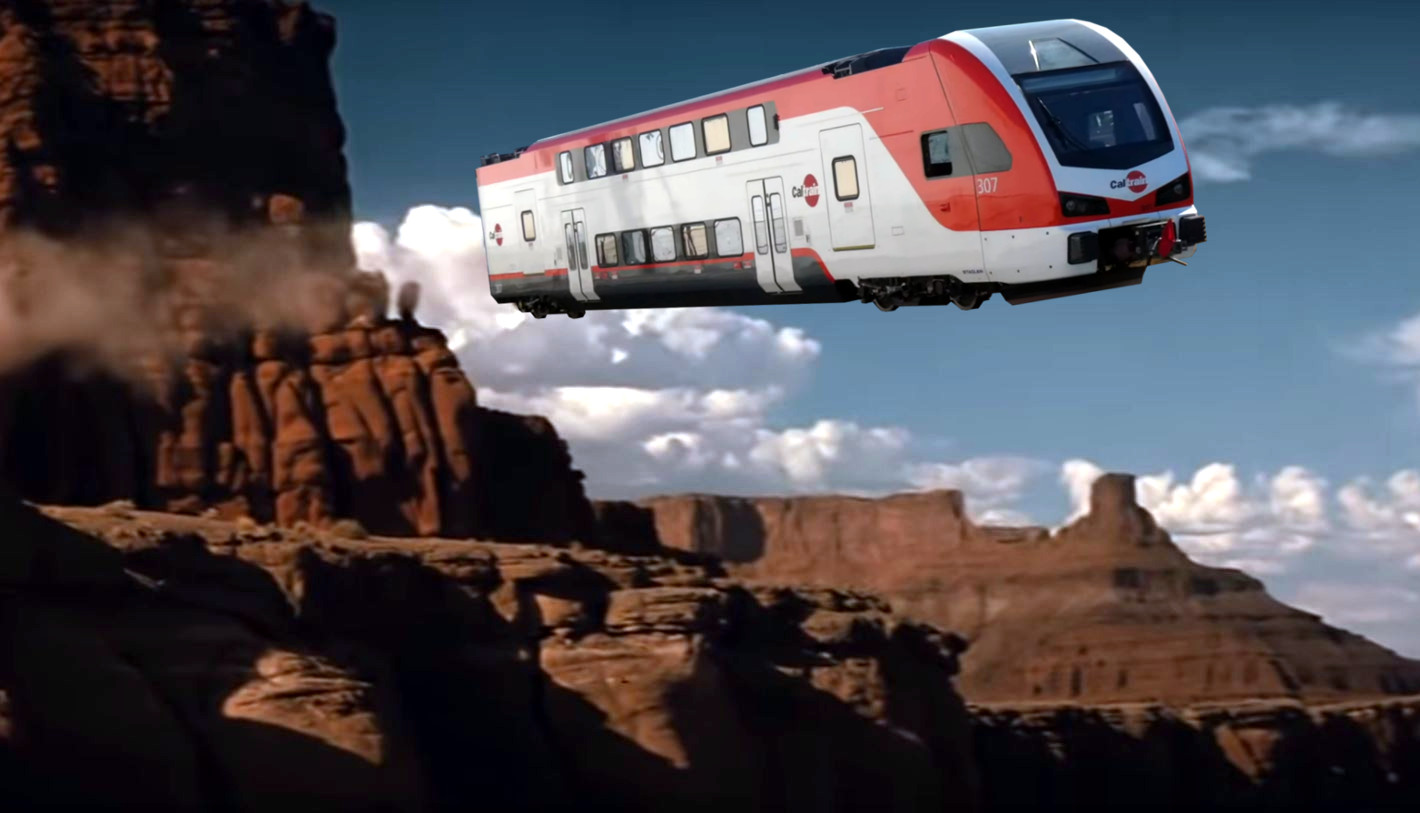
EMU jumping off cliff
One phrase we're going to hear a lot in the next couple of years is "fiscal cliff," a sudden disequilibrium between Caltrain's revenues and expenses caused by the withdrawal of the temporary federal subsidies instituted during the pandemic. The slow recovery of ridership, which until 2019 had funded ~70% of the railroad's operating expenses, is opening a $50 million/year hole in Caltrain's budget outlook through the rest of this decade, according to a draft Short Range Transit Plan (SRTP) recently submitted to the Metropolitan Transportation Commission (MTC).

The SRTP is a process that every four years requires each agency to project hypothetical near-term fiscal scenarios under a standard set of assumptions. Most interesting in Caltrain's draft is that the agency threw in a bonus scenario besides the prescribed hypothetical scenarios: the "Electrified Service scenario" a.k.a. Caltrain's actual plan.

This "Electrified Service scenario" makes zero effort to tackle operating costs, hiding behind a theory that Caltrain is inherently a high-fixed-cost operation, meaning that costs are not highly variable with the level of train service provided. All efforts are instead directed towards securing "funding opportunities," an approach that could very well succeed, as transit funding effectively grows on trees in California, no matter how inefficiently expended. Here are the scary numbers:

What if we blew up some long-held assumptions and attacked this fiscal cliff from the cost side?

Ditch Diesel Now and Go 100% Electric

Since time immemorial, the peninsula corridor electrification project has been sold as only a partial step towards electrification, anticipating that only 75% of the service would become electric with 25% remaining diesel, primarily to serve the non-electrified portion of the corridor south of San Jose. Operating a mixed fleet of diesel and electric trains blows up operating and maintenance costs, since many functions have to be duplicated (training, tools, spare parts, etc.). Revenue miles per vehicle are projected to drop by 10% when electrified service starts, which is a sure sign that your fleet is too big and isn't working hard enough.

How can Caltrain possibly operate with only the 19 EMU sets that will be delivered by 2024?

One certainly can't use all 19 in revenue service. Set one aside for maintenance downtime (grade crossing collisions will continue), and keep another two in reserve for timetable protection, essentially hot spares parked at each end of the line, crewed and ready to enter service at moment's notice to plug any delays during the peaks. That leaves just 16 sets to support a peak service level of six trains per hour per direction, a firm condition of Caltrain's funding agreement with the federal government.

That sounds downright impossible.

However, if you change the goals of a timetable to maximize equipment utilization, it turns out that it can be pulled off. Good service is just a side effect. Here is a new all-electric timetable that makes those shiny EMUs really earn their keep:

All EMU 6 tphpd
Score: 123 (relative to the benchmark score of 100 for the 2011 timetable)
Fleet: 16 EMU (zero diesel)
Utilization: 87% of train-minutes in revenue service

This is admittedly a slightly sporty timetable in that it requires aggressive 10-minute turns and a European level of padding of 7%, less than Caltrain is accustomed to dawdling with. The resulting risk of delay is mitigated by "protect" trains at each end of the line. There is also margin in the long station dwells (45 seconds) and the leisurely acceleration times built into the timetable, with power capped at only 2/3rds of the EMU's nominal rating.

The new EMUs would become highly productive assets by providing about 1.9 million revenue vehicle miles per year using just 133 cars, about 1.5x better utilization of these expensive depreciating capital assets than is currently contemplated.

The savings from disposing of the entire diesel fleet would be significant, and their residual resale value would only help Caltrain's balance sheet. The newer Baby Bullet fleet will have reached 20 years of revenue service, the minimum required by the FTA for federal funding assistance, so no penalties will arise from their early disposal. although its disposal would incur a small penalty reimbursement to the FTA since the equipment will not have reached its 25-year minimum useful life (according to FTA Circular 5010-1E, page IV-26.)

Divest the Gilroy Branch

One hitch: the overhead wire doesn't extend to Gilroy.

Gilroy service is a big weight on Caltrain's operational balance sheet because the ridership and revenue is minuscule compared to the high fixed cost of maintaining diesel service. Before the pandemic, ridership south of San Jose city limits (Blossom Hill) made up a negligible 0.8% of Caltrain's weekday ridership. South of Tamien was hardly better, at 1.2%. Until electrification is extended down to Blossom Hill (as it should be), it makes better sense to transfer this infrequent diesel service to an extended Capitol Corridor, with a direct cross-platform transfer to Caltrain in San Jose.

This can rid Caltrain of the entire diesel fleet, which is currently planned to remain at least 9 locomotives and 79 (!!) cars. It also frees Caltrain from another headache, having to comply with near-term diesel emissions mandates under consideration by the California Air Resources Board.

Reduce Conductor Over-staffing

Caltrain has too many assistant conductors. Assistant conductors are very expensive, costing about $15 million/year by FY25, about 1/3 of the operating deficit. Note this figure does not include conductors, only their assistants. The new EMUs relieve some of their duties, such as announcing station stops. The new fleet also has automatic passenger counters, giving precise real-time insights into passenger loads. While today's conductor staffing levels are determined by a formula from the number of cars, the formula should instead be revised to use recent passenger loads. This would ensure that all trains have a consistent staff/passenger ratio and that conductors have fair work loads.

Change the Operating Culture

With six electric trains per peak hour and at least 20-minute service at all stations, much better than is provided today, the conditions could be created for a robust recovery of ridership. Good service drives ridership, but if Caltrain is allowed to execute their mixed-fleet "Electrified Service scenario," as planned, we will barely achieve any service improvement as costs continue to spiral upwards.

Applying these cost-saving measures, Caltrain could close their operating deficit and erase any "fiscal cliff" without expending any energy to capture ever more "funding opportunities" to support entrenched and inefficient operating practices. The fleet does not need to grow, nor does the headcount. The operating culture needs to change: it's not enough to buy Swiss trains; you need to actually run them like the Swiss.

09 May 2021

The Exploding Cost of Grade Separations

Recently, the San Mateo County Transportation Authority prepared a grade separation program update, discussing past and future projects. What immediately jumps out of this document, and others published by Caltrain, is the exploding cost of grade separation projects. The project budgets are shooting through the roof, vastly outpacing inflation. Typical of this cost explosion is the Broadway grade separation in Burlingame, which will grade-separate a single intersection at the eye-watering cost of $327 million.

Cost Modeling of Historical Grade Separation Projects

With the SMCTA slides giving cost data for past and current projects along the Caltrain corridor, it is fairly straightforward to assemble a simple model of grade separation project component costs. All figures are inflated to 2020 dollars before fitting, and we break out unit quantities for each project of the following project components: fully elevated rail over road crossings, split (partially elevated) rail over road crossings, trenched road under rail crossings, pedestrian tunnels, stations, and the number of miles of corridor where the track elevation was changed. With all those quantities broken out for each project, we can fit a simple model that estimates the unit costs by (empirically, not rigorously) minimizing a least-squares fitting residual. The main result of this model is that projects from the mid-1990s through today consistently cost about $36 million per crossing, with not too much variation:


That brings us back to Broadway in Burlingame, which according to this model should cost only a third of the price tag of $327 million. That's right, even including two pedestrian tunnels and a new station, the entire Broadway project should cost no more than $100 million. This factor-of-three discrepancy raises some serious questions about how this project is being engineered, and whether it should even proceed in its current form. One could counter that the cost model presented here is too simplistic and doesn't reflect the unique local conditions of this project, but the model does okay with predicting the cost of every past grade separation project over the last 30 years. Is this a case of over-fitting the data, or have the engineers behind this project simply lost their senses?

With the most traffic of all grade crossings on the peninsula corridor and train-on-car collisions occurring on average once a year, the Broadway crossing is at the top of the state's priority list for grade separation, and we all know that you can't put a price on safety. That makes the Broadway grade separation project ripe for name-your-price taxpayer extortion.

Insane Costs are Baked in to the Caltrain Business Plan

A Caltrain business plan presentation from 2019 attempted to quantify the expense of partially grade-separating the corridor for each contemplated service scenario. The cost modeling for this was even cruder than the simple spreadsheet model described above: the costs for each project were either copied and pasted directly from each city's estimates (of wildly varying quality), or a standard grade separation unit cost of $255 - $355 million per crossing was adopted. This value is up to TEN TIMES the value estimated from past and present grade separation projects, and flies directly in the face of common sense. Despite the coarseness of this spreadsheet costing exercise, the resulting grade separation costs (on the order of ten billion dollars regardless of service scenario) were passed along into the regional Plan Bay Area 2050 exercise.

Why have costs exploded for a project like Broadway, which has proceeded far enough into detailed design to accurately estimate construction cost?

Cost Drivers

Utility relocation. Whenever you dig, surprises happen where utilities buried underground are found elsewhere than expected. The more and deeper you dig, the more surprises you will find. Every new discovery delays or even stops construction work, running up costs. Almost every digging project undertaken by Caltrain runs into this situation. Just in the last couple of years: in South San Francisco, construction of a grade-separated pedestrian access tunnel was delayed for 17 months, at an additional cost of $10 million (and still counting!) due to utility relocation issues. In San Mateo, the 25th Avenue grade separation project, where several new crossings were dug, was delayed by over 500 days due to negotiations with Union Pacific over the relocation of fiber optic cables. Pacific Gas & Electric also had to be paid to move a high pressure gas line. The budget for utility relocation almost tripled, from $12 million to $32 million, not counting the cost of construction delays. Meanwhile, corridor-wide, Caltrain's electrification program (while not a grade separation) is continually digging up their own brand new train control fiber optic cables, which were buried in places that don't match what the contractor said they did. This is causing many months of delay to foundation installation. The matter is now tied up in court, as one of several smoldering side sagas in the big bonfire of litigation over the CBOSS project, still building up to a climactic jury trial in 2022.

Vertical curves made for freight trains. Changing the vertical profile of the tracks, whether up or down, is subject to design constraints on the radius of vertical curves, or how quickly (and over what distance) the slope of the tracks is allowed to change. You might think this issue primarily affects faster passenger trains, but amazingly, the biggest culprit is heavy freight. Freight cars maintained to the bare-minimum standards practiced in the United States can derail at the slightest provocation, so industry track design standards are set extremely conservatively. The maximum vertical acceleration allowable for freight cars is 0.1 ft/s^2, six times less than for passenger trains. At equivalent speeds, the grade change (for example from level track to a one percent slope) must then take place over a distance six times longer than for passenger trains. If you wanted to design the vertical profile of a grade separation to the most aggressive vertical radii and shortest structure lengths allowable for passenger trains, the freight trains would have to be slowed down to 1/sqrt(6) of the passenger train speed to stay under their six times lower vertical acceleration limit. On the peninsula corridor, where we design for 110 mph passenger trains, short grade separations require that the freight trains can't go any faster than 45 mph. Unfortunately, new grade separations such as Broadway in Burlingame or downtown Redwood City are being engineered for 60 mph freight speed, which makes all the vertical curves (and bridges, embankments, trenches, etc.) almost 80% longer than they need to be for 110 mph passenger trains.

Vertical curves that can't overlap bridge spans. Recent preliminary design drawings, such as for the Redwood City grade separations, reveal a new design constraint has been applied that does not appear in older Caltrain engineering standards. The vertical alignments are configured such that wherever the track crosses over a bridge span (as for a grade separation) there is no vertical curvature. To understand how wasteful and silly this is, ask any engineer--never mind, ask any kid: is a train bridge supposed to look like design A or design B, where this  constraint has been applied so no vertical curvature exists where the tracks pass above the under-crossing? Anyone can see this design rule will blow up structure height, length, cubic yards of concrete, and of course cost. And yet, that's what we see in all the profile drawings.

Paint-by-Numbers Structure Depth. There are well-worn preliminary engineering rules for how thick a bridge deck needs to be relative to the loads it must support and the width of a span. Blind application of these rules during preliminary engineering, when the vertical track profile is often decided, results in bridge decks that are comically deep, as measured from soffit (bottom surface of the bridge) to top-of-rail. These massive bridges result in a much higher track profile, needlessly increasing the length, height, visual impact, and cost of grade separation projects. Bridge structural forms exist that minimize structure depth, and it is often possible to shorten spans by adding support columns.

How to build affordable grade separations

Here are some golden rules for designing affordable grade separations. These are rules that are clearly not being followed for Broadway, or for the Menlo Park plans, or for the downtown Redwood City plans, and directly contribute to stratospheric cost estimates for these projects.

  • dig as little as possible. Wherever possible, go up and over.
  • limit freight train speeds to no more than 45 mph.
  • allow bridge decks and vertical curves to co-mingle.
  • from the very beginning, aggressively minimize structure depths.

Another important consideration, in view of the large number of grade separation projects that will be required to advance the decadal process of grade separating the peninsula rail corridor, is to standardize designs. There ought to be a small set of bridge designs that can be repeatedly adapted to each situation, using standard prefabricated structural elements. Not every project needs to be a special snowflake.

05 May 2019

Thoughts on Grade Separations

The emerging Caltrain business plan is broaching the issue of grade separations, a decadal process that has been underway, well, for decades. We're already 63% of the way there today, with another dozen new grade separation projects in various stages of planning or construction. Achieving a reasonable level of grade separation for the peninsula corridor is estimated to cost $8.5 - 11.1 billion, a shockingly large sum that we'll just round to $10 billion. As we try to grasp the enormity of that figure, here are some contrarian thoughts:

1) Don't spend train money on car projects. The benefit of grade separations accrues primarily to automobile travel, with the elimination of gate down time. An intensive grade separation program can eventually unlock additional operating slots for more trains and eliminate the occasional incident, yielding benefits to train riders. Some grade separations are necessary, such as when expanding to four tracks. In the short term, however, the greatest benefit is the removal of an inconvenience to drivers, which in our car-centric society is held as a worthy goal seemingly regardless of cost. Rail dollars are a lot scarcer than road dollars, especially in this era of federal disengagement, so the last project we should spend them on is a project that facilitates car travel with little improvement for train riders. Rail funding should be used to make real and measurable improvements to train service, a standard by which most grade separations rate poorly. So you still want a grade separation? Build it with road funding.

Anticipated gate down times,
under various scenarios in the
Caltrain business plan
2) Quit whining about gate down time. Caltrain put together a nice summary of gate down time, the number of minutes per hour that grade crossing gates block traffic during rush hours. Today the average is 11 minutes, and under future growth scenarios it could increase to 17 - 25 minutes, with a few crossings faring worse than average. If that sounds intolerable, think about a typical roadway intersection with a traffic light. If both roads are equally important, the "gate down time" of a traffic light is 30 minutes. If one road is more important, the lesser road (for example, Ravenswood Ave where it meets El Camino Real in Menlo Park) sees "gate down time" well in excess of 30 minutes, let's say 40 minutes per hour. Nobody is clamoring to grade separate the Ravenswood / El Camino road intersection. There's an obvious double standard here, and the guidelines for what qualifies as unacceptable delay should be set the same way as they are for the grade separation of a road intersection. Gate down time should only rarely, if ever, be the reason to build a new grade separation.

3) There are few economies of scale in grade separation. Doing them all as a package does not save money. The process we have, where local jurisdictions often exert tight control over every aspect of design and construction, does not lend itself to a one-size-fits-all approach. Each grade separation is different. Grade separation designs do not depend on each other in the majority of cases where they are widely spaced. While a corridor-wide strategy is important to have, the execution of that strategy and the securing of funding is inherently a city and county issue. If we are going to have a corridor-wide funding approach, it must go hand-in-hand with taking away local control. Jurisdictions that insist on local control should be left to figure out the funding on their own. Palo Alto, where interminable and futile discussions of tunnels continue to this day, should not be allowed to control the design process if their project is paid for through a corridor-wide funding measure.

4) If $10 billion is an okay expense, then there are far better ways to spend it. Especially with rail money at stake, there are much better ways to spend $10 billion than by building a lot of grade separations for cars that produce zero improvement to train service. There are a lot of good investments that should be made to improve the amount and speed of train service:
  • Extend all platforms to 8-car length. If you put all the platforms that Caltrain ever built in the last 20 years end to end, they would stretch about 5 miles long. This is not an expensive project; it can be done for about $0.05 billion. It should already be underway, but inexplicably isn't.
  • Convert the entire train fleet to 8-car EMUs, starting by exercising the rest of the existing Stadler contract option of another 59 cars, increasing the fleet to 24 trains. The diesels are retired from the peninsula, which is a condition for starting any level boarding projects. This costs about $0.4 billion.
  • Convert the entire system to level boarding to speed trips and improve punctuality. Depending on how this is done (high platforms or low platforms, or some combination thereof) and over how long a period of construction, this would cost about $0.5 - 1 billion.
  • Build a new EMU maintenance and storage facility near Blossom Hill (San Jose) and extend frequent electrified service through all of San Jose. Including any extortion by UPRR, the owner of the tracks, this ought to be feasible for less than $1 billion.
  • Build a new transit center in Redwood City to enable cross-platform transfers between locals and expresses. Call it $0.5 billion, and throw in the downtown grade separations for another $0.5 billion to allow four tracks.
  • Expand the EMU fleet to enable 8 train per hour peak service. Expanding the fleet to 32 trains would require another 64 EMU cars, for about $0.5 billion.
  • Extend the platforms at highly patronized express stops to 12 cars in length, and extend expresses to 12 cars. This would require extending about half the fleet by 4 cars, or another 64 EMU cars. Including platforms this might cost about $0.8 billion.
This isn't an exhaustive list, but unlike grade separations, all of these projects have immediate and measurable positive effects on the quantity and quality of service provided to riders. This list achieves most of Caltrain's "moderate growth" scenario but without HSR. The tally for all of these projects is still less than $5 billion, so if $10 billion for grade separations sounds at all palatable, this list ought to be a no-brainer.

Grade separations are nice, but their cost and benefit should be weighed very carefully on a case-by-case basis. The cost should be borne by who benefits. The business plan process will hopefully create the framework to have the difficult conversations about what not to pay for with rail funding. Grade separations should be built with highway funding unless there is a clear and measurable benefit to rail service.

07 June 2017

Frequent Trains Off Peak

After electrification, Caltrain aspires to operate off-peak service at 2 or 3 trains per hour, instead of the current 1 train per hour. All-local service at 3 trains per hour works out to a fleet requirement of 12 trains in service, far less than needed for rush hour, but still racking up almost 300 train-miles per hour, or triple today's rate. That sort of service level will not be cheap to operate, unless two conditions are met to reduce operating and maintenance costs:

1) Operate Short Trains Off Peak

Shorter trains off-peak reduce maintenance costs by putting less wear and tear on the vehicles and track. The same revenue train-miles can be offered with fewer car-miles. The more off-peak service is provided, the greater the savings: at 3 trains per hour, operating 4-car EMUs instead of full-length 8-car EMUs off-peak results in a huge reduction of 25% fewer weekday car-miles.

Operating and vehicle maintenance
costs of US commuter rail, per car mile
Just how big are the savings? Typical commuter rail costs are available from the FTA's National Transit Database. The operating and vehicle maintenance costs for Caltrain and selected commuter rail operators are shown at right for the year 2015, normalized by the total number of car-miles operated. Some on this list (Metro North, LIRR, SEPTA and New Jersey Transit) operate sizable fleets of EMUs, but their maintenance costs are not significantly out-of-family with Caltrain; therefore, it's fair to assume that maintenance costs will not materially change after electrification. Since the FTA maintenance totals are not broken out by fixed and variable costs, we will conservatively assume that the variable cost (which scales directly with the number of car-miles operated) accounts for half of the vehicle maintenance cost. Squinting at the chart, let's estimate this variable cost at $2 per car-mile.

When you operate 12 hours of off-peak service at 300 train-miles per hour, the variable cost of vehicle maintenance racks up at 12 hours/day * 300 train-miles / hour * 8 cars/train * $2/car-mile = $58k/day. By reducing off-peak train length to 4 cars/train, the savings are half of this, or $29k/day. The savings from shorter trains accrue not just on weekdays but on weekends too, yielding annual savings of roughly $10 million.

Then you might want to factor in energy cost savings. Each car weighs about 60 tons loaded, and is accelerated to about 60 mph between two typical stops. The electricity consumed to accelerate is re-generated into the grid while braking for the next stop, with a round-trip efficiency likely in the neighborhood of 80%. That means overcoming the inertia of one car for one stop (neglecting drag) takes 4 MJ of electricity, or 1.2 kWh in more familiar units. At typical electricity rates of 12 cents/kWh, that's just $0.14/car/stop. Multiplying it up, $0.14/car/stop * 20 stops * 3 trains/hour/direction * 2 directions * 12 hours/day * 8 cars/train = $1600/day.  (Note that drag will significantly increase this figure, but can be neglected for this estimate because the drag of a 4-car train is similar to that of an 8-car train.) By reducing off-peak train length to 4 cars/train, the savings are $800/day. At less than $300k per year, this is just a rounding error compared to the vehicle maintenance, and can be ignored.

The Scharfenberg automatic coupler,
nicknamed "Schaku," linking up two
short EMUs (click for movie)
Offsetting these savings are the costs of making and breaking train formations several times per day, since the entire fleet needs to be available for morning and evening peak service with full length 8-car EMUs. Traditionally, this is a cumbersome operation that involves expensive and specialized labor, with ground crews stepping onto the tracks to connect pneumatic hoses and high-voltage cables. Caltrain is breaking with tradition by using a neat technological trick: the couplers on each end of the new EMUs are fully automatic Schakus, making mechanical, pneumatic and electrical connections in a matter of seconds at the touch of a button in the train cab. Barring any union rules relating to craft distinctions, making and breaking trains can be performed by train crews with zero additional labor cost.

2) Operate With One Conductor

Labor accounts for about two thirds of operating costs in typical commuter rail systems. Operating costs are strongly driven by train crew size. Minimum crew size is constrained by union rules that govern how many conductors must work on each train. Currently, the minimum crew size (dictated by Rule 11 of the agreement with the UTU) is 1 engineer, 1 conductor and 1 assistant conductor for trains up to seven cars, with a second assistant conductor required for an 8-car train or longer.

When contemplating a tripling of off-peak service, the cost of this minimum staffing level becomes prohibitive. Conductors are paid about $40/hour, and assistant conductors about $35/hour. Including benefits and other employee costs, the overall cost of these employees is easily double these figures. Additionally, conductors typically spend about half their shift time on board a revenue-producing train, so the necessary staffing levels are roughly double the number of trains in service. We saw earlier that it takes a fleet of 12 trains to operate off-peak service at 3 trains per hour per direction; staffing an assistant conductor on these trains would cost $70/hour/conductor * 1 conductor/train * 2 hours/(revenue hour) * 12 trains * 12 (revenue hours)/day = $20k/day. Again this is big money: the savings from removing the assistant conductor and going to one-conductor operation accrue not just on off-peak weekdays but on weekends too, yielding annual savings of roughly $7 million.

How do you sell this lower staffing level to the union?
  1. EMUs can relieve conductors of some of their workload, after automation of many of their traditional roles (such as stop announcements, door and lift operation, or signal aspect acknowledgement). Fare verification (proof of payment) could even become a separate role carried out by roving fare inspectors.
  2. Conductor staffing levels or pay rates can be renegotiated on the basis of actual ridership, instead of the number of train cars, since the new EMUs will have automatic passenger counters that collect detailed and accurate passenger ridership statistics.
  3. Most importantly, the total amount of work for UTU-represented employees would increase, since one-conductor operation would enable a tripling of off-peak service, resulting in 1.5 times more labor hours even after cutting conductors staffing levels in half.
It isn't a stretch to envision Caltrain and the UTU re-negotiating the labor agreement to allow just one conductor on four-car off-peak trains; there is room for a compromise that can benefit everyone.

Future Fleet Implications

If you zoomed way, way, into Caltrain's
exterior paint scheme concepts,
the Schaku was plain to see
Caltrain's initial fleet of sixteen six-car EMUs (total 96 cars) will not have the ability to split into shorter formations, but once the option for 96 additional cars (total 192 cars) is exercised, and all trains are extended to their intended length of eight cars, the practice becomes not only possible, but necessary for providing frequent off-peak service.

The fleet needs to operate two service patterns:
  1. peaks at 6 trains per hour with a fleet of 8-car EMUs
  2. off-peak at 3 trains per hour with a fleet of 4-car EMUs
To support both service patterns using the planned fleet size of 192 cars (including a rather large spares ratio, to withstand regular grade crossing collisions), the optimal fleet configuration is probably something close to:
  • 16 4-car EMUs for off-peak service, each with one bike car and one bathroom car, that can be coupled in pairs during peak hour service to form eight trains with eight cars each.
  • 16 8-car EMUs for peak service, lengthened from the base order
This results in the following order breakdown for the 96 additional option cars:
  • 32 passenger cars for CalMod 1.1
  • 32 cab cars, for 4-car EMUs
  • 16 bathroom cars (powered), for 4-car EMUs
  • 16 bike cars (unpowered), for 4-car EMUs
This EMU fleet configuration enables 20-minute off-peak service frequency for at least $17 million/year cheaper operating and maintenance cost than would otherwise be achieved with a uniform fleet of all 8-car trains. That's a large amount, easily over 10% of Caltrain's current annual operating budget. Considering that Caltrain struggles every year to scrape together enough operating funds, a stronger way of stating it is that without 4-car EMUs and one-conductor train crews, Caltrain will simply not have the financial means to provide 20-minute off-peak service frequency.

02 January 2016

Special Provision SP01040

Buried deep in the fine print of Caltrain's electrification Request For Proposals, Volume 3, Part C, Paragraph 1.04, you will encounter Special Provision SP01040.  It defines where and when the electrification contractor will be allowed access to Caltrain's tracks to perform the work of re-signaling and electrifying the railroad.  These are known as "work windows" and are tabulated at right, as extracted from the RFP.

What follows is an analysis of the far-reaching cost and schedule implications of Special Provision SP01040.

Temporal Windows

Special Provision SP01040 imposes the following time restrictions:
  • No work during weekday peak hours (6 - 10 AM and 4 - 8 PM)
  • No work on Tuesdays and Wednesdays overnight, for track maintenance
  • Only one track available mid-day, evenings and weekends
  • Two tracks will only be available in the early morning hours Friday - Tuesday.
The limits defined in SP01040 do not include time for sending crews and equipment to or from the work site, known in construction jargon as "mobilization" and "demobilization".  An hour is eaten away from the beginning and end of each work window for this purpose.

If you want to analyze a typical work week on an hour-by-hour basis, you can define six different track availability states.  Each state has associated to it an availability factor, which you can think of as how many tracks are available to perform productive work (i.e. re-signaling or constructing the overhead contact system).

Availability StateAvailability Factor
No access0
Mob/Demob for 1 track0
Mob/Demob for 2 tracks0
Single track available for work0.75
Mob/Demob for 2 tracks with 1 track already available1
Both tracks available for work2

During periods of mobilization or demobilization, the work window is technically open to the contractor, but no useful work can occur since crews are busy moving equipment and materials to/from the work site.  When a single track is available for work, trains passing on the other track will occasionally interrupt the work, which is why the availability factor is 0.75 rather than 1.  This typically accounts for 2 trains passing the work site every hour, causing work to cease for 15 minutes due to worker safety protocols.  When mobilizing both tracks for the contractor, these passing trains cease and the availability factor increases to 1.  The ideal situation is when both tracks are shut down and the contractor has full control of the work site.

Geographical Windows

The corridor has been divided into geographical segments, at least some of which must remain open at all times to allow northbound and southbound trains to meet and run past each other.  Each segment has a certain length (measured in route-miles).

SegmentLength (miles)
Segment #1, MP 0.3 - 8.0 (CP 4th to CP Sierra)7.7
Segment #2, MP 8.0 - 29.1 (CP Sierra to CP Alma)21.1
Segment #3, MP 29.1 - 44.5 (CP Alma to CP De La Cruz)14.8
Segment #4a, MP 44.5 - 47.5 (CP De La Cruz - CP Alameda)3.0
Segment #4b, MP 47.5 - 51.1 (CP Alameda - Tamien)3.6
Yard Facilities (4th & King, CEMOF, San Jose)3.0

Note that various yard facilities are assigned 3 route miles (6 track miles).

During the first phase of electrification, work may only occur in segments 2 and 4, with both tracks open in segments 1 and 3 to allow trains to meet.  Then, following an adjustment to the timetable, the second phase of the work will occur in segments 1 and 3, with both tracks open in segments 2 and 4 to allow trains to meet.  This allows Caltrain to maintain hourly service in both directions during mid-day, evening and weekend periods, single-tracking as needed around electrification work sites.

Labor Costs

Let us loosely define a unit of labor to perform electrification work on one mile of track for one hour (however many people that may actually take).  One labor unit is multiplied by the number of track miles and the number of hours to calculate a burn rate, or how much the labor will cost during any given period of time, assuming the contractor makes full use of the work windows.

We will assume that when both tracks are open, efficiencies can be realized so that only 1.5 labor units (rather than 2) are required to work on 1 route-mile (2 track-miles).  We can then assign a labor cost for each track availability state defined above:

Availability StateHourly Labor Rate
(per route mile)
No access0
Mob/Demob for 1 track1
Mob/Demob for 2 tracks1.5
Single track available for work1
Mob/Demob for 2 tracks with 1 track already available1.5
Both tracks available for work1.5

The work is performed by skilled union workers, whose hourly cost is not always the same.  While weekday work can be performed in shifts at no additional hourly expense, weekend work is another matter.  Depending on the union and the trade (the RFP contains hundreds of pages of union wage rate tables), weekend work can cost up to twice the rate of weekday work.  Let us assume overtime cost factors in as follows:

Day of WeekOvertime Factor
Monday - Friday1
Saturday1.5
Sunday2
 
Efficiency Metrics

Now let's pull all these assumptions together and come up with three metrics.
  1. The first metric is average track avaibility, measured in track-miles.  It measures how much of the railroad is available for actual productive electrification work, as opposed to shuffling workers and equipment or dodging out of the way of trains.  Average track availability is inversely proportional to how long it will take to complete the work.  If you double the amount of available track, the job can be done in half the number of weeks.  There are limits to this assumption, of course, but for sequential tasks requiring direct access to track, such as re-signaling and constructing the overhead contact system, this inverse relationship is quite reasonable.

    The way to compute average track availability is to assign each hour of the week a track availability state, based on the rules set out in SP01040.  Then, we multiply the availability factor (associated to that state) by the number of route-miles in that segment to calculate how many track-miles are available for work in that particular hour in that particular segment.  We can repeat this calculation for every hour of the week (24 x 7 = 168 hours) and for every segment.  Finally, we can add it all up and divide by the total number of hours in a week to figure how many miles of track are available on average.

    But it's not quite that simple.  Since the work is divided into two geographical phases, we must first add up the availability for segments 2 and 4 (Phase 1) and then separately add up the availability for segments 1 and 3 and the yards (Phase 2).  The average track availability for Phase 1 and Phase 2 is then averaged; this average is weighted by segment lengths to serve as a proxy for duration of each phase.
     
  2. The second metric is burn rate, measured in labor units per week.  It measures the rate at which money is spent on all the work, including not just actual productive electrification work but also the shuffling of workers and equipment and the dodging out of the way of trains.  This metric assumes that the contractor makes full use of the available windows, and that no additional hourly expenses are incurred outside of the work windows (e.g. due to the work not filling a full 8-hour union shift).

    The way to compute burn rate is to multiply the hourly labor rate (associated to each hour's track availability state) by the number of route-miles in that segment and the overtime factor for that particular day of the week, to calculate how many labor units are expended in that particular hour in that particular segment.  Once again, we need to be careful how we add up the labor for Phases 1 and 2, using the same partial sums and weighted averages as for track availability.
     
  3. The third metric is installation efficiency, measured in labor units per week per available track mile.  It measures how much of the labor is expended on actual productive electrification work, as opposed to unproductive tasks such as the shuffling of workers and equipment and the dodging out of the way of trains.  It serves a rough measure of the overall cost of tasks requiring access to the track, such as building the overhead contact system and re-signaling.  It is defined simply as burn rate divided by average track availability.  A lower number is better, indicating that a given length of track can be completed using less labor.
Four Scenarios

Armed with these metrics, we can analyze and compare a variety of electrification scenarios, including the baseline scenario specified in the RFP per Special Provision SP01040, and other scenarios of our choosing.

For the detailed calculations that support each scenario, or to explore your own scenarios and change any of the assumptions, you can download this Excel spreadsheet.
  1. Baseline Scenario: Let us scrupulously apply the work window restrictions from Caltrain's RFP, per SP01040.  Phase 1 has an average track availability of 13.3 track miles, while Phase 2 comes out to 12.1 track miles.  The weighted average of the two phases yields an average track availability of 12.7 track miles.  Bearing in mind that Caltrain has over 100 track miles to be electrified, this works out to a paltry ~12% of the railroad being available, a reflection of the extremely restrictive work windows.  This does not bode well for the program schedule, since having so little of the railroad available to the contractor will draw out the duration of all activities requiring access to the tracks.

    The burn rate works out to 3934 labor units per week, much of which is spent on mobilization and demobilization, as well as on weekend overtime work.

    The installation efficiency is 309 labor units per week per track mile.  When you consider that there are only 168 hours in a week, that is a terrible score indeed.
     
  2. Weekend Shutdown Scenario: One way to improve the average track availability is to completely shut down the railroad on weekends.  While this concentrates the majority of labor onto weekends when overtime rates are high, it opens up a 54-hour long period of uninterrupted access to segments 1 through 4a, while segment 4b and the yards remain partially open (to support tenant railroads and Caltrain maintenance activities).  This allows weekend work to be performed simultaneously in all segments, during both Phase 1 and Phase 2.

    Not surprisingly, average track availability improves considerably, with 35.3 track miles for Phase 1, 35.6 track miles for Phase 2, and a weighted average of 35.4 track miles.  By shutting down the railroad on weekends, we effectively tripled the amount of track access afforded to the contractor.

    The burn rate goes up quite a bit, because the entire railroad is being worked on every weekend.  The total works out to 8044 labor units per week.

    The installation efficiency is 227 labor units per week per track mile, a savings of 27%.
     
  3. Friday + Weekend Shutdown Scenario: The next possible step is to shut down the railroad on Fridays to extend the weekend work window to three days.  This has the advantage of increasing availability during a non-overtime weekday, but it is disruptive to riders who need to commute five days a week.  Weekend access increases from 54 hours to 78 hours, again with all four segments being worked simultaneously.

    Average track availability increases to 45.4 track miles.  Burn rate increases to 9144 labor units per week.  Installation efficiency improves to 201 labor units per week per track mile, a savings of 35%.
     
  4. Total Shutdown Scenario: The most draconian possibility is to shut down the railroad entirely.  It would be extremely disruptive for riders.  It could very well gridlock the highway 101 corridor, and in so doing, drive home the value of Caltrain for hundreds of thousands of commuters who never use Caltrain.  It would leave freight customers high and dry.  On the plus side, it would enable a coordinated construction "blitz" to complete the work at lower cost and far faster.  Electrification could even be combined with other projects such as grade separations.  Segment 4b and the yards would remain partially open (single-tracked) for the tenant railroads that use the southern end of the corridor.

    Average track availability would shoot up to 98.2 track miles.  Burn rate increases to 15600 labor units per week.  Installation efficiency improves to just 159 labor units per week per track mile, a savings of 49% (half off!)
Here are some graphs to summarize the results of this analysis.


You might wonder about the point of this exercise.  The RFP is closed and all the bids are in, so isn't all this overcome by events?

Word has it that the bids came in much higher than Caltrain expected, with contractors blaming the restrictive work windows for the higher cost.  Caltrain is now scrambling to scrape together even more funding than the $958M they thought electrification would cost (not including new vehicles).  Recall about half of that sum was estimated for re-signaling and building the overhead contact system, tasks where cost and schedule are strongly driven by work windows.

Shut Down This Railroad!

The right answer isn't to go digging between couch cushions for another several hundred million dollars.  The right answer is to shut down this railroad, because trying to electrify without shutting it down is like trying to change a flat tire without stopping your car.  A weekend shutdown would speed the work by a factor of nearly three, and reduce cost by about $150 million.  Shut down three days, save $200 million.  Shut everything down, save nearly $300 million.  Okay, maybe don't shut everything down, but at the very least, the weekends must go.

06 July 2012

Now What?

In an historic vote, the legislature today approved a funding package worth about $8 billion to begin construction of the first high-speed rail system in the Americas.  To make the package politically more palatable around the state, it included the immediate release of $706 million of so-called "book end" funding in the form of Proposition 1A bonds specifically allocated to the modernization of Caltrain, per the recent Memorandum of Understanding approved by all involved agencies.  The $706M total includes $600M of high-speed rail funding and $106M of non-HSR connectivity funding, from pots of money that are subject to different constraints.  These sums form the lion's share of a $1.456 billion funding package that covers both electrification and a new signal system for the peninsula rail corridor.

While this is no doubt a landmark occasion to celebrate for supporters of modern rail transportation, today's vote will probably not cause anything dramatic to happen on the peninsula in the short term.  Consider:

Taxpayer Lawsuits.  The opposition remains fervent and relentless, and a lawsuit challenging the release of $600M of HSR bonds to improve the Caltrain commuter rail system, with not a high-speed train in sight for more than a decade, is a near certainty.  Protections are built into the law, and require several conditions to be met for release of the funds.  Approval by the legislature is only one of those conditions, and the interpretation of the remaining ones is likely to become legally contentious.

The Environmental Clearance Process.  In April of 2010, Caltrain's electrification project had already obtained federal environmental clearance under the National Environmental Protection Act (NEPA) as the Caltrain board of directors came within a few dramatic minutes of certifying the Final EIR under California's Environmental Quality Act, or CEQA.  The board stopped short, under a surprise threat of a CEQA lawsuit, preferring to resolve any issues outside of the legal system before certifying the FEIR.  While the scope of the electrification project has not changed under the recently approved MOU, the project has now become the first in a series of incremental investments leading up to the "blended system" envisioned in the latest HSR business plan.  That means the electrification EIR may go back to square one for yet another round of public circulation (following prior rounds in 2004 and 2009), a process that is likely to take several years.  It would be surprising to see a new FEIR before 2014.

CEQA Lawsuits.  The sole enforcement mechanism built into CEQA is the lawsuit; it is therefore expected that lawsuits could follow the certification of any EIR.  While clearing electrification as a stand-alone project might be legal under CEQA, the issue is complicated by the project's new association to high-speed rail.  The two-tiered environmental clearance process adopted by the HSR project has already run into serious resistance, with the Bay Area to Central Valley Program EIR about to enter its third round of litigation since 2008.  HSR opponents could easily argue that funding the electrification project under Proposition 1A requires the prior clearance of both this program EIR as well as the project-level EIR for the "blended" San Francisco - San Jose section of the HSR project, including all the project phases expected to be completed after electrification.  Those later phases would include more controversial measures such as the construction of new overtake tracks and new grade separations.  This document is yet to be drafted; while the peninsula project EIR for the full-bore four-track system (still allowed for in the program EIR) was almost ready to circulate as of late 2011, it will require extensive revisions before it conforms to the "blended" configuration.  And that's before it becomes mired in what could become years of CEQA litigation.

The Lead Agency Issue.  The high-speed rail authority has in the past been openly hostile to funding Caltrain improvements.  The new leadership, under board chair Dan Richard, may not be much different.  Richard, like Kopp before him, is a longtime supporter of the expansion of BART, which has always been in invisible tension with Caltrain enhancements.  While he has extolled the merits of the blended book-end approach to gain political support for the entire HSR endeavor, this stance could very well weaken now that the legislative hurdle is passed.  Prior to the vote, he was quoted as saying "The Legislature wanted to emphasize that this money would be there for (the Bay Area and Southern California). And they’re right," highlighting that it is the legislature pushing this funding, not the CHSRA.  Indeed, the Authority, and the transit industrial complex behind it, may be reluctant to push for the peninsula improvements (a) because the opposition there is intense, (b) because of inter-agency rivalry with Caltrain, and (c) because the proposed projects do not involve large-scale civil works of the sort that Parsons Brinckerhoff likes to design, and its acolytes in the construction industry like to build.  Progress on the electrification project could thus depend on which agency leads the EIR process and pushes the project to fruition.  Caltrain is both competent and motivated, but the CHSRA could easily drag its feet--after all, the legislature has only authorized the bond funds to be spent, but the CHSRA retains full authority over when to actually spend them.  All the MOU demands of them is "good faith," which has been in demonstrably short supply.

CBOSS.  While the spotlight is on the electrification project, the MOU and newly passed HSR funding also covers Caltrain's new Advanced Signal System, also known as the Communications Based Overlay Signal System or CBOSS, and often criticized on this blog.  This project is a necessary pre-condition for the operation of light-weight European-style trains, and must be completed by the end of 2015 under a federal mandate that shows signs of being delayed to 2018 or 2020.  Despite Caltrain's repeated insistence to the contrary, CBOSS will not be compatible with HSR other than by fitting two separate, expensive, and functionally redundant signaling systems on high-speed trains, an unavoidable and inconvenient truth that may call into question the wisdom of spending even one cent of HSR money on CBOSS.  A far better outcome would be to make the peninsula rail corridor a testbed for the actual train control system to be deployed on the HSR system, based on the increasingly mature worldwide ERTMS rail signaling standard.

The Timeline.  The money is available only until June 30th, 2018.

UPDATE: The Poison Pill.  At any time before then, a single stroke of the pen from the Department of Finance can transfer the money to the Central Valley projects, per the Budget Act of 2012, Section 2.00, Item 2660-104-6043, Section 3, Provision 2.

The legislature's momentous step leaves many questions unanswered.
  • Is the funding of Caltrain improvements using high-speed rail bonds legal?
  • Will opponents hog-tie the electrification EIR to the high-speed rail EIRs in a bid to delay?
  • Can the existing electrification EIR be tweaked, or is it back to square one?
  • How eagerly will the CHSRA push electrification forward, if the focus is initially in the Central Valley?
  • Is it legal to spend HSR money on CBOSS?
  • Will the project be shovel-ready by June 30th, 2018?
  • How will questions of leadership be resolved, among Caltrain, the CHSRA, Parsons Brinckerhoff, and the regional design consultants?
  • Will the agencies finally treat technical compatibility between Caltrain and HSR, as long advocated in these pages, as the priority that it ought to be, allowing any train to use any track to serve any platform?
Only one thing is sure, there is a lot more sausage-making still ahead of us.

15 January 2012

The Bookend Approach

There's a lot of turmoil surrounding the California High-Speed Rail Authority these days.  Some want to forget the whole thing, while most sensible politicians (as well as the peer review group) seem to want to re-plan the project to start with the ends rather than the middle, so as to end up with something useful sooner--not to mention spending the federal money already allocated.  What if this actually happened in the coming months?

The first thing you can be sure of is that a tug of war would occur between the SF Bay Area and the LA Basin, with maybe just a sprinkle of money to placate the Central Valley.  Out of the six billion of federal and state monies currently available, let's assume that $2.65 billion ends up here.  Let's further assume that the money is actually spent in ways that enable high-speed rail, rather than poured down the usual black hole of BART extensions, never to be heard from again.  What could and should be built in the San Francisco Bay Area for $2.65 billion of high-speed rail funding?

The bookend approach, in order of priority:

NUMBER ONE: Deploy ERTMS, the train control system that will be used for HSR.  The peninsula corridor, which happens to be in need of a federally-mandated positive train control system but has nowhere near enough money to pay for it, could serve as the perfect testbed to import this key enabling technology of HSR to the United States.  In exchange for full HSR funding, Caltrain would agree to abandon their unfunded and HSR-incompatible CBOSS project.
  • HSR benefit: pilot deployment of ERTMS standard in the US, ready for expansion to the state-wide HSR network.  All regulatory hurdles cleared.
  • HSR funding share: $150 million (Caltrain can pay for other items such as the backup control facility) 
  • Environmental Clearance: not required 
  • Timeline: easily completed before 2015, following the example of Rio de Janeiro or Auckland.
  • Independent Utility: fulfills federal PTC mandate for Caltrain

NUMBER TWO: Electrify the peninsula rail corridor, exactly as already planned.  25kV overhead lines are 100% compatible with HSR and will enable a one-seat ride to San Francisco as soon as HSR reaches the peninsula.  Out of the $1.2 billion budget for the electrification project, $400 million is for a new fleet of Caltrain electric trains, and $800 million is to string up the wires.  It would seem fair to use HSR money for 50% of the fixed infrastructure, and let Caltrain / MTC come up with other funding sources to pay for the trains and the other half of the shared infrastructure.
  • HSR benefit: one-seat access to San Francisco and SFO, without changing trains in San Jose
  • HSR funding share: $400 million (50% of infrastructure cost)
  • Environmental Clearance: Complete and shovel-ready. Federal clearance is in hand, and state clearance is a simple matter of Caltrain certifying their EIR.  Preliminary engineering well underway.
  • Timeline: completed by 2016.
  • Independent Utility: provides faster, better, quieter, less polluting peninsula commute for over 10 million riders a year, and helps "ring the bay" with electric rail transit, relieving highway 101 congestion

NUMBER THREE: Build a mid-line overtake facility.  This 6.5 mile section of four-track railroad would expand the rail corridor from 9th Avenue through southern San Mateo, Belmont and San Carlos, ending at Whipple in Redwood City, by adding a new pair of tracks outboard of the existing tracks.  This adds just 15 feet on each side of existing grade separations.  The overtake would include new grade separations at 25th, 28th and 31st Avenues in San Mateo, and new stations with central island platforms at San Carlos, Hillsdale and Hayward Park.  Belmont already has a suitable island platform.  The mid-line overtake has already been identified as an important enabler of blended operations, by providing an opportunity for faster trains to pass slower trains.
  • HSR benefit: 20 minute shorter travel time to San Francisco
  • HSR funding share: $600 million (100% of the cost)
  • Environmental Clearance: not started.
  • Timeline: probably not complete by 2017 spending deadline of federal HSR funding, unless environmental clearance is fast-tracked.
  • Independent Utility: provides reliable overtaking of Caltrain locals by Caltrain expresses, at a four-platform Hillsdale station where passengers may conveniently transfer between a local and an express that dwell simultaneously on either side of the same island platform (see diagram above).  This improves service frequencies and trip times for millions of riders a year.

NUMBER FOUR: Build the downtown extension (DTX).  This 1.2-mile tunnel would extend the peninsula rail corridor to the Transbay Transit Center in the heart of San Francisco's business district.  This is a very pricey project at $3 billion YOE dollars, and one additional complication is that MTC recently gave it a very low benefit/cost ratio--most likely to protect BART ridership on the Millbrae line, and future plans to ring the bay with BART.  (A very frank, adult conversation will soon have to be had regarding unspoken aspirations for BART to ring the bay.)
  •  HSR benefit: Direct access to the jobs-rich San Francisco central business district, with excellent transit connections to the East Bay to maximize the HSR ridership catchment area on the first day of service.  Realizes full benefit of $400 million investment of HSR funds already made in the Transbay Center train box.
  • HSR funding share: $1.5 billion (50% of the cost)
  • Environmental Clearance: Complete and shovel-ready.  Both EIS and EIR are cleared, and preliminary engineering is well underway.
  • Timeline: could be completed by 2017 spending deadline of federal HSR funding.
  • Independent Utility: provides commuter access to San Francisco's central business district, where there are more jobs than near all the other Caltrain stations combined.  This would most likely result in a system ridership gain of 25% or more, easily 3 million new riders a year.
Some high-speed rail supporters will doubtless see this as a wish list of projects that benefit Caltrain at the expense of true high-speed rail.  However, these are exactly the four projects you would start with in order to build a modern standard-gauge electric railroad into the heart of San Francisco, just what is needed so HSR can run directly to San Francisco's business district from day one.  Insofar as Caltrain happens to also aspire to become a modern, standard-gauge electric railroad, yes, Caltrain benefits greatly.  But let us not forget that the non-HSR funding share to complete these four projects would be well over $2 billion; this is not a shameless and wasteful diversion of HSR funding, but a cost-effective investment in a compatible system that is more than the sum of its parts.

The very high level of "independent utility" for peninsula commuters should not detract from the fact that each of these four projects is a direct enabler of HSR service to San Francisco, effective as soon as the backbone of the system is completed using later tranches of funding.  In the meantime, the earliest investment would pay off immediately, in a way that it never could if a raceway to nowhere were built in the Central Valley.

12 November 2011

Business Plan Impressions

The CHSRA's Draft 2012 Business Plan is out.  First impressions:

Sticker Shock.  In apples-to-apples 2010 dollars, the cost has soared from $4.7 billion (2008 Business Plan) to $5.4 billion (2009 Business Plan) to a jaw-dropping $13.6 billion (2012 Business Plan).  And that's just the start.  The $13.6 billion estimate is for Option A from the Alternatives Analysis, which is the all-viaduct-and-no-tunnel option.  Community demands for trenches and tunnels will only bid up the price from there.  Toss in the San Francisco DTX tunnel and convert to YOE dollars, and the cost goes right off the charts.  Amazingly, the business plan does not actually specify how the new peninsula costs break down.  The changes in each sub-total have to be backed out from available information, as shown below from 2009 to 2012:


Until Hell Freezes Over.  Under the phased implementation plan described in the Business Plan, the peninsula rail corridor might not get improved until the late 2020's, so any hope that Caltrain had to get HSR money for capital projects, blended or not, is pretty much on hold for a long, long time.  A solid plan B will be required for Caltrain, without relying on the HSR tooth fairy.

Three Things: Concrete, Concrete, and Concrete.  The most significant cost increases, on the peninsula and statewide, are due to a breathtaking increase in the scope of concrete-pouring.  The $13.6 billion peninsula figure includes $3.9 billion for viaducts, $3.1 billion for tunnels, about $2 billion for buildings and stations, and nearly a billion for earthwork and retaining walls (the dreaded berms).  Oh, and by the way, the business plan was prepared based on cost estimates from civil engineering firms, firms that get to define the scope of the project on which they may later bid.

Atherton Real Estate is Cheap.  The feared eminent domain battles for whatever corridor expansion might be planned barely show up in the bottom line, with a mere $830 million or six percent of the peninsula budget allocated to Right of Way acquisition.

The Astronomical Cost of Accommodating Caltrain.  While the current paradigm may be that HSR would operate in the Caltrain corridor, the business plan cost numbers (and especially the must-read cost increase numbers) suggest quite the opposite, with Caltrain cast in the role of the expensive interloper.  There are surprisingly high cost numbers built into the 2012 Business Plan to build over/under/next to Caltrain even while it continues operating.  For example:
  • $2.3 billion (2010$) of additional viaduct construction expenses, "associated with staged construction, loss of efficiency, and allowance for force account and premium pay - all to account for continuous support of rail operations in the corridor."
  • $1.9 billion (2010$) for a single-track tunnel to squeeze four tracks through Millbrae between neighborhoods, planned developments, and BART, in an area where "soils are very poor"-- a tunnel that would have no reason to be built without Caltrain.  The cost of this tunnel was previously decried at $0.5 billion, but this is something else entirely: the single-track tunnel, built in the same "very poor" soils as the triple-track Millbrae BART tunnel, would cost significantly more than the entire BART to SFO extension project.
  • $0.75 billion (2010$) to build a duplicate set of tunnels along the Bayshore Cutoff into San Francisco-- multiple tunnels that would have even less reason to be built without Caltrain.
You can see the planets slowly starting to line up: in due course, somebody, somewhere is bound to point out, in the upcoming "Value Engineering" phase, that a $5+ billion premium to keep Caltrain operating is far more expensive than simply extending BART down the peninsula from Millbrae to Santa Clara to ring the Bay.

That a peninsula BART extension would be suggested as a cost-saving measure is flabbergasting indeed, but this Business Plan fairly well guarantees it.

30 October 2011

Blended Like Oil and Water

The Caltrain-HSR blended proposal, initiated by State Senator Simitian, Congresswoman Eshoo and Assemblymember Gordon to break an impending political impasse on the peninsula rail corridor, has now been evaluated by the HSR Authority's consultants.

Their version of it, submitted in a recent report to the legislature, would cost an astonishing $5.3 billion, even more than the $4.2 billion that the entire peninsula section was estimated to cost back in 2008.  This stunning price tag could have several possible explanations:
  1. a repudiation of the blended approach, accomplished by deliberately inflating the budget.
  2. an effort to pour the largest possible amount of concrete, regardless of actual operational benefit.
  3. sheer engineering incompetence and complete disregard for the new fiscal reality.
A Closer Look At Costs

While the detailed breakdown of that project budget is not provided, it's not too hard to back it out based on what is described.  Here's how it might approximately add up, including project management and contingency costs:
  • $0.3 billion to build grade separations at 25th, 28th and 31st Avenues in San Mateo, and to expand the corridor to four tracks from the southern border of San Mateo up to the vicinity of 9th Ave (milepost 18.3), with new four-track stations built at Hillsdale and Hayward Park
  • $0.3 billion to expand the existing grade separations in Belmont and San Carlos to four tracks.  This would include new stations built at San Carlos (south of the current location) and Belmont.
  • $1.0 billion to fully grade-separate the rail corridor through Redwood City, with expansion to four tracks and an elevated station.  New grade separations would be created at six locations: Whipple, Brewster, Broadway, Maple, Main, and Chestnut.  The new four-track section would tie in to the existing four-track section at Redwood Junction.  Should the Redwood City grade separations be built below grade, costs would be even higher.
  • $0.5 billion to burrow a single-track tunnel under the Millbrae station to "save" the existing Caltrain / BART station from complete demolition.  As described in the Alternatives Analysis, the station itself would be re-arranged to accommodate a segregated HSR platform at grade and the southbound Caltrain platform underground.  The tunnel approach would require two new grade separations at Center St. and Santa Paula.
  • $1.0 billion to build a six-mile (yes, six miles!) 60-foot tall elevated viaduct from Lawrence Expressway (milepost 40.9) all the way into the upper level of a massive new elevated HSR station complex in San Jose.
  • $0.2 billion to demolish existing overpass grade separations at De La Cruz (Santa Clara) and Hedding (San Jose), to be replaced with underpasses to make way for the six-mile viaduct.
  • $1.5 billion to electrify the entire corridor, an estimate based on Caltrain's latest electrification budget but discounting the cost of Caltrain's new electric train fleet.
  • $0.3 billion for positive train control and technical integration with the HSR system's train control system, which will differ from the PTC solution adopted by Caltrain.
  • $0.2 billion for reconfigured station facilities at San Francisco and San Jose.
TOTAL:  $5.3 billion

All of these individual investments must be examined in the context of their operational utility, i.e. the value they add to creating a blended Caltrain / HSR rail corridor that is as flexible and efficient as possible and best meets the service expectation of rail passengers.  And on that basis, most of the above list falls woefully short.

Let's Do Some Value Engineering
  • The six-mile (yes, six miles!) 60-foot tall viaduct to approach San Jose adds little operational value compared to cheaper alternatives such as laying additional track at grade from CP Coast (milepost 44.6) into San Jose.  The corridor is mostly 100 feet wide in this area, so the need for a viaduct--let alone a six-mile long viaduct that requires demolishing some perfectly fine grade separations that already exist--is highly questionable.  It is almost an insult to Simitian et al., who specifically requested that aerial structures be minimized.  This viaduct is the outcome of lazy engineering, the sort that avoids inter-agency coordination issues by using megatons of concrete to build over Caltrain, ACE, Amtrak, VTA, BART, UPRR, Caltrans, and everybody else.  Bottom line: with some hard negotiations and minimal takes of a few slivers of industrial property, four tracks can be built at grade all the way into Diridon Station.  Savings: - $1.1 billion
  • A four-track mid-peninsula overtake facility is the key enabler of a blended solution. However, the bulk of the cost of this mid-line overtake is a massive Redwood City grade separation project that would eliminate one of the clusters of grade crossings on the peninsula rail corridor.  Is it truly necessary to do so right away in the first phase of the blended project?  Consider these two options:
    1. The CHSRA's proposed overtake facility: 9 miles long with 5 stations (potentially including the HSR stop at Redwood City, which does not help with overtaking)
    2. A somewhat shorter overtake facility: 6.5 miles long ending at Whipple Ave (milepost 24.8) with 4 stations.
    Option 2, while only 3/4 as long, entirely avoids the need to grade-separate an expanded four-track corridor clear through downtown Redwood City.  It also delays a fight against the city's inevitable demands to burrow the rail corridor inside an astronomically expensive tunnel.  The shorter overtake might make operations slightly less flexible and robust, but at the very worst, every Caltrain could be held or slowed for just two minutes to make up for that.  Bottom line: with minor timetable adjustments, the lion's share of the cost of the mid-line overtake can be avoided.  Savings: - $1.0 billion
  • The half-billion tunnel in Millbrae is the wrong answer to the question of how to fit four Caltrain / HSR tracks through this station.  The entire Millbrae complex, including 3000-car parking garage, cost about $100 million in today's dollars.  Portions of it can be torn down and reconfigured with four tracks at grade for far less than that sum.  Bottom line: whatever the engineering constraints, you simply don't build a $500 million tunnel to "save" a $100 million station--at worst, you tear it down and start over.  Savings: - $0.4 billion
  • The need to integrate Caltrain's CBOSS train control system with the HSR train control system will drive unnecessary costs, most likely resulting in what is known as "dual fitment" of train-borne signaling equipment.  Each high-speed train, California-wide, would need to be fitted with CBOSS hardware and software, with the appropriate interfaces to allow a seamless change-over when entering or leaving exclusive HSR tracks.  This is not a trivial expense, since safety-critical signaling computers approach the cost of aircraft avionics.  Bottom line: deploy ERTMS, not CBOSS.  Savings: - $0.2 billion
TOTAL SAVINGS: $2.7 billion

The very bottom line is this: we can get 95% of the bang for 50% of the buck.  Somebody needs to inject a little bit of sanity into the planning process if a blended solution is ever going to be feasible, if for no other reason that in these times, affordability determines feasibility.  That's why the CHSRA's proposal for the blended system is a disgrace, larded as it is with operationally dubious viaducts, tunnels, bridges and underpasses; in short, a project dreamed up by civil engineers writing their own checks.