Showing posts with label FRA. Show all posts

28 July 2019

Emergency Exit Fail

Caltrain's new EMU train cars have an unusual configuration with two sets of doors. The lower level doors will be used at existing Caltrain stations, while the intermediate level doors (above the wheels at the ends of each car) are intended to be used at an undetermined date in the 2030s once these trains begin sharing stations with California high-speed rail, which will use high-floor trains and high platforms with boarding at about 50" above the rail. The California High-Speed Rail Authority, which Caltrain cryptically refers to as "external stakeholders," required this design feature as a condition of funding Caltrain's modernization to the tune of $750M, to maintain the option of sharing platforms at future HSR stations in San Francisco, Millbrae and San Jose.

The Original Plan

To maximize the short-term seating capacity of the new trains until the 2030s, Caltrain specified that the intermediate level should have temporary flip-up seats installed in front of the unused doors, five per door vestibule, with the seating blocking off the doors like this:
Configuration of intermediate level in A, B, C, E, and G cars
Because EMU cars are filled with electrical cabinets (labeled with yellow lightning bolts), the seating capacity of the train is reduced compared to a conventional train. This is the price you pay for not having a locomotive; all the bits that make the train go still need to find a place, which makes for a challenging packaging problem in a bi-level train. The reduced seating capacity of the train has been controversial and makes these temporary seats quite important. For each 7-car train, there are 70 of these intermediate level flip-up seats that make up a non-trivial 10% of the overall seating capacity of 667.

At some undetermined future date when the intermediate doors would be needed for compatibility with high platforms, the blue flip-up seating modules would be removed from the intermediate level.

A Regulatory Conundrum

In the design of any new train, federal safety regulations require that any passenger seating compartment be fitted with at least two emergency exit windows (for passenger egress) and two rescue access windows (for first responder ingress). The intermediate level counts as a passenger compartment because these flip-up seats are located within it. However, the intermediate level does not have what regulations consider to be a window; the only opening to the outside is through the doors. This set up a conflict with safety regulations.

In late 2017, Caltrain petitioned the Federal Railroad Administration for a waiver (docket FRA-2018-0003) by arguing that the emergency release feature of the doors would provide an equivalent level of safety, despite not meeting the letter of the regulation, allowing emergency access by climbing over the seat backs.

In June 2018, the FRA denied Caltrain's request because the flip-up seating installed longitudinally such that it blocks the doors could impede egress and access and therefore did not meet the intent of the regulation. The FRA stated that "the absence of need for these intermediate level doors to support current revenue boarding and alighting requirements does not negate the necessity for an unobstructed path in the event of an emergency." Curiously, this unobstructed path requirement applies only to doors, not to windows!

Implicitly, Solution A is to remove all seating from the intermediate level of the affected cars, which effectively sidesteps the emergency window requirement. But given that seating in Caltrain's EMUs is already quite limited, this solution seems like a non-starter as it would reduce seating capacity of a 7-car train by 9% from 667 seats to just 617 seats.
Solution A: not a passenger seating compartment
The FRA helpfully suggested some other possibilities.

Solution B: equip the intermediate level doors with a regulation-size emergency window of minimum dimensions 26" wide by 24" high. Unfortunately, that is too large for the dual-leaf design of the train doors; in other words, the window in each door leaf is too narrow to function as an emergency window.
Solution B: the minimum clear opening is too big for dual-leaf doors
Solution C: replace the intermediate level doors with a plug panel (essentially, a structural wall panel that does not function as a door) fitted with a regulation-size emergency window of minimum dimensions 26" wide by 24" high, until such time as the door-blocking seating is removed, the panel is removed, and the doors and platform bridge plates are re-installed.

Solution C: doors replaced by plug panels
Caltrain is now in the process of pursuing Solution C, plug panels. This change order is expected to cost about $4 million total up front, about $30000 per car, or $7000 per door. When intermediate-level doors are required a decade or more from now, a net sum of approximately another $10 million ($14 million future installation cost to be set aside, minus $4 million of door maintenance savings) would be needed to retrofit them. That is a LOT of money for a change that fundamentally reduces and complicates compatibility with HSR stations and platforms.

Other Solutions

There are other solutions that strike a better balance of functionality and simplicity without a seven-figure cost impact.

Solution D: short of removing all the seating from the intermediate level vestibule, the regulations require only one emergency window (instead of two) if there are four or fewer seats in the compartment. Removing seats from one side only and applying for a new waiver to allow unobstructed use of one of the doors in lieu of a single emergency window could work, addressing the FRA's stated concern with door obstruction. This would reduce seating capacity of a 7-car train by just 22 seats or 3% (5 seats lost in cars A and B, and 4 seats lost in cars C, E and G).
Solution D: reduced seating with unobstructed emergency access
Solution E: reconfigure the mounting bracket for the flip-up seating so that seats flip up and out of the way of the doors when not used, allowing the unimpeded use of both doors in lieu of emergency windows. This solution requires applying for a new waiver to allow the use of doors in lieu of emergency windows, but also addresses the FRA's stated concern with door obstruction. Placing the flip up seats in this manner would reduce the clear width of the door opening by a couple of inches on each side, from 51" to about 47", with no reduction to seating capacity.
Solution E: change flip-up seating orientation to provide unobstructed door access
(flip-up seats are shown in use; they fold flush against wall when not occupied)
Solution E would require no modifications whatsoever when the intermediate level doors are needed in the future, and could be implemented at all doors throughout the train including the lower level, adding seating capacity. Seats placed in doorways may sound like a bad idea, but in a crowded train, social signaling fairly quickly communicates to occupants of these seats that it's time to stand up and make way. This is the French "strapontin" seating in common use on some of the busiest rail lines in Paris:

Flip-up seats in a doorway of a brand new Bombardier EMU on Paris RER line D.
(foreground at left) credit: Wikipedia / KiHa 52
Indeed, the photo above, taken inside the same Bombardier EMU often vaunted in front of the Caltrain board by a certain member of the public as having so much more seating than Stadler's EMU, shows one of the secrets of achieving very high seating densities: flip-up seating in all doorways. The other three secrets are five-abreast seating, not having as much space dedicated to bikes, and lower acceleration performance that requires fewer electrical cabinets, leaving more space for seats. After adjusting for these four factors, it turns out that the Bombardier EMU provides no higher seating density than the Stadler EMU.

Ultimately, it is entirely possible that Caltrain simply does not wish to interface with high-speed rail in any station as a matter of policy, because it would require sharing and collaborating with another agency, and solving a somewhat complicated ADA compliance problem. Which agency would voluntarily bring that upon itself? Caltrain already took the HSR money, and installing plugs will "erase" the clunky and unpalatable concession they made in the name of compatibility, with the further bonus of not requiring another run at the FRA for a new waiver. The complicated ADA compliance issues associated with interior lifts are kicked as far down the road as possible!

No matter how you look at it, Caltrain's chosen approach is a ~$15 million mistake that reduces and complicates compatibility with HSR stations and platforms. There are cheaper, simpler and easier ways to achieve compliance with emergency window regulations. It's not too late to change course.

08 December 2018

Grade Crossing Trouble Ahead

Grade crossing in Denver (photo: RTD)
Denver's RTD has been operating a new 25 kV electrified commuter railroad since 2016. There's a big problem with it: the grade crossings gates are down for too long, which the FRA and Colorado PUC consider hazardous because impatient motorists frustrated by a longer-than-expected wait may drive around the gates just as the train finally shows up. The problem has festered, with  millions spent on human flaggers to supervise traffic at each grade crossing, contractual acrimony leading to lawsuits, and in recent days a threat by the FRA to shut down the entire railroad until the issue is resolved.

What does any of this have to do with Caltrain? The peninsula corridor electrification project uses the same electrification technology installed by the same contractor (Balfour Beatty), uses the same positive train control technology installed by the same contractor (Wabtec), must contend with more than three times as many grade crossings, and therefore, faces the same looming grade crossing problem. For months, the issue has topped the list of risks that threaten the project, and the search for a viable solution is causing the electrification contractor to fall significantly behind schedule.

How grade crossings are supposed to work

The simplest way to activate a grade crossing is for the train to shunt a track circuit at some set distance before the crossing. This is known as a conventional track circuit warning system, and doesn't work well if different trains arrive at different speeds. The point where the crossing activates must be set far enough ahead to give the required warning time before the fastest train arrives at the crossing; this makes the gates stay down too long for slower trains.

The usual solution to this problem is a Constant Warning Time (CWT) system, which uses electrical signals sent through the track to sense the distance and speed of the approaching train. The grade crossing controller can then predict when to activate the crossing such that the warning time is approximately constant regardless of train speed. This is the type of warning system installed today on the many grade crossings of the peninsula rail corridor.

The FRA provides a nice overview discussion of how various types of grade crossings work. The applicable federal regulations are under 49 CFR Part 234.

What happened in Denver

Because the Denver system is electrified, there are large 60 Hz AC traction return currents (at safe low voltage!) commonly present in the rails when a train is nearby. These currents interfere with and prevent the use of a traditional Constant Warning Time system.

The contractor came up with a "smart" solution: the crossings have a traditional track circuit warning system overlaid with a wireless crossing activation system (WCAS) that interfaces with the positive train control system. Software sends wireless messages back and forth between the train computer and the crossing controller. The train and crossing enter into a contract: the train predicts when it will arrive at the crossing and promises not to get there any sooner, and the crossing commits to activate at some fixed time interval before the appointed arrival, staying closed until the train passes. Depending on the circumstance, the train may arrive at the crossing later than anticipated when the contract was entered into, resulting in extended gate down time. When WCAS is inoperative, the old-school track circuit takes over, also resulting in extended gate down time when a train is operating at less than maximum speed.

In early 2016, before the Denver train opened for revenue service, FRA and PUC inspectors found that the crossings activation times were inconsistent, with frequent occurrence of long gate down times and erosion of what is known as "credibility" of the warning system. Things went gradually downhill from there:
  • So as not to delay the much anticipated start of revenue service, the regulatory agencies granted a temporary waiver to allow RTD to begin operating without WCAS, on the condition that human flaggers supervise traffic at each affected crossing, at the expense of the contractor.
  • The contractor tried to tweak the WCAS software to make warning times more consistent. A fudge factor known as the "Approach Condition Adjustment Factor" (ACAF, so known because every fudge factor needs an acronym to sound legitimate) was applied based on the observed statistical distribution of warning times at each crossing.
  • In September 2017, the FRA gave RTD relief in its interpretation of the consistency required for gate downtime, relaxing its unofficial consistency criterion from +/-5 seconds or +/-10% of programmed warning time to +15/-5 seconds for RTD's system.
  • Performance of WCAS failed to satisfy the increasingly picky regulatory agencies. RTD began to penalize the contractor for failing to deliver a working grade crossing solution. FRA inspectors kept writing up excessive downtime violations.
  • The FRA forbade the start of revenue service on a newer rail line that has since been completed. The original plan to create quiet zones, where train horns are not used at grade crossings, was delayed indefinitely to the continuing aggravation of neighboring residents.
  • In September 2018, the contractor decided that the regulatory agencies had invented and enforced new consistency requirements that were not in the official regulations, and sued RTD claiming "force majeure" of a regulatory change. The complaint makes a fascinating read.
  • In October 2018, the FRA provided the latest inspection report (of many) showing continuing non-compliance with the -5/+15 second consistency tolerance.
  • On November 15th, 2018, the FRA fired off a letter indicating that it was fed up with the continuing grade crossing non-compliance, among other things, and threatened to shut down the entire commuter rail system by revoking the 2016 waiver.
  • RTD is lawyering up against the FRA, and submitted a strongly worded legal memorandum with numerous exhibits effectively claiming that the grade crossing problem exists solely in the imagination of the regulators. RTD provided evidence that other railroads (including Caltrain!) commonly experienced long gate down times in violation of the criteria imposed on RTD.
Whatever happens next is sure to be dramatic. The entire saga can be reviewed under docket FRA-2016-0028, which organizes all the documents exchanged between RTD and the FRA relating to the temporary operating waiver.

Some Observations
Measured distribution of 38255 grade
crossing activation times in Denver.
  1. Denver solved the wrong problem. They tried to invent a better mousetrap, something more sophisticated than a constant warning time grade crossing predictor. All they needed to do was to provide the same simple function with a substitute detection method that didn't rely on traditional audio-frequency AC circuits, which are incompatible with electrification. Instead, they decided to invent a better mousetrap involving lots of software, GPS, and wireless messaging, which naturally attracted regulatory scrutiny.
     
  2. Complexity is bad. Multiplying the number of interfaces and creating dependencies between elements of the system leads to expensive aerospace avionics-like hardware and software that is cumbersome to deploy, test and maintain. System complexity leads to a proliferation of strange and unanticipated corner cases and failure modes.
     
  3. Software can anticipate when to activate a crossing and prevent a train from showing up too soon, but there is no software in the world that can make a train show up on time.
     
  4.  Grade crossing activation times naturally follow a statistical distribution that arises from random environmental factors beyond the control of the warning system. The low end of the distribution must never be shorter than the mandated 20 seconds, but the long end of the distribution will inevitably have some outliers. The diagram above shows the measured distribution of 38255 crossing activation times on RTD. Notice the long tail.
     
  5. Even traditional "constant" warning time systems have this statistical tail. If the FRA inspectors applied the same regulatory zeal to Caltrain as they did to RTD, Caltrain would certainly be found in non-compliance. This isn't idle speculation: RTD gathered the data to prove it.
     
  6. The criteria for non-compliance, namely a "significant difference" from the prescribed warning time, are subjective. Guidance from the FRA acknowledges as much: "Thus, prudent judgment must be exercised when reviewing the results of warning time testing to determine whether the actual warning time provided during testing was compliant with the standard."
     
  7. The regulators painted themselves into a corner. They imposed a strict -5/+15 second criterion, which is easy to verify for an inspector with a stop watch and a clip board, but makes the long tail of the activation time distribution an automatic violation that is almost impossible to avoid. In recognition of the environmental factors beyond the control of the warning system, the regulators should have used controlled test conditions or applied a different criterion, such as X% of activations within Y% of programmed warning time. This is harder to verify for an inspector with a clipboard, but the grade crossing controller ought to be able to maintain these statistical records across a very large number of crossing activations.
     
  8. While electrification is relatively rare in the US, there are numerous railroads abroad that have solved the constant warning time problem in electrified territory. This probably isn't rocket science. The mousetrap already exists.
Lessons for Caltrain
With the grade crossing warning system already at the top of the Caltrain electrification project's risk list and the contractor falling behind, this problem is already getting a lot of attention. The people involved hopefully already realize:

Keep it simple - the job is to come up with a grade crossing predictor that works in the presence of traction return currents. It will be tempting to come up with a more sophisticated custom solution that uses lots of software, but we learned from the CBOSS project, and Denver's travails, that complexity usually leads straight to disaster. The dumber the better.
Document existing conditions - a large database of activation time statistics should be assembled for each crossing as it exists today, to head off a conflict over the subjective nature of the FRA warning time consistency criteria. In the event of a Denver-like disagreement with FRA or CPUC, Caltrain would be in a position to quantify precisely how much more (and hopefully not less) consistent the new warning solution will be, regardless of the selected criterion. Caltrain enjoys the advantage that it isn't building new crossings like Denver, so there is an existing system performance baseline that is already accepted by regulators. That baseline will only be useful if it is thoroughly documented.
Plant the goal posts firmly - Work with FRA towards mutually agreed verification criteria that don't repeat the mistakes made in Denver of specifying a rigid range and then testing in the uncontrolled conditions of revenue service. The activation time distribution will always have a statistical tail. If the consistency criterion can't be met by today's existing grade crossing system, then it's probably a bad criterion.
Make sure we aren't paying for Denver - the contractor needs to be held accountable for the extent to which Caltrain electrification funds (and schedule delays!) are accruing to the Denver project's benefit, if the same grade crossing solution is ultimately pursued in both projects.

19 June 2010

Strange Bedfellows Indeed

The June 2nd CHSRA Operations Committee meeting audio recording included some interesting information that was neither in the agenda nor in the PowerPoint slides, regarding the relationship between Caltrain and the CHSRA.

The True Meaning of Track Sharing

The following exchange took place between Rod Diridon, board member of the CHSRA, and Tony Daniels, the program manager for the entire technical effort--a sort of godfather figure of the HSR project. They had been discussing and praising Caltrain's recently obtained FRA waiver, which allows Caltrain to operate European-style electric trains provided that certain conditions are met. Here's where the discussion went next:
Diridon: The joint track waiver that FRA is going to be giving now to Caltrain, is for them to use diesel and electric, their electric, not our vehicles, on their track.

Daniels: Right. Compliant and non-compliant is the best way to look at it.

Diridon: I understand. But to be more graphic here, it's the difference between using diesel locomotives and the lighter European or Asian type electric powered vehicles.

Daniels: Only for passengers. No freight.

Diridon: For passenger service, on the same track.

Daniels: Not freight.

Diridon: Right, and of course that assumes positive train control.

Daniels: Yeah.

Diridon: Have we thought about using their tracks for our … locomotives, or…

Daniels: We are. We are doing it…

Diridon: I meant their double-track system for our system.

Daniels: We are doing it.

Pourvahidi: Instead of our tracks, instead of having our tracks?

Diridon: No, I don't see in our alternatives any place…

Daniels: No no just, sorry, (…) it's not that we can't run on it, we can, if it was necessary, in the same way as the Caltrain trains can run on ours, our so-called tracks. It's just that there's not the capacity.

Diridon: Well I understand capacity.

Daniels: Right. But you can't work on either. We're planning to keep them separated except when you come in from Bayshore into 4th & King and ultimately Transbay, we have to mix ourselves on the track. As we go into Transbay, for example, we'll use the same track going in.

Diridon: Though we certainly wouldn't prefer it. But if we were stuck along the peninsula someplace with no more than a two-track system, … have you thought about that?

Daniels: Uhhh, it would change completely the whole plan. Right now, we're kind of…

Diridon: I'm not proposing it. Don't misunderstand me.

Daniels: We looked at it operationally, at 60,000 feet, and just… we're talking 22 trains an hour. That's not on, you can't turn around.

Diridon: You mean at maximum, there's 22 trains an hour. Not to begin with.

Daneils: No, but ultimately, when you're starting, you're going to be on the order of something like 18 trains an hour. Then you've got to turn them around at the other end. That's where the difficulty is, not running them on the tracks.

Diridon: You're talking about Caltrain now?

Daniels: Yeah. You can't turn that number of trains around at the terminal end.
The key nugget is highlighted in red. Despite Caltrain's dogged insistence to the contrary, the CHSRA does not, repeat, DOES NOT, plan to share tracks with Caltrain on the peninsula. Their plan is to have their own pair of exclusive-use tracks all the way up to Bayshore. Those HSR tracks could only be "shared" by Caltrain under rare circumstances when another track is out of service--a sort of breakdown lane, and certainly not a mixed-use corridor that would allow Caltrain to provide both frequent AND fast service.

This can and should be construed as a downright rape of Caltrain. HSR is going to be brutishly rammed up the peninsula corridor without due regard to the enormous benefits that a truly shared corridor could provide for peninsula commuters--whether they ride the train or drive.

Keep Your Hands Off My Stimulus

Another interesting exchange occurred regarding the $2.3 billion of federal stimulus funding that the FRA has awarded to California. As noted repeatedly at the operations committee meeting, the late 2011 deadline for stimulus funding is extremely tight, with environmental clearance (a.k.a "shovel readiness") of the peninsula high-speed rail project unlikely to be obtained, let alone litigated. Sensing the possibility that this time-critical federal funding could slip away to other parts of the state, the Bay Area congressional delegation is supporting Caltrain's effort to jockey for some of the HSR bacon.
Diridon: Also, when would be an appropriate time to talk about the impact of the attempt by the Caltrain system to acquire ARRA funds directly.

(…)

Daniels: I think that's a separate matter for the authority, I think, to try and resolve what… is Steve Schnaidt [legislative affairs consultant] here? Because he brought this up as an item that we need to try and resolve, because there is some conflict between what the peninsula wishes to do and what we're doing on the high-speed rail, and that has not been cleaned up yet, I don't think.

Diridon: Can I ask a further question there, sorry to take so much time. [Friendly banter about Diridon taking so much time.] It seems to me that the environmental clearances that the Caltrain system has, that they want to fund, are based on a Caltrain type of service.

Daniels: That's right.

Diridon: Not on a four-track system.

Daniels: Correct.

Diridon: As a consequence, if you're talking about attempting to use ARRA funds to do their electrification on a two-track system, or to do grade separations on a two-track system, it's counter-productive to our objectives. Is that not a factual statement?

Daniels: It is and it isn't. It's not a black-and-white answer. I mean you could structure it, if you could do it under the environmental, our high-speed rail environmental process, it would help ultimately the building of our piece of it. You could state it that way, but …

Diridon: I absolutely understand that we could meld their clearance into ours and modify their clearance to include a four-track system instead of a two-track system or elevated or whatever ours is going to be. But the clearance that they have now, that they're trying to rely upon in order to qualify for ARRA funds directly, is based on a two-track system--on-grade, two-track system--which may not be what comes out of our study.

Daniels: It's very unlikely it will. We will be, we know already from everything we're doing that it's a four-track system to make it work for both sets of operations, commuter and high-speed rail.

Diridon: So, at some point Mr. Chairman we need to have a conversation on this subject. Because if ARRA funds go in to build for example an undercrossing for a two-track system, we then come along at a point in the future with a four-track system, that has to be accommodated by the undercrossing, we have to rebuild the undercrossing. That's the worst kind of government. We don't want to be tearing up brand new projects in order to change something.

Daniels: Well here's the answer to that movie, Rod. The question that we raised right at the beginning of them having some guidance from the FRA about how we're going to put these ARRA funds together will include whether we can or cannot do what you've said. On first glance, I don't think you can, because the ARRA funds are supposed to be for high-speed trains, and a two-track commuter line is not a high-speed train.
Let the games begin. As a clarification, Caltrain board has not actually certified the electrification EIR just yet. That action, unexpectedly held up last April, is reportedly slated for early July.

A Compromise Solution?

One of the many strings attached by FRA to their Caltrain waiver is that positive train control must be installed, tested, and FRA-certified before Caltrain can carry even a single passenger on an electric train. That puts PTC in the critical path. Unfortunately, Caltrain's PTC plans do not jive with high-speed rail's PTC plans. That lack of jive makes it exceedingly unlikely that ARRA high-speed rail money will be allowed to fund Caltrain's PTC project. In these lean times, just where is Caltrain going to find $230 million (opening bid!) to build something that's incompatible with high-speed rail?

A far better approach would be to grant Caltrain some ARRA money to become the first installation of ERTMS in the United States, blazing the path for high-speed rail. Everybody wins: Caltrain gets a lower-risk, timely PTC solution with funding to back it up--and HSR gets the bureaucracy of importing and tailoring ERTMS taken care of early, a state-wide benefit that is far from a parochial peninsula interest. With a viable PTC program in place, it might even make sense to start thinking of funding some Caltrain electrification infrastructure--infrastructure that would be quite useless without PTC. See the Catch-22?

When you're in a hole, the first thing to do is stop digging.

25 February 2010

Caltrain Waiver Details

Some interesting documents recently showed up under docket FRA-2009-0124, Caltrain's petition for waiver of compliance with certain FRA rail vehicle design regulations. While the comment period closes on March 12th, there are no comments posted yet, perhaps a sign of the extensive stakeholder discussions that moved this waiver application to where it is today. These fascinating documents include (see Docket File):
  • A structural analysis report that provides technical justification for the waiver of certain FRA crashworthiness requirements, which highlights interesting differences between modern European and American approaches to rail vehicle crash safety. Big industry players like Alstom, Siemens and Bombardier (but curiously not Stadler?) all seem to have contributed to this effort.
  • A compliance assessment that details which U.S. rail vehicle regulatory requirements will and will not apply to Caltrain's future EMU order. This document makes clear that even if the waiver is granted, there are so many unique U.S. requirements that buying an "off-the-shelf" European train is out of the question.
  • A technical description of CBOSS, the new signaling and train control system that Caltrain is bravely attempting to develop. Interoperability with Union Pacific freight trains, a focus on soon-to-be-removed grade crossings, and a slew of don't-exist-yet features all promise to spice things up by "challenging the supplier to develop something new and to do it in a way that involves minimal impact to the Class 1 freight railroads that are collectively working to develop their PTC solution"... to put it mildly. As was opined here before, good luck with that.
  • Grade crossing lists for Santa Clara and San Mateo counties, with safety improvements now underway.
  • A hazard analysis that describes accident scenarios and their mitigation.
  • A summary of infrastructure assets with assorted sundry facts about Caltrain (did you know this? Caltrain has 44 main track #20 turnouts, and 7,386 parking spaces. Oh, and a ten-gallon hat holds barely six pints).
  • A listing of vertical and horizontal clearances at overpasses, tunnels, bridges, sheds and canopies. This contains an interesting tidbit: the contact wire height of the future overhead electrification, down to 21'1" in many places--less than a foot from the top of Plate H freight cars. This presumably implies that the wires will be de-energized at night for freight operations. Wire heights drop to less than 18' north of Bayshore, which may require gauntlet tracks for excess-height freight to reach the Port of San Francisco... one wonders what they have in mind, besides the obvious solution of forgetting the idea of Plate H freight service to the Port.
For the technically inclined, this makes for some very interesting reading. The picture that emerges is that of a very limited and surgical waiver of a few requirements within a regulatory framework and development environment that remains firmly anchored to the world of freight trains.

Sometimes, it's useful to step back and contemplate what we are attempting to build here on the peninsula. Might things not be simpler if Caltrain and the CHSRA invoked paragraph 8.3.(c) to build "a transportation system that is a significant change in the method of delivery of Commuter Service which would be incompatible with Freight Service on the Joint Facilities" ?

26 January 2010

Petition for Waiver of Compliance

Caltrain's petition for a waiver of compliance from certain FRA crash safety standards is on the federal docket as of Monday, January 25th. This marks the start of a 45-day comment period. All documents associated with the petition can be found under docket number FRA-2009-0124.

Obtaining this waiver is key to the transition from Caltrain's existing equipment to the latest European-style electric trains (which meet different but equally effective crash safety standards), and also blazes an important regulatory trail for the peninsula HSR project.

It will be interesting to watch what sorts of comments are received, e.g. from freight customers potentially dissatisfied by more restrictive operating hours (midnight to 5 AM) or from U.S.-based vehicle manufacturers who might fear the market being opened to European suppliers. Stay tuned.

21 April 2009

Regulatory Vacuum

Preliminary design for the California High Speed Rail project is proceeding in the absence of key regulations from the California Public Utilities Commission (CPUC), the Federal Transit Administration (FTA), the Federal Railroad Administration (FRA), and numerous other agencies. While high speed rail is a very mature technology, it is still foreign and exotic in the United States, and our regulatory agencies do not yet have an effective or complete regulatory framework in place to direct the development of high speed track and trains. The regulatory vacuum is already causing some strange and potentially regrettable design decisions to be made, with negative consequences for the peninsula corridor.

Platform Heights

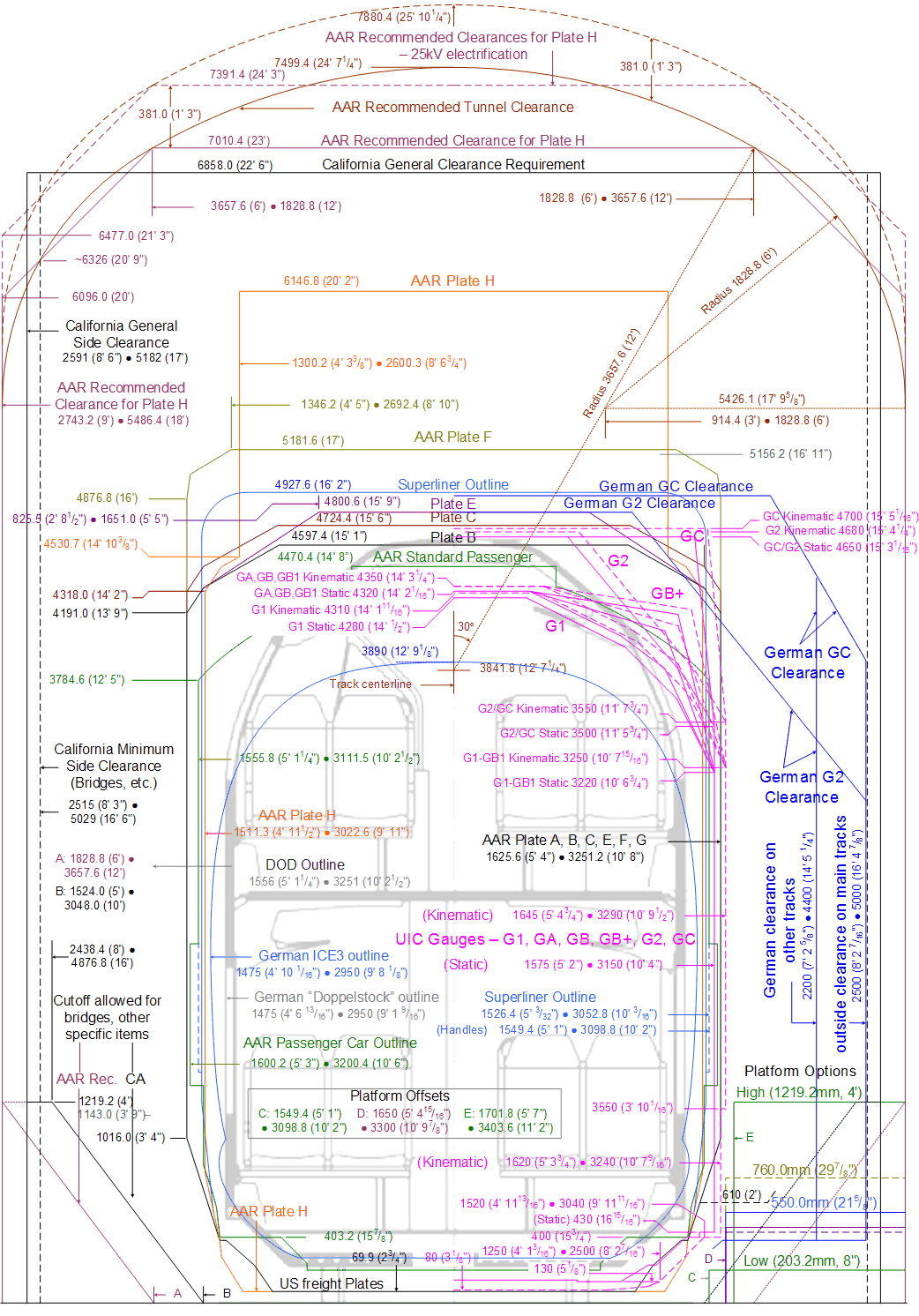
The side clearance dimensions around passenger rail platforms in California are regulated by the CPUC under General Order No. 26, originally issued in 1948, covering every relevant railroad situation from stock chutes to icing refrigerator cars. Where freight trains share tracks with passenger trains, as they do on the peninsula corridor, G.O. 26 limits passenger platforms to a height no more than 8 inches (203 mm) above the top of the rails (ATOR) to allow trainmen to ride on the side of freight cars without fear of getting clipped. Of course, none of these olde-tyme railroad practices are very relevant to 21st century rail technology.

Nevertheless, 8 inches is the maximum height of all existing Caltrain platforms. Taller platforms are allowed, but only beyond 7 feet 6 inches (2.3 m) from the track center line; in other words, taller platforms are only allowed if they do not come closer than about 3 feet from the side of a train. A lot of good that does for passengers! Combine G.O. 26 with ADA accessibility requirements, and you get a ghastly regulatory abortion called a "mini high platform" (see figure at right), to facilitate wheel chair boarding using a so-called "bridge plate" manually placed across the yawning moat between the high platform and the train. Mini-high platforms continue to sprout up and down the Caltrain line, most recently in Redwood City and Menlo Park, while elsewhere in the world, humans have discovered level boarding.

Of course, the regulatory rigors of accommodating freight trains are not anywhere on the CHSRA's radar screen, which is why they are planning for level boarding platforms regardless of where Caltrain eventually ends up--one can only hope, higher than eight inches. At stations to be served by both HSR and Caltrain, namely San Francisco, Millbrae, Redwood City or Palo Alto, and San Jose, it is quite possible that we will end up with different, incompatible platform heights with station tracks forever assigned to one or the other type of train. This runs counter to the most basic principles of interoperation, where the flexibility to assign any train to any platform (in a pinch) is paramount.

Moving beyond MOUs, who will bring about amended regulations to ensure that we have a common platform standard for HSR and Caltrain?

Who will make sure this standard allows the off-the-shelf procurement of new trains, without costly redesign? A hint: the most relevant platform heights are 22 inches (550 mm) and 30 inches (760 mm).

Why is Caltrain apparently not vigorously pursuing a waiver of G.O. 26?

High Voltage Electrification

Like platform clearances, overhead electrification of railroads is regulated by the CPUC. General Order 95 specifies the rules governing overhead electric line construction in California. Garden-variety 25 kilovolt overhead electrified railways do not exist in California, and G.O. 95 therefore does not allow them. That's right: 25 kV electrification is currently illegal in California. Caltrain has long-standing plans to electrify the peninsula corridor, and had been pursuing new regulations with the CPUC to cover 25 kV trains. More recently, the approach appears to have shifted towards obtaining a waiver from G.O. 95 instead.

Whatever happens, why is the heavy lifting for high speed rail being left to Caltrain? Moving beyond MOUs, where is the coordinated approach with HSR?

Safety and Train Control

Railroad safety in the United States is regulated by the FRA in a manner that places a premium on crash survival over crash avoidance. That's why we still have the 19th-century practice of train engineers calling signal aspects to their conductor (unless texting on their cell phone), with few if any automated systems to catch human errors. This safety philosophy is well-suited to the cost structure of the heavy freight rail business that dominates our landscape. On the opposite end of the spectrum, high speed rail safety relies almost entirely on avoiding a crash in the first place--not unlike airliners. In Europe, high speed trains zoom through dense fog at nearly 200 mph, with a train control computer watching over the driver's every move. Both philosophies achieve the intended level of safety, but what is supposed to happen when you need to mix both types of traffic on the same corridor, as is planned on the peninsula?

To their great credit, Caltrain is taking the national lead on the issue of mixed traffic regulations, as part of their plan to operate European-style passenger trains that are considered "non-compliant" with existing FRA safety regulations. As of September 2008, Caltrain staff estimated the likelihood of obtaining regulatory relief to be closing on 90 percent. That's very encouraging.

Caltrain's safety concept includes a radio-based positive train control system to be installed on the peninsula when the corridor is electrified, known internally as CBOSS (Communications-Based Overlay Signal System). This raises a host of questions, again moving beyond generic MOUs:

Why is Caltrain specifying CBOSS as a wireless system, excluding an entire segment of the wired train control market?

Is CBOSS an expensive re-invention of the wheel, where existing train control systems such as the Japanese Digital ATC and the European ETCS Level II might plug-and-play?

Why is Caltrain moving ahead with a solicitation this year, fueled by $500k in federal funds earmarked by congresswomen Jackie Speier and Anna Eshoo, for implementation in the next couple of years--before HSR train control requirements are fully defined?

Why should Caltrain be taking the lead on this critical technology issue, when the standard they develop will need to be applied California-wide to the entire HSR system and likely other HSR corridor traffic such as Metrolink, Union Pacific and BNSF?

Doing It Right

Sometimes, doing it right means stopping and charting a new course. One of the fundamental principles of good systems engineering is that you must develop a complete and concise set of design requirements before you dive into the detailed design of station platforms, overhead electrification or complex train control systems. Caltrain does not seem to have fully absorbed the extent to which HSR alters the requirements of nearly every improvement project in their pipeline. Preliminary design activity on all the above items should be slowed and resources re-allocated towards bringing the technical requirements and regulatory framework into better focus. The successful integration of HSR and Caltrain on the peninsula corridor depends on it!