Showing posts with label freight. Show all posts

11 May 2025

Fixing Santa Clara County

Today, Caltrain is hardly recognizable with regular and punctual half-hour service all day, every day, using swift and comfortable trains that are the envy of any North American regional rail system. This unequivocal success sets the agency on the best possible trajectory out of the pandemic doldrums. Unfortunately, that won't be enough.

Most of what is still wrong with Caltrain is concentrated in Santa Clara County, where the wrong priorities are hurting Caltrain's finances. Revenue comes from a good product: a passenger experience of fast, frequent, and regular service. Here's what should be fixed in Santa Clara County:

Frequency is freedom 

It is a well-established research finding that short and regular headways result in a faster-than-linear positive response in ridership and revenue. Unfortunately, Caltrain planners have decided that an end-to-end trip under the one-hour mark (known in the diesel era as the Baby Bullet) is worth sacrificing regular headways. Once an hour during the morning and evening peaks, a train will skip five stops to make this stunt possible: Santa Clara, Lawrence, San Antonio, California Avenue and Menlo Park, just across the county line. Fixing this error at a grand total of eight minutes of run time would unlock 15-minute clockface frequency throughout Silicon Valley, at zero added operational cost. The ridership induced by this tweak will dwarf the tiny number of long-distance riders who abandon Caltrain due to a longer trip, recalling that the average Caltrain ride is ~25 miles.

Re-imagine connecting shuttles 

With 15-minute peak service throughout Silicon Valley, connecting services can be reconfigured so they no longer need to reach "major" stops (known in the diesel era as Baby Bullet stops). Silicon Valley always was a continuous employment and housing blob, and "major" stops were an artifact of diesel service patterns where the tradeoff between frequency and trip duration was far more pronounced than it is with swift EMUs. To reach "major" stops, shuttles spend precious minutes stuck in gridlocked traffic sewers that run parallel to Caltrain, such as El Camino Real and Central Expressway. Ditching this gridlock not only speeds each connecting trip, but allows the same number of shuttle drivers and vehicles to be redeployed towards more frequent trips; both effects will generate Caltrain ridership. The vast fleets of luxury coaches that ply highway 101 can be viewed as an indictment of Caltrain's service pattern; major employers will respond if Caltrain upgrades to a compelling 15-minute product.

Ditch diesel

Operating and maintaining a separate diesel fleet to provide infrequent part-time service to the small towns south of San Jose generates less than one percent of weekday Caltrain ridership (see chart). This astonishing under-performance persists even after the addition of a fourth daily round-trip to Gilroy in late 2023.

While transit agencies aren't profit-seeking businesses and their purpose isn't always to maximize ridership, the Gilroy branch is one of those cases where the cost of providing the service is very far out of proportion with the public benefit. While Caltrain doesn't break out the cost of Gilroy service, the marginal cost of the fourth train is quoted as ~$3M, so we can extrapolate at least $12M plus the fixed operating and maintenance costs of separate tooling, training, parts, etc. associated with sustaining the diesel fleet. Caltrain would be better off spending this money on contracting with VTA for more frequent 568 rapid bus service. Between Gilroy and Blossom Hill, this south county bus is already much more frequent (~every half hour) and barely any slower (~8 minutes in peak traffic) than Caltrain.

Divesting of the remaining diesel fleet (9 locomotives and 41 cars) is a one-time source of income, but has some strings attached because the FTA funded its original purchase. Hanging on to diesels for "fleet resiliency" is becoming less critical as the electrified system demonstrates increasing reliability. The Trump administration is unlikely to care either way, and there are plenty of operators who might be interested, such as a potential new agency based in Monterey County.

Is this poking south county in the eye? No, because there's a much better plan. Read on.

Acquire UPRR's Coast Subdivision and electrify to Blossom Hill

As compensation for deleting service to Gilroy, Caltrain should extend electrification and frequent EMU service by six miles from Tamien to Blossom Hill. This portion of the corridor has high residential density to support significant new ridership if well-served, which it currently isn't. Caltrain likes to argue that a railroad has high fixed costs, and that cutting service can't save much money. The converse must also be true: adding more EMU service, using the existing fleet, can't cost all that much.

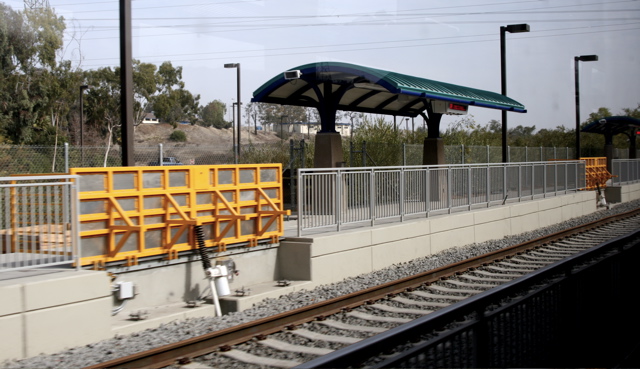
A stack train under the wires;
it's really no big deal.
(Samuel Walker photo)
 
Land owner Union Pacific is notoriously difficult to negotiate with, but there is no reason for Caltrain or VTA to fight alone. The state should get involved since this corridor forms part of the future high-speed rail system and is already slated for acquisition. Freight trackage rights would be preserved, and the tallest freight trains could operate under the wires as they already do elsewhere in the U.S. (see photo). Bridge clearances are already above 23 feet to clear Plate H at Almaden Expressway and Blossom Hill Road, and above 22 feet at Curtner Ave. and Capitol Expressway, nothing that would require expensive bridge reconstruction.

If this sounds like a megaproject, it isn't. It does not require any new traction power facilities; no new paralleling station is needed at Blossom Hill if this short extension is initially built as basic 25 kV without feeders. It does not require environmental clearance, thanks to new laws (Alex Lee's AB2503). It does not require any new trains, as Caltrain's EMU fleet will soon swell to 23 trains, where today's service pattern only requires 14. It's about as basic as electrification projects come: string up 15 track-miles of wire.

To get VTA interested in helping to fund this capital project, you would call it the "South County BART Connector." Since San Jose Diridon station would then require two tracks and a single island platform to support all Caltrain service, there could be savings in postponing the gold-plated Diridon Integrated Station Concept, a megaproject that costs $3-$6 billion while providing no identifiable service benefit for Caltrain passengers.

Failure of Imagination

With pandemic-era federal subsidies expiring and a new transit-hostile federal administration, Caltrain needs to show more creativity and imagination in adjusting its offering. The success of the initial electrified service shows that the best prescription for financial health is to focus relentlessly on the product: fast, frequent and regular service. Anything that doesn't contribute to the product is a distraction.

11 January 2017

UPRR Leaves, Sort Of

Caltrain and Union Pacific have recently agreed on the terms of a deal for UPRR ceasing to operate freight trains on the peninsula, between Santa Clara (CP Coast) to San Francisco. This is not the end of freight, however. The Deal Terms Sheet (2MB PDF) outlines the process by which a smaller "Short Line" operator would take over the rights and obligations to continue serving rail freight customers on the peninsula. It also unravels a laundry list of contentious issues that pitted UP and Caltrain against each other. In summary, there are three phases to the deal:

  1. The agreement recently entered into by Caltrain and Union Pacific, stipulating that:
    • UP will start looking for a new short line freight service provider.
    • Caltrain will ensure that short line locomotives with freight PTC can operate throughout CBOSS territory, a condition described as "unconstrained interoperability," a great pretext for more CBOSS program blowouts
    • Caltrain will ensure that Caltrain rolling stock can operate on UP's freight PTC equipped Gilroy branch, or cease operating on the Gilroy branch.
    • Caltrain agrees to never electrify UP's Main Track 1 from CP Coast (Santa Clara) through San Jose to CP Lick (south of Tamien), the land under which Caltrain owns.
    • UP agrees not to object to the CPUC safety requirements (1.4 MB PDF) formally adopted on 10 November 2016 for Caltrain's electrification project.
    • UP allows Caltrain's SSF station reconfiguration project to proceed, trading some old yard tracks and a loading dock for $2 million plus a new Caltrain-funded freight yard track at Newhall in Santa Clara.
    • UP settles some old claims by Caltrain for track maintenance.
       
  2. In the coming months, 
    • UP will select a Short Line and obtain Caltrain's approval.
    • Caltrain will sign a new trackage rights agreement with the short line.
    • Caltrain will sign a new trackage rights agreement with UP that replaces the current trackage rights agreement, concerning the "South Terminal Area" around San Jose.
    • The Surface Transportation Board will hopefully approve the whole deal, which is the entry criterion into phase 3.
       
  3. Upon STB approval,
    • Caltrain will own the "common carrier" obligations and be on the hook legally and financially for abandonment of freight service, should that ever be contemplated.
    • The Short Line will own the common carrier obligations on the sidings and lead tracks not owned by Caltrain.
    • UP will transfer to Caltrain the rights for intercity passenger service north of CP Coast in Santa Clara, but not south of there.
    • UP will agree not to pursue legal action against the electrification project.
This agreement could open a tiny sliver of hope for building grade separations that are both cheaper and more community-friendly without stubborn opposition from UP. On the other hand, it gives no hope for relief from freight PTC interoperability, justifying additional costs that have not already been sunk in the bottomless pit that is CBOSS.

05 November 2014

High Voltage Rulemaking Update

Caltrain mascot?
(photo by wwarby)

UPDATE 05 November 2014: HSR lawyers hang Caltrain out to dry by amending the scope of the rulemaking process explicitly to apply only to "25 kV electrification systems constructed in the State of California serving a high-speed rail passenger system capable of operating at speeds of 150 mph or higher, located in dedicated rights-of-way with no public highway-rail at-grade crossings and in which freight operations do not occur."  Could Caltrain possibly not have seen this coming?

ORIGINAL POST, 25 May 2014: Feathers are really starting to fly in the Public Utilities Commission proceeding to establish a regulatory framework for 25 kV railroad electrification in California, under CPUC docket number R1303009.  Electric utilities and freight railroads are putting up a big fight against the California High-Speed Rail Authority that threatens to leave Caltrain hanging out to dry.

With the impending electrification of the peninsula corridor clearly in mind, the freight railroads asserted in January comments that "it remains unclear if the proposed rules will be sufficient for high-speed train operation in shared rights-of-way” and that “[i]f the CHSRA does not amend its petition to clearly state the intended scope of the rulemaking, the Commission should order further workshops to ensure that the proposed rules are carefully vetted out for application in shared rights-of-way."

Freight railroads are concerned about a number of compatibility issues, including electromagnetic interference with their signaling systems and vertical clearance for their freight cars.  Electrification could impair vertical clearances especially under bridges.

The CHSRA's response, filed in late March, was crystal clear:
The purpose of these rules is to establish uniform safety requirements governing the design, construction, operation and maintenance of 25 kV ac (alternating current) Railroad Electrification Overhead Contact Systems (OCS) constructed in the State of California in right-of-ways dedicated solely to passenger use with no public highway-rail grade crossings and in which freight operations do not occur.

(...)

[The freight railroads] know that the proposed General Order is not ambiguous and that it will not apply to track where freight operations occur. Their continuing refusal to be satisfied on this point reveals a desire to delay and obstruct this proceeding.
The peninsula corridor, of course, meets none of these criteria.  It is not dedicated solely to passenger use.  It has numerous highway-rail grade crossings.  Freight operations occur daily.  The freight railroads are understandably worried about this issue of scope, given that the legislature has allocated more than a half-billion dollars of HSR funding to electrifying the peninsula corridor; Caltrain plans to complete the electrification project in just five years.

Where does that leave Caltrain?
  1. No regulatory framework exists for Caltrain's electrification project
  2. CHSRA is explicitly not planning to establish such a framework
  3. The freight railroads are vigorously opposed to the idea
  4. Time is running out
That leaves Caltrain with few options.

The Short Line Option

It has been suggested that the rulemaking process would be less contentious if a smaller "short-line" freight operator were to buy the trackage rights UPRR enjoys on the peninsula corridor.  Presumably, such a short-line operator would be less adversarial in the negotiation of a mutually agreeable regulatory framework and technical solution for electrification.

This scenario unfortunately fails to take into consideration the precedent-setting nature of placing 25 kV electrification over any track where freight operations occur, regardless of ownership.  The big freight railroads, UPRR and BNSF, will be no less interested in such a proceeding at the CPUC than if their own tracks were being electrified.

The Nuclear Option

Section 8.3.c of the trackage rights agreement with UPRR specifically allows for the wholesale abandonment of freight service on the peninsula, should Caltrain "demonstrate a reasonably certain need to commence construction on all or substantially all of the length of the Joint Facilities of a transportation system that is a significant change in the method of delivery of Commuter Service which would be incompatible with Freight Service."  While 25 kV electrification over freight trains doesn't seem to be such a big deal on the East Coast or the rest of the world, the freight railroads' arguments in the latest CPUC proceedings could be construed as a belief that 25 kV electrification is fundamentally incompatible with freight operations in California.  Do we really want to go there?

Whatever option is pursued, there is little doubt that the freight railroads will have a big hand in the outcome, and that lawyers and judges will be involved.  The freight railroads have clearly demonstrated that they have:
  • Intimate familiarity with the intricacies of the CPUC rulemaking process
  • Ready access to a deep bench of experts who can testify on any technical subject
  • An army of well-paid lawyers
Caltrain will bring a knife to a gunfight if they don't get their act together soon.

21 September 2011

Port Scores Pork

The Port of San Francisco recently received $3 million from the FRA to upgrade the 1-mile Quint Street lead track that connects the port to the peninsula rail corridor.  The government's press release states (with emphasis added) :
Port of San Francisco, California – Quint Street Yard Track and Signal Improvements – $2,970,000 to improve an approximately one mile-long spur connecting a Caltrain mainline track to the San Francisco Rail Yard. The mainline is under consideration for use as part of the California high-speed rail project, and the current condition of the spur track limits the frequency, weight and length of trains that can use the track, causing delays. The improvements will allow freight trains to operate at higher speeds and clear the mainline more quickly, significantly reducing delays to Caltrain commuter trains and future high-speed rail trains.
Meanwhile, back in the real world, Caltrain has been granted a waiver of compliance from certain FRA crashworthiness regulations that enables the operation of lightweight electric rolling stock from European manufacturers.  The same waiver would presumably be extended to any high-speed trains that might use the peninsula rail corridor.  The FRA's waiver decision letter states (with emphasis added) :
JPB additionally explains that the Caltrain 2025 program will temporally separate freight and passenger operations between San Francisco and Santa Clara, CA (Mileposts 0.2 to 44.6).  Temporal separation between these mileposts will be achieved by limiting freight movements to the exclusive freight period hours of midnight - 5 a.m.
That's right, temporal separation means that freight trains will not operate in the same hours as passenger trains, making the need to "clear the mainline more quickly, significantly reducing delays to Caltrain commuter trains and future high-speed rail trains" nothing more than a specious pretext.  Nice play for $3 million, nonetheless!

Temporal separation, by the way, is the best way to avoid the expenditure of millions upon millions of dollars to make Caltrain's positive train control system compatible with Union Pacific freight PTC (and thus, incompatible with the HSR train control system).

29 May 2010

The Great Platform Height Transition

The editorial position of this blog has always been that Caltrain and high-speed rail ought to be 100% interoperable, to derive the maximum transportation benefit from the considerable investment about to be made in the peninsula corridor. This creed can be summed up in a simple slogan: Any train, any track, any platform.

As was previously pointed out in the discussion of platform heights, it is most likely that high-speed rail will make use of high platforms. "Any train, any track, any platform" would require Caltrain to convert its own platforms to the same height as HSR. It's one thing to gripe about platform heights, but quite another to pull off the transition without interrupting commuter service. How can it possibly be done?

Here's an idea: (click to enlarge)

The end result would be a desirable center island platform for Caltrain. One could even build it such that the edge could be cut back to a gentle curvature after construction, resulting in the compact "football island" configuration when HSR is added.

Another useful feature of this concept is that it lends itself to phased construction of the four-track stretches where they are most needed. Commuter trains could use the extra track capacity years before HSR enters service, achieving a level of "independent utility" that the framers of AB 3034 might be proud of.

General Order 26-D

ADA regulations mandate level boarding for Caltrain's new electric trains. Since it is impractical to build a rail car with a floor just 8 inches above the rails, at the same height as the existing platforms, this mandate will require all platforms to be raised from their current height of 8 inches regardless of their final height, whether it be the same as HSR or something in between.

Platform edges higher than 8 inches are prohibited under the California Public Utilities Commission's General Order 26-D, which requires an ample clearance envelope to allow the outdated practice of "train men" riding on the side of freight trains.

There are only two ways around 26-D: compliance by way of a complex, failure-prone and maintenance-intensive technical solution that will saddle Caltrain with endless operating and maintenance costs in order to accommodate two freight trains per day, or... a waiver. Caltrain has now demonstrated its ability to navigate bureaucracies and obtain regulatory waivers; why not obtain permission to move one sign (pictured at right) south from San Francisco to Santa Clara?

08 May 2010

The Top 10 Reasons For Peninsula BART

The elephant in the room of Bay Area transit politics is BART, a system with nearly ten times the ridership of Caltrain. While it will be heresy to most Caltrain supporters, especially now that HSR has presented a once-in-a-generation opportunity for Caltrain to be modernized, let us play devil's advocate and consider the top ten reasons to build BART instead. (photo at right based on a shot by Storm Crypt)

10. Improve Return on Sunk Investment. BART extensions are famous for being extremely expensive. Improving ridership by providing a seamless, transfer-free transit experience would increase the return on $1.5 billion spent to extend BART to Millbrae, and $6 billion (and counting!) about to be spent to extend BART to Milpitas, and then to San Jose and Santa Clara. Peninsula BART would provide a bit more bang for all that buck.

9. Lower Crew Staffing Costs. BART has only a single operator per train. Each Caltrain has a minimum of crew of three, with many trains staffed with a crew of four. Staffing costs account for a large portion of Caltrain's operating costs, and help explain its current predicament. While BART labor is not known for its thrift, at least train crews would be right-sized.

8. Steve Heminger Would Like It. The MTC executive director commented on the commission's recent report that the Bay Area's 28 transit agencies have too much organizational redundancy and even corridor redundancy. Who knows, maybe that's why "BART to San Jose" will really go to Santa Clara, paralleling Caltrain for nearly 3 miles. Anyhow, without Caltrain we'd be down to 27 transit agencies, and schedules and fares would be integrated with BART all the way around the Bay.

7. Shut Down For Construction. The terms of the MOU between Caltrain and the CHSRA stipulate that the peninsula corridor must be upgraded without interruption to Caltrain service. That results in amazingly complex, long and expensive nine-stage construction sequences such as depicted in the Alternatives Analysis, Appendix C, pages 41-43. Has anyone compared the cost and benefits of keeping Caltrain operating during construction? If the corridor is shut down, it can be rebuilt more quickly and cheaply, and the conversion to BART becomes straightforward. As an added bonus, there would be no need for temporary "shoofly" track detours around construction sites, reducing the need for eminent domain to acquire temporary construction easements.

6. Eliminate Those Pesky Freight Trains. Paragraph 8.3.(c) of the trackage rights agreement with UPRR allows for abandonment of freight service "In the event that [JPB] demonstrates a reasonably certain need to commence construction on all or substantially all the length of the Joint Facilities (...) of a transportation system that is a significant change in the method of delivery of Commuter Service which would be incompatible with Freight Service on the Joint Facilities". That is c-o-d-e for B-A-R-T. With heavy freight out of the picture, several community impacts are potentially reduced:
(a) Grade separations can be built with steep 3% grades, instead of the so-called "requirement" of 1% now being used for design. This results in grade separation structures that are shorter, more compact and slender-looking than the massive concrete required to carry massive freight trains.

(b) Commuter tracks no longer require overhead electrification, with a contact wire 21 feet above the rails to clear very tall freight cars. HSR requires just 17 feet of clearance, and BART uses visually unobtrusive third-rail.

(c) No more horns in the middle of the night, and a 100% guarantee that every last grade crossing will be eliminated, since BART, like HSR, requires total grade separation.
The only downside would be about 400 additional five-axle trucks using highway 101 every day, representing a ~40% increase in five-axle truck traffic, an ~8% increase in all truck traffic, and less than a half of a percent increase in total vehicle traffic. (See Caltrans 2008 truck traffic count for highway 101.)

Those worried about greenhouse gas emissions should note that over 50 years, 400 daily peninsula truck round-trips will add about 10,000 tonnes of CO2 to the atmosphere. Those emissions are the same as the emissions from pouring a cube of concrete just 50 feet on a side... which you can well envision would be less concrete than required to build those extra long and extra heavy freight-compatible grade separations in the first place. Bottom line: by accounting for the GHG emissions from additional concrete, it is likely that switching peninsula freight from rail to road would actually reduce overall GHG emissions.

5. Easier Tunnel Construction. With diesel trains and their toxic exhaust permanently banished from the peninsula rail corridor, an expanded selection of tunnel construction options would become available. BART itself requires a much smaller tunnel gauge, thanks to its lower speed (80 mph), low-slung third-rail electrification, and the compact loading gauge chosen to facilitate construction of the Transbay Tube. A two-track cut-and-cover tunnel (subway box) has a cross section of about 40 x 20 feet for BART, versus 60 x 35 feet, nearly triple, for Caltrain / freight.

4. Small Marginal Investment. BART is a nose-bleed expensive solution, often decried for its enormous opportunity cost. The uninformed often attribute the high cost of building BART to its non-conventional 5'6" track gauge, but gauge has very little to do with it. A significant portion of the cost of BART goes into building grade separation structures (overpasses, underpasses, viaducts, tunnels) to separate trains from auto, bicycle and pedestrian traffic. With HSR on the peninsula, 100% grade separation is already in the cards, making the marginal cost of BART much less than the usual quarter billion dollars per mile.

3. No New SF Tunnels, Plenty of Transbay Capacity. The HSR project as currently planned includes four tracks all the way into downtown San Francisco, which requires the construction of four new tunnels alongside the existing two-track Caltrain tunnels (known by the rather creative designation Tunnel 1 through Tunnel 4). Someone is bound to point out that such an enormous expense, likely several billion dollars, could be entirely avoided by tying the peninsula corridor into BART at Millbrae. The historic Bayshore Cutoff, which accounts for less than 5% of Caltrain's ridership, would become available for exclusive HSR use. San Bruno and South San Francisco already have BART stations, and Bayshore and 22nd Street are served by MUNI's 3rd street line. With Caltrain gone, HSR even gets 50% more platform space at the Transbay Transit Center.

As an added bonus down south, there would be no need for an elevated HSR station at San Jose's Diridon Station, since the existing space at ground level could be converted from Caltrain to HSR use, leaving one or two tracks for UPRR, ACE and what little Amtrak service might still remain. Peninsula commuters would use the downtown San Jose BART stations instead.

2. The Strength Of An Idea. BART was always meant to expand south, and all recent extensions have been planned or built with tail tracks that are ready-made for further expansion into Caltrain's peninsula corridor. No matter what the cost, BART advocates regard the Millbrae to Santa Clara link as the final link in their manifest destiny to ring the bay. The general public falls easily for this idea--One Ring To Rule Them All. When people think of modern, fast rail service, they think of BART because that's what they've been exposed to. Never mind whether it makes any sense: it just sounds like such an obvious idea, and with Caltrain going out of business, what better time to do it than now?

1. I'm a PC and you're a Mac. While the Peninsula Rail Program professes the virtues of a corridor shared between Caltrain and HSR, the devil is in the details. A huge array of conflicting stakeholders, arcane regulations, and differing technical requirements are inexorably leading the project down a path of incompatibility:
Rather than a shared corridor, what is emerging here is a typical PC and Mac situation: two systems that do basically the same thing in fundamentally incompatible ways. With a PC train and a Mac train, any synergy or flexibility or efficiency that might be gained through shared operations (any train, any track, any platform) is forever lost. So, why even bother? BART's broad gauge could hardly make the situation any worse.

Supposing the Peninsula Rail Program wanted to do better than peninsula BART, it would pursue total operational integration of Caltrain and high-speed rail, the whole point of this blog. Any train, any track, any platform. Failing that, they are handing BART the perfect excuse to step in once shovels are in the ground for grade separations. Count on it.

To be clear, this post is NOT an endorsement of BART on the peninsula--far from it. Rebuilt properly, the peninsula rail corridor has the potential to become a model of efficient and flexible transportation, with capacity and speed that BART could never touch, that would make the Swiss, Japanese and Germans nod with approval. But that will require a little bit more vision than is currently being demonstrated.

16 April 2010

Alternatives Analysis Analysis, Part 1

This post is the first in an open-ended series, picking through the recently-released preliminary alternatives analysis. The AA is a voluminous document with plenty of material to be dissected over the next several months, in no particular order.

The Station Access Fallacy

Section 4.1.2 of the Alternatives Analysis discusses track and station arrangement options. In particular, it is pointed out that a key consideration in providing good station access for Caltrain passengers is to consider that the majority of Caltrain stations, and the majority of Caltrain ridership, is on the west side of the tracks. That sounds pretty good in theory... but in practice, consider the following:
  • The rail corridor must be 100% grade-separated, with no crossings, so passengers may only cross the tracks via pedestrian underpasses or overpasses, never at grade.
  • To access an island platform, or the platform on the "far" side of the tracks for at least one direction of a passenger's daily commute, every passenger will use underpasses or overpasses at least twice daily regardless of station configuration, and regardless of which side of the tracks they might live or work.
  • Putting Caltrain on the west side of the corridor, rather than in the middle, might save each passenger a grand total of 30 feet of walking distance, far shorter than the stairs or ramps to the platform or the walk to the doors of an 85-foot rail car.
  • It takes seven seconds to walk an extra 30 feet. Some hike!
In a 100% grade-separated corridor, it is given that station access will be limited to a handful of access points somewhere along the 800-foot length of a Caltrain platform. As long as those are well-planned (e.g. Belmont), that's perfectly acceptable. The station access "advantage" of putting Caltrain on the west side of the corridor is insignificant.

The One Percent Rule

In the AA profile plans of Appendix B, page 3, a design criterion is established: the maximum grade for Caltrain (shared use) tracks with diesel-powered freight trains is 1.0 %. The community impacts of this gentle grade, required exclusively for freight trains, were previously discussed. And yet, Caltrain's own engineering standards state that "maximum design gradient (...) for grades up to two (2)% may be implemented with the approval of the Caltrain Deputy Director of Engineering. (...) Grades exceeding one (1)% shall be limited to tangent length less than 1200 feet." Why is a more stringent standard now being applied? Certainly not for high-speed rail or Caltrain, both of which will easily handle 3% grades.

The results of this conservatism are already apparent. For example, the proposed elevated alignment through downtown San Mateo would require lowering 1st, 2nd, 3rd, 4th, 5th and 9th avenues, with extreme community impact, because (a) the grade is 0.8%, even less than the specification, and (b) there is a requirement to return to grade level before the curve into Hayward Park to avoid having a vertical curve in a horizontal spiral, a track geometry complication exceptionally allowed for (see TM 2.1.2 paragraph 6.1.7) in the CHSRA's own track design guidelines. Let's face it: the age of picks and shovels is over; in the 21st century, computers, lasers and differential GPS should make the construction and maintenance of overlapping vertical and horizontal curves a breeze, without having to demolish half of downtown San Mateo.

With things already tight as they are, the time for making judicious and appropriate design exceptions is now. Using overly-generous specifications will unnecessarily constrict the design space, inflame community opposition, and drive costs through the roof.

19 March 2010

Roller Coaster Physics

Roller coaster rides, and avoiding them on the peninsula rail corridor, is a recurrent concern that recently came up in a discussion of tunnels. Millbrae councilwoman Gina Papan claimed that an underground station in Millbrae would cinch a tunnel through Burlingame because "you can't have a roller coaster from Millbrae to Burlingame."

Let's bust this myth with a quick look at the physics and specifications of HSR track alignment.

Discomfort arises when there is a curve in the tracks, because passengers conform to Newton's first law: they tend to keep going straight. The centripetal force imparted by the train causes them to follow the curve, and sometimes to spill their drink. In horizontal curves (left or right), engineers can use superelevation, a simple trick that harnesses gravity to provide the centripetal force and smooth the ride. Vertical curves (up and down) are a different matter: passengers must bear the full brunt of the centripetal force.

The centripetal force is perceived as a vertical acceleration, such as you might feel when riding an elevator, and goes as velocity squared divided by radius.

The recently published HSR design standards (specifically, TM 2.1.2 section 6.1.6.2 and TM 1.1.6 section 6.1.7, which trace to the AREMA manual, Chapter 5, Part 3.6) describe the design limits placed on vertical acceleration: typically just 2 to 3 percent of gravity, obviously much less than would ever be experienced on a roller coaster. Given this acceleration limit and the planned operating speed of 200 km/h (125 mph), the references above contain the following constraints:


ParameterDesiredLimitExceptional
Passenger-Only 125 mph Vertical Curve Length*
840 ft
650 ft
420 ft
Freight 75 mph Vertical Curve Length* (sag)
2000 ft
1200 ft
1200 ft
Freight 75 mph Vertical Curve Length* (crest)
1500 ft
1200 ft
1200 ft
Passenger-Only Maximum Grade
1.0 %
1.7 %
3.0 %
Freight Maximum Grade
1.0 %
1.0 %
2.0 %

* per percent of grade change

What do these mean? To find out, it's helpful to look at a picture of what a vertical track profile looks like when you need to transition from one elevation (or depth) to another. The figure at right shows the basic anatomy of a vertical transition. Passenger discomfort (if any) occurs only in the curved portions at the beginning and end of the transition; the straight ramp in between is not perceived as having any less comfort than flat and straight track. Simply lengthening this ramp will increase the overall height of the transition. Assembling the above specifications into actual ramp lengths, we can calculate a useful metric: the total length of a vertical transition, depending on how much rise is required.


Transition RiseTrain TypeDesiredLimitExceptional
15 ft (Ground Level to Elevated)Passenger Only2340 ft
2140 ft
1830 ft
Passenger + Freight2830 ft
2600 ft
2600 ft
30 ft (Trench to Ground Level)Passenger Only3840 ft
3300 ft
2750 ft
Passenger + Freight4730 ft
4200 ft
4170 ft
45 ft (Trench to Elevated)Passenger Only5340 ft
4200 ft
3470 ft
Passenger + Freight6250 ft
5700 ft


5370 ft

90 ft (Tunnel to Ground Level)Passenger Only9840 ft

6850 ft
5100 ft
Passenger + Freight10750 ft
10200 ft
8100 ft
105 ft (Tunnel to Elevated)Passenger Only11340 ft
7740 ft
5600 ft
Passenger + Freight12250 ft
11700 ft
8850 ft


Keep in mind that even the "exceptional" values would not be anywhere close to a roller coaster ride: the acceleration would be only about 4% of gravity. Roller coasters routinely exceed 100% of gravity.

What immediately jumps out from the table is that the trickle of peninsula freight trains make these transitions much longer and potentially much more community-disruptive than passenger-only infrastructure.

As for Gina Papan's notion of Burlingame getting a tunnel as a consequence of a hypothetical underground Millbrae HSR station: it would take less than a mile for tracks to rise up to an elevated structure that clears Broadway in Burlingame, with the utmost passenger comfort.

Myth Busted.

26 November 2009

Electrification Blues

While overhead electrification using 25,000 volts AC is a widespread technology that is even found in several states in the Northeast, it has never been used in California and the relevant regulations either do not exist or do not allow for it. Caltrain finds itself in the unenviable position of blazing a new regulatory trail, with little success to show thus far.

Regulatory Wild Ride

In 2007, Caltrain filed an application with the California Public Utilities Commission to have a new General Order established for 25 kV overhead railroad electrification. This application was backed by a draft standard and a series of workshops, and attracted participation from electric utilities and freight railroads. Caltrain later realized that the duration for establishing a new GO and only then applying under it for permission to build the project would not meet their schedule for completion by 2014. Despite an FRA reviewer stating that the draft standard was "96% of the way to the finish line," Caltrain withdrew its application, scrapped the draft GO, and decided instead to file for a waiver of existing rules on a project-specific basis.

In June 2009, Caltrain filed a new application requesting authority for variances from portions of CPUC General Order 95, which governs overhead electric line construction in California. This application was shared among interested parties including the Union Pacific Railroad and its key customers on the peninsula.

UPRR protested the application. Its protest brief listed the following issues:
  1. Caltrain's proposed variances do not meet industry engineering standards. Among other items, UPRR states: "The issue of clearances is critical. Clearances determine, in part, the types of railcars that can be operated on a track and the types of loads that a car may carry."

  2. Caltrain's proposed variances conflict with UPRR's legal rights and obligations as a common carrier freight railroad. UPRR contends that constraints on the types and loads of railcars would constitute a forced abandonment or partial abandonment of UPRR's peninsula operations, which requires approval from the federal Surface Transportation Board--and not the CPUC.

  3. Caltrain's proposed variance would conflict with the trackage rights agreement established when the peninsula corridor was sold, especially the clauses concerning abandonment of freight service.
Caltrain folded immediately and withdrew its application, stating sheepishly:
Caltrain has learned that certain interested parties had more serious concerns with the Application than were anticipated. Rather than undertake discussion with such parties under the scheduling constraints of a Commission proceeding, Caltrain prefers to resolve these concerns separately and resubmit the Application at a later date.
In its protest, UPRR suggested the following timetable to resolve the issue:
  • 1 September 2009 - Prehearing conference
  • 14 October 2009 - Workshop re: engineering issues
  • 9 December 2009 - Further prehearing conference
  • 4 May 2010 - Hearing
  • 15 July 2010 - Final decision
What this reveals, if nothing else, is that UPRR will vigorously defend its rights on the peninsula corridor, even without prodding from local residents who oppose HSR. This does not bode well for other regulatory changes that will be required, in particular a waiver of GO-26D to allow level boarding at station platforms--another move that is sure to attract a protest from UPRR.

Vertical Clearance Issues

The basic issue that underlies all this legal maneuvering is one of clearance dimensions, especially vertical clearances, where high-voltage overhead electrification infrastructure (contact wire, supports, etc.) might interfere with the operation of excess-height freight cars.
  • UPRR and its customers (especially the Port of San Francisco) want the unimpeded future ability to operate so-called excess-height freight cars, such as autoracks and double-stack container cars, none of which currently operate on the peninsula north of Santa Clara.
  • Such excess-height freight cars are up to 20'3" tall measured ATOR (above top of rail), with a recommended clearance of 23 ft ATOR for any obstacles such as bridges and tunnels.
  • Caltrain's plans to electrify the peninsula showed the 25 kV contact wire at a typical vertical height of 23 ft (7.0 m) ATOR, in compliance with these recommendations.
  • High-voltage wires require additional stand-off clearances (about 1 foot) to prevent arcing to trains or bridges, i.e. short circuits.
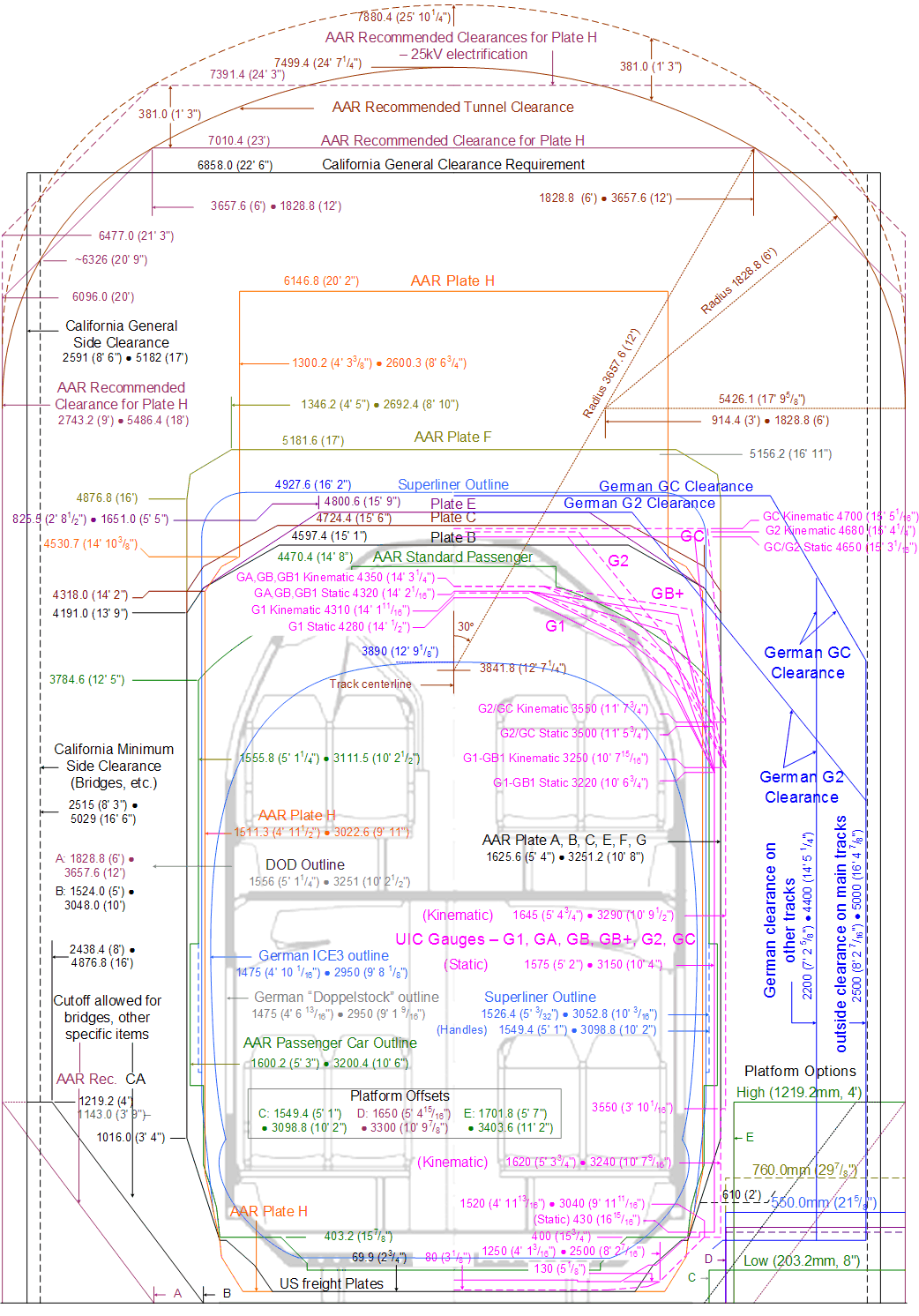
  • The peninsula corridor has numerous bridges with clearances at or less than 23 ft ATOR (see graphic at right), where the overhead wire would get closer to the top of freight cars than the recommended clearance.
  • Caltrain has proposed de-energizing the overhead electrification at night when freight trains operate. This might allow the wire to get down to about 21 ft ATOR (shown as a black dotted line in the graphic.)
  • Electrification support infrastructure underneath bridges can take up several feet vertical clearance, especially when configured for high speeds (125 mph) where a single trolley wire is insufficient.
  • Increasing vertical clearances under existing bridges and tunnels by undercutting the rail bed is often complicated by utility lines, culverts or creeks that pass under the tracks.
Clearly, excess-height freight cars will considerably complicate if not preclude electrification, and something will have to give.

The simplest solution, one that is in the best interest of the people footing the electrification / HSR bill (yes, that's you), is for Caltrain to file an application with the STB for a partial abandonment of freight service, resulting in a permanent restriction to AAR Plate F clearances (freight cars 17 ft ATOR, with overhead wire at 20 ft as shown by the green dotted line in the graphic above). This would not impede any of the current freight operations on the peninsula, and would facilitate the construction of trenches for certain grade separations in sensitive residential areas.

A Clash of Titans

Ultimately, Caltrain's role in this situation is secondary. The players who hold the cards are the UPRR, the California High Speed Rail Authority, and the Federal Railroad Administration. It is unclear if these players have any interest in the simple solution. Will they think about who should pay for this? Freight is and always will be a minority rail user on the peninsula, and it's hard to think of a reason why taxpayers should spend millions of dollars to buy UPRR and its customers complicated and maintenance-intensive solutions like movable overhead conductor rails or gauntlet tracks, especially when excess-height freight cars already have ample access to key regional facilities like the Port of Oakland.

We've already seen what gold plating for freight can do: expensive infrastructure is built on the taxpayer's dime for some hypothetical future need, and then languishes unused. Exhibit A is the Kelly Moore freight spur in San Carlos, which has yet to see its first freight car.

09 August 2009

The Effect Of Heavy Freight

Heavy freight trains operate nightly on the Caltrain corridor. "Heavy freight" is characterized by very high axle loads (up to 30,000 kg or 65,000 lb) and very high mass per unit length (up to 7,500 kg/m or 5,000 lb/ft). Today, they are not much of a nuisance and few people notice them, but what will happen when the high speed rail project is built on the peninsula? HSR will bring a lot of changes, but some of them will be attributable to freight more than high speed rail. This is an attempt to tease out the specific community impacts of heavy freight trains.

The Caltrain corridor has more than 40 grade crossings, every one of which will be eliminated. Grade crossings can be eliminated either by closing them permanently, or by building a grade separation overpass or underpass, similar to the many grade separations that already dot the corridor. Usually, the easiest way to build a grade separation is to keep the railroad tracks at ground level and detour the road over or under the tracks. In some cases, though, detouring the road is not practical because of nearby residential or business frontage, or major roads and intersections.

Those situations are where the railroad tracks must be elevated above or sunk below ground level. Those situations are causing quite a controversy in the communities along the Caltrain corridor, because the HSR project's preference is for cheaper elevated structures.

Getting Trains to Climb

You might think that 125 mph (200 km/h) passenger trains would need very gentle grades and a vertical track profile that is as flat as possible--but you'd be wrong! What determines train safety and comfort is vertical curve radius (at that speed, a minimum of 6 miles or 10 km), and not the steepness of the grade. Powerful high speed passenger trains and modern EMU commuter trains planned by Caltrain can easily climb grades that are very steep by railroad standards, like a whopping 3% (i.e. 3 feet up for every 100 feet along the track). It's the heavy freight trains that have difficulty with those grades, because freight locomotives will start spinning their wheels if they attempt to drag a massive train up such a steep incline. That's why heavy freight trains are typically limited to grades of about 1% (i.e. 1 foot up for every 100 feet along the track). Grades any steeper than that require additional locomotives, shorter trains, and cost more to operate.

Grade Separation: Rail Overpass

When a grade separation is built over a road that cannot be lowered, the railroad tracks must be raised about 20 feet above the level of the road. That includes the clearance for road vehicles, plus the thickness of the bridge deck, plus the height of the rails, as shown in the diagram at right. (Trains go on the top, cars and trucks on the bottom.)

To get the rails up to that height, long sloping approaches are needed on either side of the crossing, forming an elongated hump. If you were to stand close enough to such a hump structure, you would see a retaining wall.

What will heavy freight trains do to the design of a typical grade separation rail overpass? They make the approach ramps much longer and greatly increase the area of the retaining wall that neighbors would have in their back yard, as shown in the figure at left, with the vertical scale greatly exaggerated. Walls block sight lines, are themselves ugly to look at, reduce property values, and can attract graffiti and neighborhood blight.

Compare and contrast a typical 1% rail overpass with a 2.5% rail overpass:


Parameter1% Grade2.5% GradeFreight Effect
Minimum Vertical Radius10 km (6 mi)10 km (6 mi)0% tighter
Height6.1 m (20 ft)6.1 m (20 ft)0% higher
Length of Wall > .3 m (1 ft) High1250 m (4100 ft)870 m (2800 ft)44% longer
Length of Wall > 2.4 m (8 ft) High840 m (2750 ft)550 m (1800 ft)53% longer
Wall Area4200 m2 (45,000 sq ft)3000 m2 (32,000 sq ft)40% larger
Fill Volume (75 ft Width)125,000 cubic yards

(12,500 truckloads)
90,000 cubic yards (9,000 truckloads)40% larger


Exact values may vary, but the relative percentages will be very close. Smaller walls mean lessened community impact, but heavy freight trains make the walls significantly bigger.

Grade Separation: Rail Underpasses

The other possible option is to sink the rails under the road. When a grade separation is built under a road that cannot be raised, the railroad tracks must be sunk over 30 feet below the level of the road. That includes clearance for trains, high voltage overhead electrification, and the bridge deck. The resulting trench must be dug even deeper than rail level to account for the foundation of the structure.

Once again, to get the rails down into a trench, long sloping approaches are needed on either side of the crossing, forming an elongated sagging profile. Adding a twist, heavy freight trains can be up to three feet taller than regular trains, which requires digging the trench three feet deeper than would otherwise be needed, as shown in the figure at left. On a structure that's 75 feet wide and well over a mile long, that adds up to a lot of extra dirt to remove.

Compare and contrast a typical 1% rail trench underpass with a 2.5% trench underpass:


Parameter1% Grade2.5% GradeFreight Effect
Minimum Vertical Radius10 km (6 mi)10 km (6 mi)0% tighter
Depth of Trench
9.8 m (32 ft)8.8 m (29 ft)10% deeper
Length of Trench > .3 m (1 ft) Deep1850 m (6100 ft)1000 m (3400 ft)80% longer
Trench Wall Area9300 m2 (100,000 sq ft)4600 m2 (50,000 sq ft)100% larger
Excavated Volume (75 ft Width)280,000 cubic yards

(28,000 truckloads)
140,000 cubic yards (14,000 truckloads)100% larger


Exact values may vary, but the relative percentages will again be very close.

Heavy freight trains double the amount of excavation needed for a railroad trench underpass. That may be fine with neighbors because the trains would stay even more out of sight, but since a trench is more expensive, an elevated solution will be preferred. That's right: where a wall might not have been required, heavy freight trains could tilt the balance in favor of an elevated wall. The Churchill Avenue crossing in Palo Alto is a great example where this trade-off may occur to the detriment of the neighborhood.

Rise and Fall

Heavy and long freight trains perform poorly on a track profile that rises and falls across each road crossing like a roller-coaster. Such undulating profiles complicate train handling and can cause hazardous slack action. That's why the grade separations in Belmont and San Carlos are built on a continuous elevated embankment that stretches for several miles, simplifying the handling of trains using the primitive manually operated air brake.

In contrast, modern, powerful electric passenger trains with advanced automatic train control systems can glide over these ups and downs without causing their passengers any discomfort. In the manner of an airplane's autopilot, the train's control software automatically adjusts throttle and braking in concert with the vertical profile of the track, which is stored in an on-board database. This capability allows considerably more rise and fall in the vertical profile, which minimizes the extent of elevated structures and thus lessens impact on communities.

Heavy freight trains tolerate very little rise and fall and will increase the impact of elevated grade separations because the stretches between grade separations may stay elevated.

Bridge Columns

On sections of track elevated over roads, or open viaducts to allow community access to both sides of the tracks, trains run on what is effectively a bridge. Bridge design depends on the load that will be carried. A good proxy for this load is the linear mass density of the heaviest train, or how much the train weighs per unit of length.


ParameterHeavy FreightPassengerFreight Effect
Linear Mass Density7,500 kg/m (5,000 lb/ft)2,500 kg/m (1,700 lb/ft)200% heavier
Load On a 15 m (50 ft) Span113,000 kg (250,000 lb)38,000 kg (85,000 lb)200% heavier


While these values are approximate and do vary quite a bit, heavy freight trains can be two to four times as heavy as a passenger train! Throw in the usual factors of safety, and you don't have to be a civil engineer to guess what that does to a bridge design:
  • Bigger and/or more concrete columns
  • Shorter spans with columns spaced closer together
  • Thicker bridge decks
  • Costlier construction
These are not characteristics that you might call neighborhood-friendly. Heavy freight trains will make the design of graceful elevated structures nearly impossible. (For a representative attempt, visit San Carlos.)

Track Maintenance

The interaction of wheel and rail is an arcane subject that mixes black art with cutting-edge research. It is the stuff of academic journals, so we won't venture out of our depth here. Wheel and rail profiles are typically engineered as a system, in order to achieve a balance of cost, wear, fatigue, and noise characteristics. In a nutshell, as quoted from a journal article, "Lines that handle high-speed passenger trains during the day and freight traffic at night represent the most challenging conditions under which to properly maintain rail and track."

Loaded to 30,000 kg per axle (65,000 lb), freight cars can operate with wheel flat spots that measure up to 2 inches in length. The resulting thump-thump-thump is not only loud, but it wreaks havoc on tracks that are carefully aligned for passenger trains.

On the peninsula, passenger trains will always outnumber freight trains, and by a vast margin. Is heavy freight worth the extra track maintenance cost, likely to be borne by the taxpayer? Is it worth the additional noise, especially if so much more track will be elevated?

A Foreign Idea: Light Freight

While it may initially read like it, the foregoing is not a manifesto against freight. Rail is an environmentally friendly way to move freight on the peninsula, and removes trucks from highway 101. The problem isn't freight per se, but heavy freight. It is possible to operate freight trains with much lighter loads and more compact loading profiles. In other countries, such trains are routinely and safely mixed in with high speed passenger train traffic. American manufacturers like GM and GE export hundreds of light freight locomotives to those countries, so it isn't like this would require any development effort. You can pick up the phone today and order yourself a JT42CWRM (photo at right by CargoFighter), made right here in the U.S.A., and hook it up with freight cars that maybe aren't loaded quite all the way to the brim to keep the weight down. This would be more expensive to operate, but may be worth the enormous savings in capital cost (big structures, more concrete), and especially--most importantly--improved urban design and quality of life in the communities along the Caltrain corridor.

There are many ideas about how high speed rail on the peninsula should be "Done Right". For the reasons enumerated above, doing it right means heavy freight should be banished from the peninsula. The benefits are probably not worth the additional cost to communities. Such a ban would probably enjoy little support from the Union Pacific Railroad, Caltrain, and even the California High Speed Rail Authority and its coterie of engineering consultants, whose U.S.-centric cultural inertia may exceed that of even the heaviest freight train. Are they capable of thinking outside the boxcar?

05 July 2009

Focus on: San Mateo

The city of San Mateo was incorporated in 1894, 30 years after the railroad began operating. Along the 4.5 miles of rail through the city, there are today three Caltrain stations, two of which (Hillsdale and San Mateo) are Baby Bullet stops. The three stations in San Mateo generate greater combined Caltrain ridership than San Jose, a city with ten times San Mateo's population.

San Mateo is among the most treacherous areas on the peninsula to expand to four tracks for high speed rail because the existing Caltrain tracks run through dense residential neighborhoods and downtown blocks where the available right of way width is significantly less than 100 feet. The city is a "ground zero" of future grade separations: it is home to one-fifth of the grade crossings on the entire peninsula rail corridor (9 out of 46). To improve safety and traffic circulation, the city has long had plans to grade-separate all of its rail crossings; high speed rail will only hasten this process. The San Mateo County Transportation Authority has been carrying out a series of preliminary grade separation footprint studies in support of these plans.

San Mateo finalized a Rail Corridor Transit-Oriented Development Plan in April 2008, covering the vicinity of the Hillsdale and Hayward Park Caltrain stations and including the re-development of the Bay Meadows racetrack site.

Station Area and Downtown

The San Mateo Caltrain station was rebuilt in 1999-2000 to alleviate auto traffic congestion. The new $11 million station with underground parking (photo above by ibison4) replaced a sparse older station a few blocks to the south. Every time a train stopped at the old station's center boarding platform between 3rd and 4th Avenues, auto traffic on 2nd through 5th Avenues was paralyzed, exacerbating rush hour congestion.

With some foresight, albeit a bit fuzzy, the new station's underground garage and surrounding structures were reportedly built so as to allow the tracks to be relocated underground. This would not only grade-separate the tracks through town, but also accommodate a future BART subway, as was envisioned in the late 1990s while construction of the SFO extension was underway.

Plans change.

The problem is now this: the new station building and underground parking encroach on the railroad right of way and do not leave the necessary clearance for four tracks, as likely required for Caltrain and HSR, whether at, above, or below grade. Worse, a couple of blocks south of the station, San Mateo's new downtown cinema and Main Street parking garage were completed in 2003 and encroach on what was once railroad right of way, leaving just 50 - 60 feet for the tracks (see Caltrain right of way map).

There will be no easy or cheap solutions to these constraints. In discussions about a preliminary grade separation footprint study for downtown, city staff makes the following key observations:
  • The vertical alignment of all the downtown rail crossings must be consistent, since their close spacing does not allow sufficient space for rail grade changes;
  • Any grade separation alternatives with the tracks at grade or near grade is infeasible because of the need to lower or raise downtown streets in a manner that severely impacts frontage on both sides of these streets;
  • The two remaining vertical alignment alternatives leave the streets at grade, with the rails either fully elevated or underground--the latter being the city's stated preference;
  • The right of way required to build a four-track underground trench is 110 feet wide, far more than the 50 - 60 ft available;
  • Moving the horizontal alignment of the tracks to the east (with impact to Railroad Ave and frontage) is preferable to impacting the new train station, Main Street parking garage and downtown cinema;
  • The underground alignment presents significant technical complications, with residential property impacts just north of downtown where the tracks would ramp down, possible street closures, as well as the technical difficulty of crossing San Mateo Creek underground.
While no decisions have yet been made, and despite the city's stated preference for a depressed alignment, the elevated alignment may present the least physical impact to property adjoining the tracks, although the visual impacts are worst. The city is considering options to mitigate the Berlin Wall effect, including building the track on a viaduct instead of retained fill. Contrary to San Mateo's official preference, the California High Speed Rail Authority shows an elevated track profile with 15-foot embankments through San Mateo in their program EIR/EIS; this may or may not be the preferred alternative once they complete the project EIR/EIS.

The issue of track alignment through downtown San Mateo is discussed in much greater detail in Threading the San Mateo Narrows. That discussion includes diagrams showing various track configuration options such as the elevated shown below.
For more details, read all about Threading the San Mateo Narrows.

North Central San Mateo

North of downtown, the tracks curve through dense residential blocks on right of way that ranges from 60 to 90 feet wide, less than the ~75 feet required to run four tracks on a retained embankment, and certainly less than the ~110 feet required to excavate a trench or tunnel. The tracks cross four residential streets (Poplar, Santa Inez, Monte Diablo and Tilton avenues) on low-clearance bridges that have long been slated for refurbishment.

The key question for downtown and the North Central neighborhood will concern the vertical alignment of the tracks. The close proximity of these residential blocks to downtown, combined with the gentle track gradients required for freight trains (yes, freight trains), will require that these areas be considered as one.

Vertical Alignment Considerations

The vertical profile of the existing tracks in San Mateo is shown in the figure below. This figure was created from Caltrain track survey data, with the vertical scale greatly exaggerated. The grade level of cross streets is estimated from the known vertical clearance at each location; the level of creeks is likewise estimated.


We make a few assumptions (for more background on where these came from, read about The Shape of Palo Alto):
  • Vertical track radius is constrained to a minimum of 10 km
  • Gradient limit of 1 to 1.5% for freight trains, 2.5% for passenger trains
  • 20-foot clearance from underpass road surface to top-of-rail (to clear trucks)
  • 30-foot clearance from overpass road surface to top-of-rail (to clear freight trains)
  • Tracks must be close to level for 750 feet north of First Ave, for Caltrain platforms
  • Tracks are elevated at Peninsula Ave., an area with adequate clearances and commercial frontage that would favor this minimum-cost solution.
Scenario #1: track elevated throughout. With a 1% gradient limit and a 10 kilometer vertical radius constraint, this is what San Mateo would look like. We assume each road is depressed by 5 feet (something that can be done with little impact to adjoining frontage), with the rails raised by 15 feet. It is likely that a viaduct structure would replace the existing embankments, possibly making room for a rebuilt Railroad Ave. All vehicle height restrictions in North Central would be removed. Worth noting, the elevated alternative does not require the closure of any crossings, unlike depressed alternatives.


Scenario #2: trench through downtown. To shorten the sloping approaches and reduce the depth of the trench, we assume each road is raised by 5 feet (something that can be done with little impact to adjoining frontage), with rails depressed by 25 feet. Even this 25-foot trench penetrates below the water table and will require constant pumping to keep dry. With the 1% gradient limit desirable for freight trains, this design would require the closure of Villa Terrace, Bellevue, Poplar, Santa Inez, Monte Diablo and Tilton avenues, unless those streets were either raised or depressed with considerable impact to frontage on either side of the tracks.


Scenario #3: trench through downtown, with steep approaches. With a less stringent gradient limit just a shade over 2%, difficult for freight trains but easily handled by high speed trains and Caltrain, the approaches to the trench are much shorter. This allows underpasses at Villa Terrace, Bellevue and Poplar and reduces the need to close cross-streets. Santa Inez, Monte Diablo and Tilton would likely still be closed.


Scenario #4: tunnels. While this alternative will no doubt be studied by the CHSRA, it is unlikely to be implemented due to a host of disadvantages, not the least of which is the astronomical cost. The sloping approaches to a tunnel diving under downtown are likely to present even greater interference with cross-streets than the depressed trenches described above.

Whatever alternative is ultimately favored, one must keep in mind that the biggest constraints on the vertical alignment of the tracks come from freight trains, which don't handle steep grades well and require very high vertical clearances. The more nimble electric trains used by HSR and Caltrain would easily handle steep gradients up to 2.5%, and would require about 3 feet less vertical clearance. In short, freight trains may have a direct impact on San Mateo neighborhoods.

Southern San Mateo

The southern half of San Mateo is an area currently slated for extensive re-development. It does not have nearly as much access across the tracks as northern San Mateo, and the available right of way is far less constrained, generally greater than 100 feet (see maps for mileposts 18, 19 and 20). The area encompassing the Hayward Park and Hillsdale Caltrain stations (and the former Bay Meadows race track) is slated for redevelopment as described in San Mateo's Rail Corridor Transit-Oriented Development Plan.

Hayward Park includes a reverse curve in the tracks (curving right, then left). The northern curve at milepost 18.8 has a radius of just 1100 meters, good for about 95 mph. This curve made #5 on our list of Top Ten Worst Curves on the peninsula. While it was already flattened by shifting the tracks 20 feet westwards in the year 2000, this curve may need to be straightened some more so that high speed trains don't need to slow down as much in this area. This may not please residents of South Boulevard.

The Hayward Park Caltrain station was rebuilt in 2000 and moved slightly to the south of its former location. The original station provided convenient pedestrian access across the tracks at 16th Ave; the City is now considering a new pedestrian underpass at this location to restore the access that was lost after the move. The new Hayward Park station was built for three tracks, although it currently has only two tracks. The southbound platform already includes a cut (see photo at right) allowing it to be trimmed back to make room for a third passing track. Whatever the original intent of this configuration, the station will likely be entirely rebuilt when high speed rail comes through town.

The Route 92 overpass (actually two side-by-side bridges, seen in the background of the photo) provides ample clearance for four tracks.

The Hillsdale Caltrain station is already planned for relocation to the site of the former Bay Meadows station, and will be located between newly constructed grade separations at 28th and 31st avenues, connecting the west side of El Camino to the newly developed Bay Meadows area. The tracks will be elevated over 25th, 28th and 31st, linking up to the existing grade separation at Hillsdale Ave. These long-standing plans by the Caltrain JPB and the City are unlikely to be altered by the HSR project, except for quadruple tracking; for a detailed description, refer to Chapter 4 of San Mateo's Rail Corridor Plan. The resulting vertical profile is shown in the diagrams above.

South of Hillsdale, the frontage along the east side of El Camino Real is already owned by Caltrain, Samtrans or Union Pacific; while businesses on that narrow strip of land will likely be displaced, plenty of land is available for expansion of the tracks.

San Mateo promises to be one of the biggest design challenges on the peninsula. The CHSRA certainly has its work cut out for it, with a 50-foot right of way threaded through dense city blocks surrounded with residential neighborhoods, with a creek thrown in for good measure.

NOTE: This post will be updated continuously, as warranted by additional information or new events relating to San Mateo.