Showing posts with label Baby Bullet. Show all posts

24 January 2020

Electric Timetable Contest

The coveted Takt Cup
Timetable planning has long been a staple of this blog, with the support of rapid prototyping tools like Richard Mlynarik's excellent Taktulator, a calculator for "Taktverkehr," the German term for clockface timetabling. While it may take a few minutes to learn how to use the tool, you can easily punch in a stopping pattern into the Taktulator to get an instant score, based on well-researched quality metrics and train performance calculations described here almost a decade ago. The service quality score is normalized so that the 2011 timetable, not much different from today's, earns 100 points.

Working back from its long term service vision, Caltrain has started planning for the near term timetable change that will occur with the start of electric service. Through a process of elimination, Caltrain has settled on two candidate service patterns, each with six trains per peak hour per direction, linked below in the Taktulator. You can verify that the resulting string line diagrams match extremely closely with the last couple of slides in Caltrain's presentation.

Two Zone with Express
Score: 123.3
Fleet: 13 EMU + 7 diesel

Distributed Skip Stop
Score: 124.1
Fleet: 13 EMU + 7 diesel
This timetable has a bit of a "can't get there from here" problem.

Can YOU beat those scores with a better concept?

Of course, scores depend on the assumptions you make. If you assume that the downtown extension is built into San Francisco Transbay, that all the diesels are replaced by EMUs, that dwell times are shortened by system-wide level boarding, that operating practices are reformed to allow better punctuality with less padding of the timetable, that terminal turn times are shortened to match foreign practice, and that a cross-platform transfer station is built in Redwood City with a short four-track section from just north of San Carlos into Redwood City (most of these contemplated in Caltrain's long-term planning), then you can set a sky-high score. In fact, using the Taktulator, you can even quantify the service benefit of each separate improvement. If we're allowed to dream, surely this is one of the most efficient:

Richard's Finest
Score: 230.2
Fleet: 16 EMU

Unfortunately, for the start of electric service in 2023, we'll have to settle for a bit less. There is no service to San Francisco Transbay, there is a fleet of 19 EMUs available of which you probably don't want to operate more than 17 at any given time, dwell times are still long (for simplicity, assume 45 seconds everywhere), timetable padding is ample (assume 10%), terminal turns are slow (assume 15 minutes), and there are no expanded stations or passing tracks. So, with those assumptions input into the Taktulator, can you beat Caltrain's score and win the coveted Takt Cup?

Please post your suggested Taktulator timetables and scores (and your supporting rationale) below in the comments. In your comment, use a clickable hyperlink, in the format <a href="your-taktulator-link">your timetable title<\a>, for brevity and clarity.

Here's my first entry for this contest, to kick things off:

Silicon Valley All Stop
Score: 126.9
Fleet: 17 EMU + 4 diesel

This improves on Caltrain's concept by admitting what census data and Caltrain's presentation tells us: all of Silicon Valley has enormous ridership potential, and running skip-stop express service south of Menlo Park is harmful to overall service quality. In short, the Baby Bullet is bad. This timetable also makes better use of the EMU fleet, as was intended when additional trains were ordered, by running 5 EMU + 1 diesel per hour per direction, instead of 4 EMU + 2 diesel.

Can you beat my score subject to the assumptions above?

25 August 2018

Over-Promising on Electrification

Numerous recent Caltrain materials include the following quantitative claims (see slide at right) about the service benefits of the electrification project:
  1. A baby bullet train making 5-6 stops will make the SF - SJ trip in 45 minutes, down from 60 minutes today.
     
  2. A train making the SF - SJ trip in 60 minutes will be able to stop 13 times, up from 6 stops today.
Both of these claims are greatly inflated. They are easy to verify using a computer program known as a train performance calculator, which numerically integrates the differential equations of motion of a train based on the known characteristics of the track (vertical profile, curve, speed limits, station stops, etc.) and of the train (power, weight, tractive effort, drag, etc.) Physics and math can predict timetable performance quite accurately.

Myth #1: the 45-minute Baby Bullet express

Today's diesel performance
(pure run time, no padding)
Here is what a typical baby bullet run looks like today, with an MP-36 diesel locomotive, six Bombardier coaches, and a load of 600 passengers. There are five stops in this example, each lasting (very optimistically, as riders will attest) just 60 seconds. The pure run time from San Jose to San Francisco 4th and King is 52:22 under ideal conditions, without any margin or padding that is added to a real timetable; compare to the weekday northbound timetable at 64 to 67 minutes, or up to 25% longer (!) than the pure run time. Note that the weekday timetable has been extensively padded lately due to crowding; in 2012, the same run was timetabled at 59 minutes with 12% padding.

Tomorrow's EMU performance
(pure run time, no padding)
All other things being equal, let's substitute an EMU train for our slow diesel. The same run drops to 48:15, just four minutes quicker. This isn't surprising: baby bullet trains spend most of their time cruising near the speed limit, where the faster acceleration of EMUs doesn't provide a benefit. With all other things being equal (including crowding and long dwell times--why would electrification resolve these?) we can expect the timetable for our five-stop baby bullet to drop by the same four minutes, or 60 to 63 minutes. That is a full 15 to 18 minutes slower than claimed by Caltrain! Even if you remove the copious 5-8 minutes of extra padding present in today's timetable and compare to the 2012 timetable, we're still 10 minutes slower than claimed, at 55 minutes.

EMU performance at 110 mph
(pure run time, no padding)
How could you possibly get to 45 minutes? One approach is to raise the speed limit to 110 mph, which is planned in the long term but clearly outside of the scope of the electrification project. Changing only that variable, and slowing down as needed where curves limit the speed to below 110 mph, our EMU now makes the same San Jose to San Francisco run in 41:32, almost seven minutes faster. However, we're still 7 to 10 minutes slower than Caltrain's 45-minute claim, or 2 minutes slower when using 12% padding. Again, the reasons for having such enormous amounts of timetable padding will not suddenly disappear after electrification!

The best way to get there is with level boarding, which alleviates Caltrain's crippling dwell time problem. Level boarding has two benefits: the primary benefit is in the form of reduced dwell time during each stop, and the secondary benefit is in the smaller amount of timetable padding that is needed, thanks to the improved schedule adherence that is possible when the occasional wheelchair lift deployment no longer threatens to inject random three-minute delays. Padding could conceivably be cut to 7%, and dwell time to 30 seconds. No new simulation runs are required-- our five-stop 79 mph EMU makes it in (48:15 - 2:30)*1.07 = 49 minutes on the timetable; the 110 mph EMU makes it in (41:32 - 2:30)*1.07 = 42 minutes.

Caltrain's claim of a 45-minute baby bullet is readily attainable only after three major improvements are made. These are not included in the scope of the electrification project and are currently unfunded:
  1. Conversion of the baby bullet fleet from diesel to EMU
  2. Implementation of system-wide level boarding
  3. Curve realignment, track upgrades and grade crossing safety upgrades for 110 mph
To promise a 45-minute baby bullet run in the short term is at best misleading and at worst a flat-out lie. Once the electrification project is complete, we can expect approximately zero improvement in baby bullet performance, with timetabled runs in the range of 64 to 67 minutes. If the initial slight increase in capacity of the electrification project relieves crowding (but will it, enough to offset the performance loss from dragging a seventh Bombardier car?) then we could return to the 2012 timetable performance of 59 minutes.

Myth #2: the one-hour, 13-stop limited

Let us assume for the moment that padding returns to the 2012 level of about 12%. Assuming 60-second dwells and a 79 mph speed limit, how many intermediate stops can a limited train make between San Jose and San Francisco before the timetable hits one hour?  Subtracting 12% pad from one hour, we need to make a pure run time of 53:34.

With today's diesel bullet performance, Caltrain's claim of six stops in one hour checks out reasonably closely at 54:57 or just over one hour including padding, i.e. close enough. Let's change the assumptions, one by one:

Simulation CasePure Run TimeTimetable
Case A, Diesel, dwell 60, 6 stops, 12% pad0:54:571:01:33
Case B, EMU, dwell 60, 6 stops, 12% pad0:50:100:56:11
Case C, EMU, dwell 60, 7 stops, 12% pad0:52:040:58:19
Case D, EMU, dwell 60, 8 stops, 12% pad0:53:581:00:27
Case E, EMU, dwell 30, 8 stops, 7% pad (level boarding)0:49:580:53:28
Case F, EMU, dwell 30, 9 stops, 7% pad (level boarding)0:51:220:54:58
Case G, EMU, dwell 30, 10 stops, 7% pad (level boarding)0:52:460:56:28
Case H, EMU, dwell 30, 11 stops, 7% pad (level boarding)0:54:100:57:57
Case I, EMU, dwell 30, 12 stops, 7% pad (level boarding)0:55:340:59:27
Case J, EMU, dwell 30, 13 stops, 7% pad (level boarding)0:56:581:00:57
Case K, EMU, dwell 30, 13 stops, 7% pad (level boarding), 110 mph0:53:080:56:51

Simulation Case K
(pure run time, no padding)
Case D shows that the maximum number of stops permissible under post-electrification conditions is at most 8, just two more stops than today, and not 13 as claimed by Caltrain. Only after level boarding does the number of stops increase to 13 as shown by Case J, but once again, level boarding is not included in the scope of the basic electrification project. Case K illustrates the diminishing returns from increasing the speed limit to 110 mph; the more stops a train makes, the less benefit there is from the higher allowable speed. Case K (see diagram at right) shows the train almost constantly accelerating and braking, which is not how one would choose to operate given the cost of electricity in the real world.

The takeaway message to Caltrain is this: don't over-promise and under-deliver on the modernization project. Your electrification project reduces time in motion and establishes a foundation for further improvements, but is not sufficient by itself. To deliver the service benefits promised in your public presentations, you absolutely need level boarding to reduce time at rest.

(do I sound like a broken record?)

02 June 2012

Is Demand-Based Planning a Myth?

Original photo by qviri
With over 80% of riders using Caltrain to commute to their jobs during rush hour, one would think that the service would be planned around where people live and where people work, using cold hard numbers from the census.  That's known as traditional demand-based planning: provide service where the most people will use it.  It's not rocket science, and demand-based planning is used all around the world to plan excellent rail service.

But not here on the peninsula.

In a contrarian argument made circa 2005, Caltrain's operations staff claimed that demand-based planning is a myth. (14 Mb PDF file)   At the time, Caltrain was crowing to its industry peers about the success of the Baby Bullet.  The keys to success included "Questioning Traditional Planning Processes" and "Trusting Your Intuition".  Numbers don't matter, just go with your gut!

In the years since, there has been plenty of hard evidence that the Baby Bullet has severely reduced ridership at many locations, especially in Santa Clara County.  Indeed, data from the 2010 census can be correlated to the latest Caltrain ridership data without ever looking at a timetable to reflect quite accurately which Caltrain stops are under-served and falling short of their ridership potential.

Maybe demand-based planning isn't such a myth after all.  Maybe numbers don't lie.  Here's hoping that objective, quantitative metrics will play a central role in planning future blended operation scenarios with high-speed rail.  This stuff is too important to trust anybody's intuition.

18 December 2011

The Baby Bullet Effect

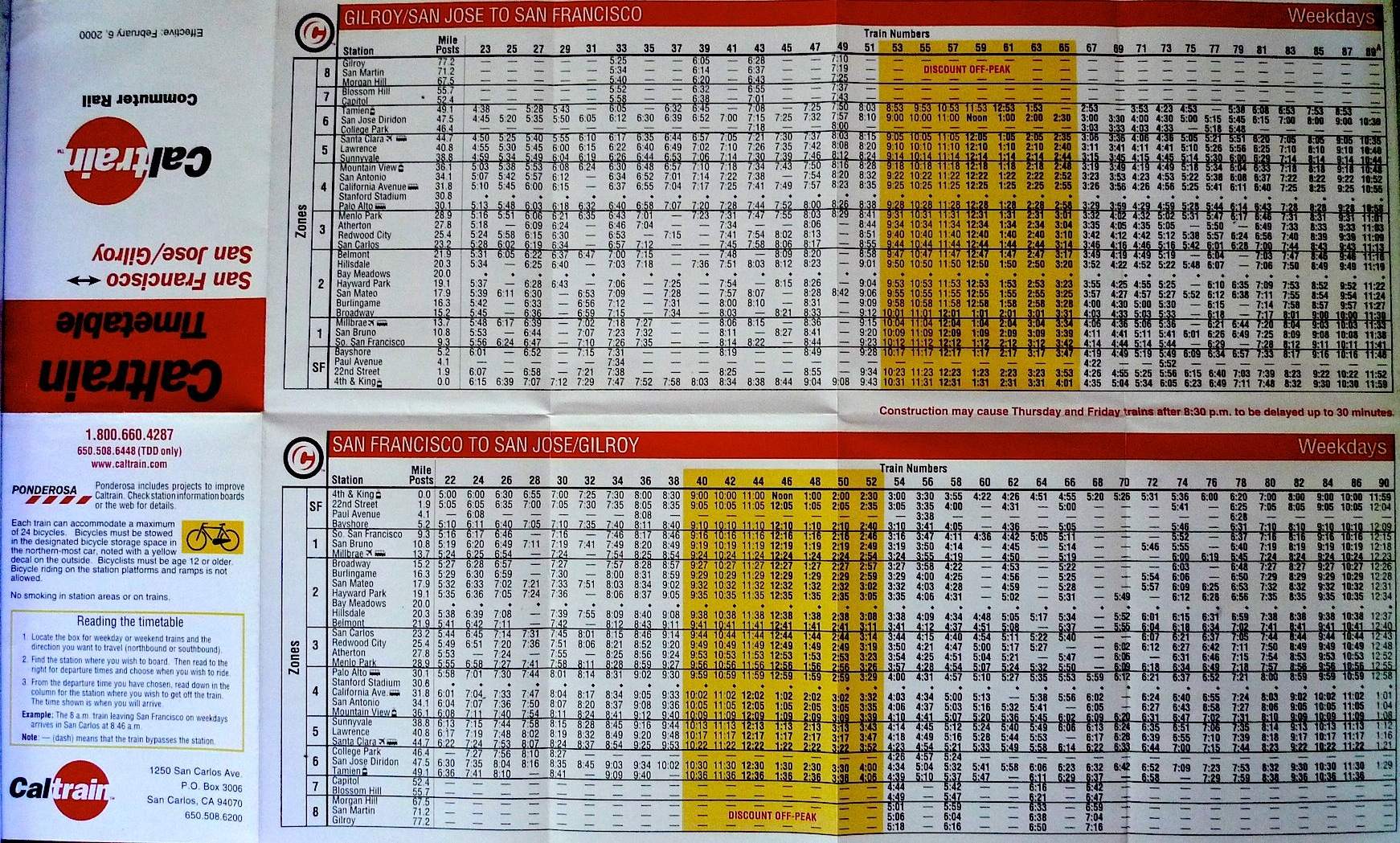
 For many years prior to 2004, including throughout the dot-com boom, Caltrain operated an all-stops a timetable with less stop-skipping (see February 2000 example) that fairly well revealed the underlying ridership demand at each station.  In 2004, that all changed with the advent of the Baby Bullet.  While the Bullet was a marketing triumph and remains a successful source of ridership and revenue, there was an under-reported flip-side to this new service: many small (and not-so-small) stations lost service.

Caltrain publishes annual ridership counts for each station, which can be distilled into a single table of historical counts of weekday boardings for each station reaching all the way back to 1992 (download 55kB Excel spreadsheet).  This data reveals interesting patterns.

The share of ridership at each station, which was fairly stable over several years leading up to the 2004 launch of the Baby Bullet, settled into a new pattern that has shown itself to be fairly stable in the years since 2004.  The change in each station's share is shown in the figure at right (also available as a 141kB PDF file), where 100% represents each station's average ridership share over the period 1999 - 2003, or the initial size of its slice of the ridership pie back in the pre-bullet days.  Following 2004, some slices got bigger, while other slices got smaller.  The entire pie also got a bit bigger, although that is not shown in this figure of the proportional trends for each station; ridership has only recently exceeded the 2001 peak.  The Baby Bullet Effect has divided stations into two groups: winners and losers.  Most of the losers were small and could justifiably be dispensed with.  Some were not, and are under-served to this day:
  • California Avenue in Palo Alto, 1376 weekday boardings in 2001, down to just 895 at last count
  • Lawrence in Santa Clara, 1309 weekday boardings in 2001, down to just 531 in 2011
  • Santa Clara, 1124 weekday boardings in 2001, down to just 656 in 2011
  • Burlingame, 985 weekday boardings in 2001, down to just 675 in 2011
  • Belmont, 892 weekday boardings in 2001, down to just 369 in 2011
  • San Bruno, 844 weekday boardings in 2001, down to just 403 in 2011
All of these places have more residents and jobs than implied by today's poor ridership, and are consistently under-served by Caltrain.

Planning for the Future

The future timetable plans revealed so far by Caltrain, including their notional electrification timetable and the timetables evaluated in the blended operations analysis, consist of an all-skip-stop service pattern as illustrated at left which "bakes in" the ridership pie slices as they exist today.  While the Baby Bullet is slated to be discontinued, its negative impact will live on at the places listed above, which will continue to be served by only two trains per hour (out of six).  Stakeholders at those stations should not allow this to happen.

As they plan their future operational concept, it is important that Caltrain base their stopping pattern on raw population and jobs data and not on the highly distorted ridership patterns induced by the Baby Bullet Effect.

09 April 2011

Mind The Service Gap

Having cobbled together additional funding for the next fiscal year, Caltrain has published a revised 76-train timetable that is now proposed to go into effect this summer. This timetable is an improvement over the previous proposal, a controversial 48-train peak-only timetable (previously analyzed here) that caused an outcry up and down the peninsula. To save $3.3 million in annual operating costs, the 76-train timetable cuts ten trains from today's peak service by eliminating the Baby Bullet express trains and substituting fewer limited-stop trains.

How does this new 76-train timetable stack up? We put it through the Metricator to extract key rush-hour trip time statistics, using the same methodology as before... with the expectation that the results might not be so great.

First, as a reminder, we consider the current timetable. The basis of comparison is today's 86-train-per-day, 5-train-per-hour timetable, to which we assign a score of 100.
And now, the proposed 76-train timetable:
Wait, is that right? One-hundred-and-four?

Did You Say Better?

Four trains per hour with no Baby Bullets is better than five trains per hour with Baby Bullets? Surely this shocking result must be wrong?!? The short answer is no, the numbers don't lie.

The long answer requires a little bit of background discussion. You see, the Baby Bullet has a dirty little secret. In order to achieve such stellar trip times, other trains must clear the tracks ahead of it, because if the express ever caught up to a local, then it would no longer be an express. In practice, that translates to very long service gaps just before a bullet comes through. Service gaps (i.e. how many minutes pass between two successive departure times for a given origin & destination pair) are an important component of the convenience of taking the train. In these calculations, an effective trip time is computed based on the following sum:
  • 70% of the average trip time
  • 30% of the best trip time (to favor express service)
  • 20% of the mean wait between trains (far less than the random arrival figure of 50%)
  • 15% of the maximum service gap (to penalize very large gaps between trains)
What happened in the new 76-train schedule can be understood by taking a closer look at the numbers. Some best trip times got a bit worse, due to the lack of Baby Bullets; some mean wait times between trains got a bit longer, due to 4 rather than 5 trains per hour; but the maximum service gaps dropped precipitously, enough to outweigh the other effects when considered for all origin and destination pairs, even after weighting the results by ridership.

Various other observations on this new timetable:
  • Rush hour service is significantly improved for stops such as Burlingame, Lawrence, Sunnyvale, Cal Ave, etc. as can be readily observed in the effective trip time savings. Note these are all the stops where service was degraded when the Baby Bullet service started.

  • Closing Hayward Park makes sense. Despite all the talk of transit-oriented development at this location, the fact remains that ridership is so low that wasting three minutes of everybody else's time to stop there isn't worth it. Besides, the station will be less than a mile away from Hillsdale when that station is moved to the north, as long planned.

  • There is a long and awkward service gap departing San Francisco between 6:45 and 7:30 PM.

  • San Bruno, where Caltrain is investing a nine-figure amount to rebuild the station, is left with dismal rush hour service.

  • Express service isn't inherently bad. It adds the most value when trains ahead don't have to get out of the way, i.e. there is a way to overtake trains without penalizing local service by imposing large service gaps ahead of the express. There exists a six-train-per-hour timetable that scores 145... but it requires a mid-line overtake. That's why a phased implementation of future peninsula corridor improvements should include a mid-line overtake facility as extensively discussed here and here.
So should the Baby Bullet be scrapped? That depends on one's beliefs... namely:
  • Do service gaps matter? The opinion presented here is obviously that they do. Caltrain seems to consider trip time only in terms of how long a passenger spends on the train (see page 16 in their presentation), without much regard to how long they might spend on the platform waiting for the next train. The underlying assumption is that every passenger builds a routine around the same train every day, and shows up just in time for that train.

  • How valuable is the Baby Bullet brand? There is reality, and then there is perception. People buy a product based on their perception, and the Baby Bullet undeniably has a certain cachet. The Baby Bullet has been marketed very effectively, to the point that most people believe that Baby Bullet trains are faster than they actually are. That belief doesn't show up in the raw metrics, but it does enter into people's choice of transportation.
When all is said and done, the choice between the proposed 76-train timetable and preserving today's timetable comes down to $3.3 million. That amounts to a mere 3 percent of Caltrain's annual operating budget, and makes this particular decision pale in comparison to far more pressing issues such as providing Caltrain with a dedicated funding source and advancing the electrification project.

30 April 2010

Alternatives Analysis Analysis, Part 2

If you haven't run out of steam as you finally reach Appendix K of the recently-released preliminary alternatives analysis, you will come across an intriguing fact: by the year 2025, Caltrain plans for a best trip time of 65 minutes from San Jose to San Francisco 4th & King, and 70 minutes to the Transbay Transit Center.

The Baby Bullet we know and love does San Jose to San Francisco in as little as 57 minutes (by the timetable, which is generously padded at the end of the run to make on-time performance statistics look better). In practice, diesel bullets can and do make the run in 55 minutes.

How can this possibly be? $6 billion later the best commuter service will be 10 minutes slower?!?

How can a timetable, the very root of years of painstaking planning and carefully apportioned capital investment, the embodiment of a grand vision of improved commuter service, the next coming of the Baby Bullet, fall so terribly short of what could have been?

How many microseconds will it take for the entire NIMBY universe to latch on to this inconvenient truth?

Some observations:
  • The proposed timetable, towards which every Caltrain capital investment ought to be targeted in tangible and measurable ways, is presented almost apologetically, and seems almost an afterthought;

  • Caltrain plans to give up (that's right, give up!) commuter trains overtaking each other, despite the presence of a third and fourth track in what is nominally a "shared corridor", and henceforth operate on just two tracks. The reason offered is that overtakes are operationally unreliable--but that is only so because Caltrain's existing passing tracks are very short, and Caltrain's existing gallery cars turn station dwell times into a game of Russian roulette. By 2025 both of those reasons will have vanished.

  • Confining Caltrain to a separate, 2-track system does not take advantage of any synergy with HSR, and perpetuates a false choice between speed and frequency. Today this trade-off is biased in favor of speed, but the Baby Bullet limits throughput to 5 trains per hour. In Caltrain's proposed 2025 timetable, based on the BART model, the trade-off is biased in favor of throughput (one train every six minutes!) but average speed suffers just like BART's. In a fully HSR-compatible system with a mid-line overtake, this constrained trade-off would be removed entirely, freeing Caltrain to provide both speedy AND frequent service with cross-platform transfers.

  • The underlying assumption appears to be that with HSR in the mix, Caltrain will no longer need to provide express commuter service. Even as Caltrain is starved of operating funds and teeters on the brink of bankruptcy, it appears perfectly willing to cede its highest-yielding ridership to the HSR operator, with no guarantee that service will mesh together with convenient timed transfers and a common fare structure.

  • Some might say, if there will be a high-speed train every five minutes in each direction, how could there possibly be any spare track capacity to allow Caltrain to overtake on the high-speed tracks? This question is ill-posed: a portion of that ridiculously frequent HSR service would no doubt be used to serve intra-peninsula demand that Caltrain could not tap into if it were stuck on two tracks with slower trip times. The track capacity should be re-allocated to better meet demand.

  • The fundamental issue here is one of flexible and dynamic allocation of a scarce and valuable resource: track capacity. If you build two separate systems that are not designed to inter-operate (freely sharing tracks and stations), then you cannot adjust service patterns to meet the demand that actually develops. You're stuck with guessing what demand will be 25 years from now, and quite literally casting it in concrete. The outcome, more likely than not, is sub-optimal, with demand under-served and resources under-used.
Caltrain's entire strategic service plan ought to be re-oriented toward the following specific interoperability goals:
  • The same platform height as HSR, so station platforms can be allocated to actual demand, making optimal use of a scarce resource;
  • The same train control system as HSR, so commuter trains and high-speed rail can freely mix and track capacity can be dynamically allocated to actual demand, again making optimal use of a scarce resource;
  • An improved timetable that provides both speed AND frequency through the implementation of a mid-line cross-platform overtake.
With those features, a good case could finally be made that the high-speed rail project would produce tangible benefits that trickle down in measurable ways to each and every community along the peninsula rail corridor. Sadly, right now it looks like those $6 billion will buy us 10-minute slower commuter service. This is simply unacceptable.

06 January 2010

The Tao of Timetables

Amid all the hoopla about high-speed rail and quadruple tracking on the peninsula corridor, it's easy to miss the original point: to convey people from point A to point B as quickly and conveniently as possible. The peninsula rail improvements aren't just about pouring concrete and running zoomy trains; they ought to be about providing a service, especially to the dominant users of the corridor, namely local commuters and travelers, people who live and work right here on the peninsula. This important constituency is too often eclipsed by the bright spotlight shining on statewide high-speed rail.

Service is where it all begins, as demonstrated when Caltrain's Baby Bullet started operating in 2004. Because the Bullet increased speed and convenience, ridership soon grew by a third, and Caltrain was featured on the cover of industry journals. But the Baby Bullet was just a baby step compared to what might soon be possible, and Caltrain can't afford to rest on its laurels.

The only three things that will really matter for the future of Caltrain are service, service and service.
(photo by Christophe Dune)

Constructing the Ideal Caltrain Timetable

Timetables are admittedly boring, but they are a compact and efficient way to describe a transit service. Improvements to the service are best understood through their effect on the timetable. Caltrain passengers stand to benefit from several future service improvements that can be sorted into two categories: (a) service improvements that come "for free" as a result of electrification and swift new EMU trains, and perhaps more importantly (b) service improvements that require a little bit of planning, creativity, intelligence, and effort to pull off.

Caltrain is relentlessly focused on (a) and appears distressingly oblivious to (b).

Type (a) service improvements that can basically be taken for granted are:
  1. Quicker start-to-stop times, since EMUs are more powerful and lighter than today's anemic and heavy diesel trains. The time savings from faster acceleration and braking really accrue when a train makes many stops.

  2. Shorter station dwell times, since EMUs will have more doors and level-boarding for rapid passenger loading and unloading.

  3. Faster top speeds, since the peninsula corridor will be grade-separated and use a modern signalling system shared with HSR. While acceleration is far more important than top speed, improving from today's 79 mph speed limit to about 100 mph does yield marginal benefits.
Those are very nice, but they're just the low-hanging fruit. Type (b) service improvements are less obvious, but deliver enormous benefits for passengers. They include:
  1. Clockface scheduling, known in german-speaking countries as Taktverkehr (literally, "traffic to a beat"). In a clockface schedule, every train runs on a periodic timetable with a regular stopping pattern that repeats at some fraction or multiple of an hour (e.g. every 15, 30 or 60 minutes). In Switzerland, the entire country runs on a regular beat. Clockface scheduling eliminates annoying Caltrain questions such as "When is the next train coming?" or "Does it stop where I'm going?" A clockface schedule takes all the guesswork out of taking the train by allowing simple memorization of the timetable (e.g. :07 past the hour, every 15 minutes) Clockface scheduling is also a key enabler of intermodal connections. Connecting feeder services, whether bus, employee shuttle, light rail, HSR, etc. can be synchronized to the "beat" for quick, hassle-free transfers.

  2. Zero-wait transfers between local and express trains, so customers at smaller station stops can benefit from fast express service to the destination of their choice. Zero-wait transfers extend the benefit of express service to a much wider selection of origin and destination pairs. A zero-wait transfer means that an express train overtakes a local at zero speed, on the opposite side of the same platform. Passengers simply walk across the platform to switch to a faster or slower train, as suits their destination. Overtaking at zero-speed enables such transfers in the first place; if one were to wait for the express, the time savings from the express would evaporate before they could provide any benefit.

  3. Two, or maximum three, station stopping patterns, for simplicity. Customers no longer fret whether any given train will stop at their destination; no more agonizing Caltrain questions like "Should I get on this train or the next?" or "Does this train serve the stop where I'm going?," no more squinting at the timetable. Caltrain conductors would no longer make long-winded and repetitive announcements about upcoming stops and which stations will or won't be skipped.
What would an ideal Caltrain timetable look like with all of these improvements? We'll soon find out, but first, a small detour through...

String Theory

To think about timetables without having to stare at big tables of numbers, it helps to use a graphical representation of rail traffic known as a string graph (also known as a stringline diagram). Traffic is displayed as a time-distance graph with time along one axis and stations (distance) along the other. The movement of each train is represented by a string that connects each station according to the time intervals required to move from one station to the next. In effect, a string graph is the visual equivalent of a timetable. For example, the weekday morning Caltrain timetable is shown in the string graph at right. There are many kinds of strings, each corresponding to a different stopping pattern; the irregular pattern makes it difficult to memorize the timetable between any two stations. The red strings represent Baby Bullet express traffic, and the blue strings represent slower trains. When the lines cross (as circled on the diagram), one train overtakes the other. Today this can only happen in Sunnyvale or Brisbane, where Caltrain already has four tracks.

Going back to our list of ideal timetable features, we can construct a string graph that includes them all. In the real world of operations planning, this is done using sophisticated simulation software, and needs to take into account detailed train performance, speed limits, curves, signal block lengths, off-nominal conditions, and knitting together with the HSR timetable (itself a complicated mess; see pages 16-24).

To first order, it can be done with a spreadsheet. Download a Caltrain string graph (385 kB Excel spreadsheet) to play with it.

The resulting Caltrain timetable is shown in the string graph at right, screen-grabbed directly from the spreadsheet. This string graph shows an example timetable, at a relatively sparse 6 trains per hour, with the following features:
  • 15-minute local interval
  • 30-minute express interval
  • Fast acceleration using 90 mph EMUs
  • 45-second platform dwell times
  • Zero-speed cross-platform overtake at Redwood City
It's quite easy to change these assumptions using the spreadsheet to see what happens. At a glance, the timetable certainly looks more symmetrical and orderly, but how does one meaningfully compare old and new?

The Service Improvement Table

The best way to convey an improvement plan in a way that the average person understands is to publish a service improvement table, an example of which is shown at right. (This example table does not show every station pair; for brevity, it shows a sampling of 10 stations.) This table is built by simply comparing the old and new string graphs. For each station pair along the peninsula, the improvement table shows how many more trains per hour connect the station pair, and how much quicker they are than today. This table is constructed by comparing the string graph of today's timetable with the string graph we constructed above.

The table is a quantitative, objective measure of the degree to which service is improved. All capital improvements on the peninsula corridor should be evaluated and prioritized by their effect on the service improvement table.

Marketing 101

Memo to Caltrain: nobody really cares about "growth" or "advanced technology" or "flexible equipment" or "power facilities", or even "less pollution" as trumpeted in the latest electrification update. Those are entirely the wrong selling points. What customers most care about is getting quickly and conveniently from point A to point B.

Damn the pantographs, what you need to sell and deliver is a service plan.

When people ask "what's in it for me", show them the service improvement table for where they live and work. When people worry about the disruption from the peninsula HSR project, they can see that some benefits actually trickle down meaningfully and measurably to each and every city along the Caltrain corridor. Put this table in front of city council members up and down the peninsula. Publish it in local newspapers. Make brochures. Drop leaflets. When Burlingame gets worked up about grade separations, explain to them that service at Broadway will go from none at all to a train every 15 minutes. When Palo Alto frets about community division, show them how California Avenue will see a quadrupling of service, and will be 9 minutes closer to Millbrae.

A Litmus Test

The dirty little secret is that all the service improvements described above could have been realized without HSR, requiring only a few miles of strategically placed track amplification to enable a mid-peninsula overtake, and using capital improvement funds in a targeted fashion that measurably improves service. (Instead, Caltrain is plowing $300 million into the San Bruno grade separation, which provides zero service improvement, while claiming it is fiscally doomed without HSR).

The peninsula HSR project, which continues to be engineered for extremely high levels of service (despite lowered ridership estimates), will consume precious resources that currently belong to Caltrain--in particular, key portions of its corridor. Constructing HSR in a manner that precludes the above schedule, or something similar to it (i.e. clockface schedules with mid-line overtakes) from being reliably operated will forever stunt the future of the peninsula commute. That can rightly be considered totally unacceptable.

The timetabling criteria outlined in this article form an objective litmus test for an important question that should linger in the minds of peninsula residents: MOU notwithstanding, is Caltrain getting screwed over by the HSR project? Armed with this knowledge, you can be the judge.

19 September 2009

Platform Height

Among the things on your mind as you step across the platform gap to board a train, the height of the platform above the rails probably ranks last. As it turns out, this dimension--and correspondingly, the floor height of the train--is very important. It determines:
  • platform dwell times, or how long it takes passengers to get on and off;
  • interoperability between two train systems, Caltrain and HSR;
  • accessibility for the disabled and people carrying bulky items (luggage, strollers, bicycles);
  • the available options for procuring affordable, off-the-shelf train designs.

Level Boarding

The Americans with Disabilities Act (ADA) mandates that all new rail vehicles and platforms provide level boarding, with the height of the train floor within 5/8" (16 mm) of the height of the platform, a tight specification that is quite difficult to achieve in everyday practice. The grand staircase that greets most Caltrain passengers will no longer be allowed because the ADA requires "the most integrated setting reasonably achievable." Caltrain got by until now by using a hodge-podge of grandfather clauses and band-aid solutions allowed under ADA law, but as the system transforms from an old-style diesel commuter railroad to a modern, fast and frequent transit system, level boarding and full accessibility is no longer a negotiable feature. Indeed, level boarding features prominently among the goals of Project 2025, Caltrain's blueprint for reinventing the peninsula commute.

That does leave the question unanswered: exactly which height is appropriate for this level boarding to take place? As we will see, this question has far-reaching implications for the peninsula corridor.

Caltrain's Plan

Caltrain has for many years harbored the desire, if not the financial means, to operate swift electric multiple unit (EMU) trains. These trains would increase service speed and frequency, especially at those stations that saw service cut back to make room for Baby Bullet service.

Going back many years, Caltrain's studies invariably conclude that such EMUs should necessarily have two levels (an upstairs and a downstairs), much like Caltrain's existing fleet. The reasons have to do with providing a certain passenger capacity under a cost trade-off between service frequency and train capacity, fitting within platform and train length limitations, taking full advantage of the ample vertical clearances that are available... and last but not least, perhaps also the sheer Strength Of An Idea.

Caltrain wishes to procure its new trains on the global marketplace. A sampling of various European bi-level EMUs under consideration, with corresponding entry floor heights:
  • France - Alstom Coradia Duplex: 600 - 645 mm (24 - 25")
  • Germany - Siemens Desiro: 600 mm (24")
  • Switzerland - Stadler Dosto: 570 mm (22")
For reasons related to vehicle packaging (fitting all the train's innards, systems and amenities around the passenger space), as well as historical European platform standards, these double-deck EMUs typically have entry doors and vestibules on the lower deck, with a floor height of 570 - 645 mm (22" to 25"). High-platform EMU designs are less common, although they do exist in Paris and Sydney.

Enter HSR

While HSR on the peninsula corridor has long been a dream, the increasing tempo of events (Proposition 1A, the federal stimulus, environmental planning for the San Francisco - San Jose HST project) has made it increasingly likely that Caltrain commuter trains will mingle on the peninsula corridor with a steady flow of long-distance high speed trains linking the region to the rest of California. Caltrain and the California High Speed Rail Authority (CHSRA) have signed a memorandum of understanding establishing a broad framework for sharing the peninsula corridor, which envisions "mixed traffic from Caltrain commuter rail and the high speed train service capable of operation on all tracks."

The MOU identifies the urgent need for a systems engineering integration plan, a detailed technical framework for how Caltrain and HSR will mesh together. Importantly, this plan will have to address the issue of level boarding, and whether "mixed traffic" also applies to platform tracks.

The global HSR marketplace, from which the CHSRA will procure its trains, clearly tends toward so-called "high floors" about four feet above the rails: the floor of the rail car's entry vestibule is built high enough to fit the train's wheels underneath. A sampling of various HSR makes and models, with entry floor heights:
HSR will quite naturally gravitate towards high platforms.

Regulatory Considerations

Platform heights in California are governed by the federal Department of Transportation and the California Public Utilities Commission. There are many laws on the books, and yet more undergoing approval. Taken together, they form a complicated regulatory thicket that has previously, and probably will again, produce odd solutions. The key regulations that govern platform height include the following:
  • Platforms must be within 5/8" of the height of the train floor (36CFR1192.175 and 36CFR1192.93) for level boarding
  • HSR trains must use high-platform level boarding (36CFR1192.175), typically understood as about four feet floor height
  • Commuter platforms must provide full-length level boarding (DOT guidance)
  • There may not be steps down into a train (DOT guidance)
  • Commuter platforms may not exceed 8" above top-of-rail (CPUC General Order 26) to provide clearance for freight trains.
  • New commuter cars must have a 15" floor height for compatibility with Amtrak (see proposed change to 49CFR37.85, effectively already law)
Now it gets really confusing.

These regulations not only contradict each other, but also lead to the strange notion that HSR and commuter rail are inherently incompatible and must therefore be built to differing platform heights. Regardless of this legal mish-mash, it is unlikely that the CHSRA will choose a platform height with Caltrain compatibility in mind; they will choose whatever suits the high speed rail system. That leaves Caltrain to follow their example... or not.

One can easily see where this is all headed, based on the figure at left: with bi-level EMUs, Caltrain is likely to end up with an entry floor height in the low twenty inches, while HSR will end up in the forties. The non-negotiable requirement for level boarding would result in two different and incompatible platform heights. Does that even make sense?

The Consequences of Platform Incompatibility

If one considers the peninsula corridor as a transportation system rather than two independent services simply sharing a right of way, platform compatibility emerges as a key enabler for realizing the potential synergy between HSR and Caltrain, with one serving as a feeder for the other. HSR can operate as a Flight-Level Zero airline with enormous parking garages and rental car facilities, or it can be deeply integrated into an efficient network of transportation where riding the train to your destination anywhere on the peninsula corridor is not only possible, but convenient and desirable.

One of the greatest opportunities currently facing rail planners is the provision of cross-platform transfers between Caltrain local and express trains. Under this operational concept, a local and an express show up simultaneously, on opposite sides of the same platform, and exchange passengers. In effect, the express overtakes the slower local at the platform, rather than somewhere between stations, allowing passengers to switch conveniently from one to the other. Such exchanges, operating on regular clock face schedules, would enable fast and frequent service to and from all the stations currently under-served by Caltrain, such as Belmont, Burlingame or San Antonio, and would greatly magnify the utility and efficiency of Caltrain as a feeder to peninsula HSR stops. Caltrain to Caltrain cross-platform transfers, the key to this highly desirable operational concept, inherently require the same boarding height on both sides of the platform as shown in the figure at right.

Proceeding with two incompatible platform heights would have the following negative impacts:
  • A cross-platform coordinated transfer between local and express commuter trains would be precluded at peninsula HSR stops, unless additional platforms were built. As shown in the figure under Option B, the two key transfer points on the peninsula corridor (Millbrae and Palo Alto / Redwood City) would preclude cross-platform transfers precisely where they are most needed, permanently crippling Caltrain's development potential.

  • If cross-platform Caltrain transfers were nevertheless implemented at the Millbrae and Palo Alto HSR stops, these large stations would have to be further expanded with additional platforms (shown in the figure under Option C) and up to six tracks (if HSR infrastructure were completely secured). Such enormous stations, approaching the size of an aircraft carrier, would be out of scale with the surrounding community.

  • San Francisco's Transbay Transit Center would be operated as two independent mini-terminals, with four HSR platform tracks and two Caltrain platform tracks. The loss of redundancy from the inability to assign any train to any platform would (a) exacerbate traffic jams in the station approach (by limiting the available paths and thus curtailing terminal capacity); (b) allow small incidents that delay a train (e.g. a medical emergency or law enforcement activity) to propagate to other trains; and (c) prevent spare capacity (unused platform tracks) from being re-allocated between Caltrain and HSR in response to actual travel demand, as opposed to ridership projections made decades into the future.

  • The resulting inability of the Transbay Transit Center to support a full Caltrain rush-hour schedule would require the existing station at 4th & King streets to be retained indefinitely, thus confusing commuters, contradicting San Francisco's 1999 Proposition H, and occupying many acres of land that would be more usefully developed for other purposes.

  • The San Jose train station, already planned as a massive double-deck structure, would require dedicated tracks and platforms for each service. With compatible platforms, it is likely that a single-deck configuration could meet the various needs of Caltrain, HSR, ACE and Amtrak.

  • Under delayed or otherwise unusual traffic conditions, high speed trains could not stop at a Caltrain platform to discharge passengers.
The Transition Conundrum

If a common, compatible platform height specification for both Caltrain and HSR is the desired outcome, how do we get from here to there? One of the key requirements for the development of the peninsula rail corridor is to do so without interrupting Caltrain service, to avoid dumping another 20,000 cars on congested roads. Furthermore, changing the height of station platforms, or procuring and commissioning new trains, are not done at the flip of a switch: each would last many months. Under those conditions, converting Caltrain to a different boarding height will be tantamount to changing the wing of an airplane... while in flight. That's not to say it is impossible, but it will require some very creative solutions from Caltrain, an issue that we will revisit later.

In the meantime, now would be a fine time for Caltrain to initiate the waiver process for GO-26D, since it is sure to encounter stiff opposition and delay from certain entrenched interests.

27 June 2009

Baby Bullet: Here Today, Gone Tomorrow?

In June 2004, after a period of falling ridership and revenue, Caltrain began operating a limited-stop express service, known as the Baby Bullet. Express trains used newly installed passing tracks in Sunnyvale and Brisbane to overtake slower local trains (as illustrated in the photo at right by Dan Klitzing). The start of Baby Bullet service marked a turning point for Caltrain, with weekday ridership rocketing from 25,000 to about 40,000 and farebox recovery ratio increasing to the mid-forties.

It was a welcome change to see Caltrain's transformation from a plodding public transit operator to a more strategic, business-oriented organization putting passenger service first. As evident in ridership statistics, Baby Bullet express trains consistently score the highest passenger load factors and are the greatest source of fare revenue for Caltrain.

Meanwhile, the California High Speed Rail Authority intends to transform the peninsula corridor into a four-track operation, with the slow pair of tracks shared by Caltrain locals and freight trains, and the fast pair of tracks shared by Caltrain expresses and high speed trains. The Memorandum of Understanding signed in April 2009 between the CHSRA and the Peninsula Corridor JPB (Caltrain) envisions "mixed traffic from Caltrain commuter rail and the high speed train service capable of operation on all tracks".

What exactly does that mean for Baby Bullet service?

Some Numbers To Connect

  • 31% of ridership: Baby Bullets are Caltrain's highest-revenue trains, accounting for 31% of weekday ridership but only 22% of trains. There is a demonstrated market for rapid commutes along the peninsula. Will a private HSR operator attempt to cherry-pick this market away from Caltrain, leaving the publicly-funded agency on the hook to operate less profitable local trains?

  • 4.8 million passengers: The CHSRA is under great pressure to show that its business plan "pencils out" and will allow funding of system extensions (to Sacramento and San Diego) partially through revenue bonds. The Authority estimates in its ridership and revenue forecasts that by 2030, 3.7 to 4.8 million passengers a year will ride HSR between peninsula destinations (San Francisco, Millbrae, Redwood City / Palo Alto and San Jose), accounting for about 9% of the entire system's ridership, and 2% of its fare revenue. That level of intra-peninsula ridership amounts to nearly half of Caltrain's entire 2008 ridership. Does this imply HSR intends to take over Caltrain's express commuter service and associated revenue?

  • 9 or 10 tph: According to the same ridership and revenue forecast, which serves as the foundation for the analysis of design alternatives, the peninsula corridor will be sized for a traffic of 9 or 10 high speed trains per hour, each way, by the year 2030. When all trains travel at the same speed, a pair of tracks can support about 20 tph each way, but when speeds differ (as they might between HSR and express commuter trains) the capacity can drop into the low teens. With little spare capacity assumed for express commuter trains, will the CHSRA conclude that sharing tracks is not beneficial after all?

  • 2'1" platforms: The CHSRA and Caltrain have so far shown no intention of coordinating on the crucial issue of platform height. Quite the contrary, details emerging from the Transbay Transit Center project in San Francisco indicate that the two systems will operate with different and incompatible platform heights (3'6" for HSR and 2'1" for Caltrain--a difference of two steps). The implication is that high speed trains will be unable to use Caltrain platforms, and vice versa. Will this restrict the number of locations where express commuter service can be provided?

  • 2 dedicated tracks: The environmental impact work in southern California is a bit more advanced than on the peninsula, and a design alternatives analysis has already been released for the Los Angeles to Orange County section. (By the way, we should see one for the peninsula before 2009 is out... that's when the can of worms officially gets opened!) The LA - Anaheim route is similar to the peninsula in that it will have a mix of HSR and commuter traffic. The CHSRA analyzed several scenarios involving mixed commuter - HSR operation, and rejected them all in favor of dedicated tracks for HSR, stating on pages 36 and 37 that "the Dedicated HST Alternative was identified as the only alternative capable of accommodating the peak demand forecast for all classes of train service at acceptable levels and on-time performance." In other words, commuter trains can't be allowed to gum up the HSR timetable. In case there was any remaining doubt, they really drive it home: the dedicated alternative "provides for a safer environment (no mixing of FRA-Compliant and Non-Compliant trains), and does not require a waiver from the FRA." The result is a train-size Jersey barrier between the high speed tracks and lesser trains, as shown in the figure at right. Will the same, unimaginative "Dedicated HST" logic be applied on the peninsula?

  • More than 4 tracks: Before the wording of the MOU between the CHSRA and Caltrain was altered, it stated that the peninsula corridor would be four tracks wide and that "In some places the corridor may consist of more than four tracks." Does this amount to leaving the door open for the possibility that HSR tracks could be completely segregated from Caltrain, with additional tracks (beyond four) as required to operate express commuter service?

  • 70 minutes: If Caltrain service were operated by electric multiple-unit (EMU) trains, an all-stops local would need 70 minutes to travel between San Francisco and San Jose. (Refer to a presentation describing Caltrain's Project 2025, made by their "Rail Transformation Chief" Bob Doty last September: Part 1, Part 2, Part 3) While this is much faster than 91 minutes achieved by diesel locals today, it is still 13 minutes slower than today's best Baby Bullet timing of 57 minutes. Express service will be needed even with the fanciest EMU technology if today's run times are to be preserved, let alone improved upon. Might Caltrain settle on 70 minutes as "good enough"?

  • 9 board members: The nine-member board that governs Caltrain is composed of appointed county officials with little knowledge of rail operations and greater allegiance to the interests of their home county than to the specific interests of Caltrain. In practice and through no fault of their own, their accountability to current or potential commuters is limited to little more than good will and personal dedication. Furthermore, funding sources for Caltrain are unreliable. In political clout or financial wherewithal, the PCJPB is far outclassed by the CHSRA. Supposing they tried, could Caltrain protect its own interests with much vigor? Will the CHSRA wave the electrification bill over their heads to get whatever they want?

  • 30 days: while the MOU signed between the CHSRA and Caltrain envisions "mixed traffic from Caltrain commuter rail and the high speed train service capable of operation on all tracks," either party can unilaterally cancel the MOU upon 30 days' notice.

  • Zero: the CHSRA's desire to navigate the byzantine process to obtain from the Federal Railroad Administration a "mixed operations waiver" is likely zero. Such a waiver would be required if HSR service were operated on the same tracks as heavy trains that are fully "compliant" with FRA crash safety regulations. Caltrain is taking the lead on this complicated issue and making good progress, but what if this effort falters? Will the lazy answer be dedicated HSR tracks, strictly off-limits to Caltrain?
Implications for Peninsula Commuters

One doesn't need to wear a tinfoil hat to view the above points as possibly suggesting a "Dedicated HST" scenario on the peninsula corridor, with high speed trains operated entirely separately and independently from Caltrain. Why would this be bad for peninsula commuters?

  • There would be no flexibility in adapting the stopping pattern of express trains to actual demand. If express service were taken over by HSR, the intermediate stops would be Millbrae and Redwood City / Palo Alto, due to platform incompatibility. Need to get from San Mateo to Mountain View in a hurry? Today, there's the Baby Bullet. Tomorrow? Forget about it and take the local.

  • The opportunity to create transfers between local and express commuter service, across a common platform, would be lost. The HSR tracks would occupy a large portion of the right of way, making it difficult to create a four-track, cross-platform commuter interchange station. Cross-platform transfers are extremely useful in creating feeders for express service and cutting journey times even for riders who do not live or work near an express stop.

  • Any spare capacity of the HSR tracks, such as might result if the ridership forecast was optimistic, would be wasted since it could not be taken up by other services such as express commuter trains.

  • Incidents (e.g. suicides) would cause more disruption and reduce operational flexibility, since commuter / HSR trains could not use each other's tracks to circumvent the location of the incident. "Single-tracking" around an incident is far more disruptive to a timetable than detouring four tracks into three, as would be possible in a shared-track scenario.

  • A common fare system where a single fare covers the trip from point A to point B, regardless of the transit operator or speed of service, would be less likely.
Anyone who cares about flexible and efficient express commuter service--regardless of who provides it--should hope that shared HSR / Caltrain operations on the peninsula corridor aren't just empty talk. Making it happen will require more coordination and possible regulatory complication, but failing that, the Baby Bullet's days may be numbered.

14 February 2009

Peninsula Rail Traffic: 2030

How much rail traffic can we expect on the peninsula by the year 2030? Both the California High Speed Rail Authority and Caltrain have projected ridership figures that allow us to estimate overall traffic levels on the peninsula corridor. Ridership figures are used to sell transportation projects to the public; more often than not, they are slightly overstated. Accordingly, consider the analysis below to be an upper bound.

Caltrain Capacity

Today, Caltrain runs 98 trains per weekday, with a peak rush hour capacity of 5 tph (trains per hour) per direction, or 6400 seats per peak hour, counting both directions. Off-peak capacity is 2 tph per direction, and weekend capacity is just 1 tph per direction.

Caltrain has about 37,000 boardings per weekday. At 98 trains/day x 640 seats/train, this figures to a 58% load factor (the average proportion of occupied seats) assuming all trips go the full length of the line. In practice, the average load factor is likely under 50%, although the most popular rush hour trains do approach 100% (i.e. standing room only).

Caltrain plans to grow its ridership, independently of high speed rail, by using electric rolling stock that can operate faster and more frequently. Their Caltrain 2025 plan calls for a peak capacity increase from 6400 seats/hour to 11000-16000 seats/hour by the year 2025. Assuming trains remain at the same seating capacity, this implies an increase in peak traffic from 5 tph to 9-12 tph per direction. Total capacity would roughly double, to about 200 trains per weekday.

Is this a reasonable estimate? It is useful to compare with BART's current traffic through the transbay tube. At peak times, BART runs about 20 tph in each direction, in 10-car trains that seat 700 and often carry crush loads of over 1000 people. Considering that BART serves a much greater geographical area than the peninsula, their 28000 seats/hour peak capacity in 2009 seems at least consistent with Caltrain's lower bound of 11000 seats/hour, achieved 15 years later. The verdict on Caltrain ridership projections: plausible (update: see comments section for a dissenting verdict: highly optimistic)

High Speed Rail Capacity

The California High Speed Rail Authority has published various ridership estimates over the years, the latest of which is contained in their 2008 business plan. The chapter on ridership and revenue estimates that by 2030, the peninsula corridor will see 8 - 10 tph per direction during six peak hours (6-9AM and 4-7PM) and about 6 tph per direction off-peak. That's a total of roughly 220 trains per weekday or 1300 trains per week.

Interestingly, there are no trains that skip San Jose or terminate at San Jose, which neatly sidesteps the rivalry between San Francisco and San Jose for the title of most important Bay Area destination.

If you assume the average HSR train seats about 400 people, that amounts to 27 million seats a year. That compares to 20 million seats a year currently offered by airlines between the Bay Area and the LA basin. (Southwest Airlines alone flies nearly 100 flights daily each way, although each one seats only about 130 people). Compared to airline traffic alone, the HSR figures sound optimistic, although most of the ridership is claimed to come from automobile traffic on the 5, 99 and 101 freeways, rather than airline traffic. Accounting for traffic growth between 2009 and 2030, which would double in that time span at an annual growth rate of just 3.5%, the verdict on HSR ridership projections is: plausible. (update: see comments section for a dissenting verdict: ludicrous)

Peninsula Traffic in 2030

Let's add it all up. Since peak hours for Caltrain and HSR will coincide with morning and evening rush hours, it is conceivable that peak traffic on the peninsula could reach 20 tph in each direction by the late 2020's (9-12 tph Caltrain and 8-10 tph HSR). Off-peak traffic would be closer to 10 tph in each direction (4 tph Caltrain and 6 tph HSR). Total weekday traffic would be about 420 trains (including both directions), an increase of four times over today's traffic levels over a span of two decades. To an observer at any given place along the peninsula corridor, there would be a train passing by on average every 1.5 minutes at rush hour, and every 3 minutes off-peak.

While the 20 tph figure is similar to that achieved by BART on two tracks, the peninsula corridor will be very different: it will support five different classes of service, each running at a different average speed.
  • HSR express, SF-SJ in 30 minutes (non-stop)
  • HSR limited, SF-SJ in 34 minutes (1 intermediate stop)
  • Caltrain Baby Bullet, SF-SJ in ~45 minutes (4 intermediate stops)
  • Caltrain limited, SF-SJ in ~55 minutes (10 intermediate stops)
  • Caltrain local, SF-SJ in ~66 minutes (15 intermediate stops)
Mixing these different classes of traffic requires frequent overtaking, which explains the requirement for four tracks throughout most of the peninsula corridor.

In San Francisco, there is a different implication to this 20 tph peak figure: since all trains must run at the same speed in the final approach to San Francisco, as dictated by the tight curve radii in this area, they would no longer need to overtake each other. Theoretically, running 20 tph through this speed-restricted area could be done on fewer than four tracks-- possibly just two! With homogeneous speeds, BART does it every day through the transbay tube, meshing together trains from four far-flung lines into a 20 tph trunk with just two tracks. Similarly, Amtrak and New Jersey Transit run up to 24 tph each way on the two tracks under the Hudson river. In both cases, there are efforts underway to increase the number of tracks, but it does give you a feel for the maximum throughput of two tracks when traffic is perfectly homogeneous.

Terminal Turnback Capacity

When a train reaches the end of the line in San Francisco, it needs to be cleaned, serviced and provisioned for its next trip. From arrival to departure, these operations typically take about an hour on other rail systems. If time is of the essence, which it will be in San Francisco, the turnback time might be reduced to about 30 minutes, very low by rail standards and commensurate with airline operations. The Transbay Transit Center is planned to have just six platform tracks shared by HSR and Caltrain, a very small number by international rail terminal standards. If a train occupies a platform track for just 30 minutes at a time, the maximum turnback capacity of a six-track terminal is 12 trains per hour.

This highlights another interesting feature of San Francisco rail operations: overall capacity into and out of the city will be constrained by terminal turnback capacity, and not by track capacity. You could build a six-track approach into San Francisco, but you still couldn't squeeze more trains in and out of the city.

Solutions to this Transbay turnback constraint include:
  • Turning some trains, most likely Caltrain services, at another station. The existing Caltrain terminal at 4th & King streets might be retained for this purpose.
  • Turning some HSR services at San Jose. This has the added benefit of reducing traffic on the peninsula.
Whatever happens between now and 2030, it is likely that the peninsula corridor will be hardly recognizable when compared to its current state.