Showing posts with label train box. Show all posts

19 September 2021

Down the Tubes with DTX!

DTX overview
San Francisco's Downtown Rail Extension project (DTX), officially known as the Transbay Transit Center Program Phase 2, is a two-mile tunneling project to extend the peninsula rail corridor from its existing terminus in the Mission Bay neighborhood to the purpose-built basement "train box" of the Salesforce Transit Center (SFC). The project is regionally important, as there are more jobs located within a half-mile radius of the SFC than within a half-mile radius of all Caltrain stops combined, from 4th and King all the way to Gilroy. The DTX is nearly shovel-ready, in the sense that environmental clearance is in hand and engineering is being advanced to award construction contracts the moment a key ingredient becomes available: money. Gobs and gobs of money.

Too Big To Fail

The last time the costs of the Phase 2 project were tallied in 2016, the total came to $3.9 billion in year-of-expenditure dollars assuming a 2025 opening. Due to delays, we can anticipate at least another five years of escalation at 5%, bringing us to $5 billion before any changes to the project scope. One can reasonably expect that Bay Area transit agencies' proven inability to deliver mega-projects on budget or on time is quite likely to blow up costs well beyond these figures. As a recent example, the Phase 1 project, completed in 2019, cost $2.4 billion (year-of-expenditure) or about 50% more than the $1.6 billion YOE budget of May 2010, adopted after the train box scope was added.

The DTX project's regional, state and national significance is certainly not lost on our Transportation Industrial Complex. To improve the chances of getting the Phase 2 project federally funded (after which any cost growth becomes easier to fund, following former SF mayor Willie Brown's "theory of holes"), the TJPA is undertaking a phasing study to make the project appear more thrifty. The various approaches include deferring or deleting components of the project, such as a pedestrian connector to BART, an intercity bus facility, and an extension of the basement train box. This nibbling around the edges amounts to $0.4 billion in 2027 dollars or about 8% of the total Phase 2 project cost, a drop in the bucket.

A $30 million project development study is now in the pipeline to get Phase 2 to the state of readiness required to apply for federal New Starts funding by August 2023.

PAX: The World's Most Expensive Grade Separation

If you thought the cost of grade separations is exploding, you really haven't seen anything yet: meet the Pennsylvania Avenue Extension (PAX) addendum to the DTX, a grade separation project that will approach $2 billion for two crossings, reaching the stratospheric cost of $1 billion per crossing.

Even after spending $5 billion (before inevitable cost overruns), the DTX project will leave two existing street crossings at grade, at Mission Bay Drive and 16th Street. Not to be outdone, the city and county of San Francisco has performed a methodical series of planning studies to conclude that a new grade separation project is needed. Rather than taking on the challenge of bending some design rules to keep it simple and make it fit, the favored paint-by-numbers engineering solution is a bored tunnel, which averts any conflict with a planned 27-foot sewer pipe and the sacrosanct pile foundations of the I-280 viaduct, each of which are under the jurisdiction of other agencies. The combined cost of DTX + PAX is estimated at $6.0 billion. Take away the latest (2016) $3.9 billion cost estimate of DTX and you get about $2 billion added for PAX.

Link21 Crashes the Party

Meanwhile, BART is in the early planning stages for beefing up its throughput capacity between the greater East Bay and San Francisco, with a second Transbay Tube. It's worth pausing for a moment to consider what an astonishing piece of infrastructure the first Transbay Tube already is: it carries almost twice as many people during rush hour as the entire ten-lane freeway that is the San Francisco - Oakland Bay Bridge, and at significantly faster speeds. Looking past the pandemic, long-term growth trends indicate that the region must plan for a second Transbay Tube.

Transbay Tube II is the centerpiece of an enormous regional rail program known as Link21, the scale and ambition of which dwarf the DTX. While there are many decisions yet to be made about the implementation details of Link21, perhaps the most critical decision centers on what technology to put in the tube: wide-gauge BART, standard-gauge regional rail, or both.

This question is already of great concern to TJPA, which writes in its August 20, 2021 Phasing Study:

BART and Capitol Corridor’s Link21 program is currently in the early stages of development and has not yet determined a preferred alignment, technology, or rail gauge options to meet their goals and objectives for a future transbay rail crossing. As expected at this stage of development, all options remain available for consideration. For example, Link21 may determine that a second transbay crossing best meets stakeholder needs if it provides additional capacity for the BART network only and does not provide a standard gauge rail crossing of the Bay. BART’s infrastructure and trainset design, however, are incompatible with Caltrain and CHSRA standards. Most significantly, BART operates on a wider track gauge with vehicles that may not meet collision requirements, and therefore a BART-only connection would not relieve congestion and conflicts on the DTX.

We can already see a problematic mindset emerging here, where "BART" is automatically conflated with "five-foot-six track gauge," setting up a false dichotomy of BART-or-standard-gauge.

Caltrain + BART: a Necessary Merger

The false dichotomy of BART-or-standard-gauge threatens to poison the debate around Link21 alternatives. The Transportation Industrial Complex has a vested interest in this incompatibility, as it ultimately forces multiple mega-projects to be built. Why build it right when you can build it twice and get paid twice? From the standpoint of scope and profit maximization, it would then make sense to keep DTX and Link21 as separate projects, despite their overlapping purpose and need to link the greater Bay Area megaregion together using high-capacity passenger rail infrastructure. Seamless integration is good for riders and taxpayers, but not so great for consultants and civil engineering mega-firms. That's why these firms have an interest in propagating the myth that BART and standard gauge rail will always be mutually exclusive.

Removing this false dichotomy is becoming a primary reason for merging Caltrain with BART to form a single Bay Area Rapid Transit system, although there are many other reasons. BART does not have to be synonymous with wide gauge; indeed, BART already operates a seamless standard-gauge extension between Pittsburg and Antioch, and provides day-to-day management of the standard-gauge Capitol Corridor. A new BART peninsula line, while indistinguishable from Caltrain's service vision, would suck the air out of the emerging pointless debate around the track gauge of the second BART transbay crossing. The Measure RR sales tax can serve as a dowry to integrate San Mateo and Santa Clara counties into a restructured BART district.

Link21, to its credit, places equity and inclusion at the forefront of its project development process. The contrast with DTX is jarring, as TJPA's Phase 2 project can easily be viewed as just another gold-plated white-collar rail project enabling nine-to-five technology and finance types to more conveniently access San Francisco's skyscrapers from the affluent suburbs to the south, without ever having to mix with the blue-collar working class. Bringing DTX under the Link21 umbrella, and merging Caltrain into BART, immediately defuses the classism and racism that underlies this anachronistic Mad Men commuter rail vibe.

Transbay Through Running

A stub-end terminal station suffers from fundamental throughput limits related to long turn times and the unavoidable crossing streams of inbound and outbound traffic in the station approach or "throat." For a given number of platform tracks, a through-running station configuration where all trains that come in one end of the station can exit the other end will always provide more throughput capacity, whether measured in trains per hour or passengers per hour. Trains don't have to dwell any longer than necessary at a platform, and don't foul opposing traffic on their way in or out.

With the DTX as it is, past operational analysis indicated that just 12 inbound and outbound trains per hour (8 Caltrain + 4 HSR) would push the limits of the terminus design, with near-saturated platform occupancy. If you uncork the other end of the train box (by having Caltrans clear some right of way i.e. dismantle and redevelop a couple of medium-rise buildings to the East) so that the DTX can connect directly to a new transbay crossing, everything changes. A lot of new capacity is created by virtue of not having to layover or turn trains right smack where your platforms and track real estate is the most expensive.

A recent through running operations analysis commissioned by the TJPA shows that the Salesforce Transit Center could handle up to 20 trains per hour per direction if no more than six of them turn at the station. Any more than six turning movements, and the excessively long platform re-occupancy times (as the study notes, due to the poor layout of the switches leading to tracks 1-4) will reduce throughput capacity to less than 20 trains/hour.

Broken Assumptions at Link21

The TJPA phasing study reports the following direct quote attributed to Link21 project team:

We have received briefings on the operational modeling for DTX and it would seem that even a three-bay DTX tunnel poses operational constraints. A robust service level through the transbay crossing is required to justify investment into Link21. Link21 is envisioning scenarios where not all trains that cross the Bay would continue to San Jose. At this point, there is no other location to turn trains around in the northern peninsula which makes flexibility in DTX important to the Link21 Program.

You read that right: the Link21 team is thinking of turning Capitol Corridor trains at the Salesforce Transit Center, a completely American idea (copied straight from Penn Station New York) that is operationally insane if you think about it for even a minute. In a through-running configuration, all trains that cross the Bay should stop in downtown San Francisco and get out immediately. The California High Speed Rail Authority is planning a huge yard in Brisbane, a perfect place to clean, service and layover Capitol Corridor trains. These deadhead (non-revenue) moves are much less wasteful of infrastructure capacity than treating a through-running station as a terminal.

As was remarked in previous discussions regarding San Jose, the act of parking or laying over trains at a station platform is the railroad equivalent of parking an empty truck in the middle of a bustling loading zone, and then concluding that the loading zone fails to function adequately. Just stop it, don't even think of turning trains here!

The Bottom Line

Here are the pros and cons of merging DTX with Link21:

 Pro
 Con
 Eliminates silly idea of a multi-gauge transbay tube project Could further delay DTX, since Link21 is at an earlier stage of development
 Increases SFC throughput capacity and bang-for-buck, making the enormous cost of DTX worth it
 Exposes DTX to political re-prioritization
 Provides faster Peninsula - East Bay connections than existing BART, and finally "Rings the Bay with BART"
 Greatly reduces scope and profits for Transportation Industrial Complex
 Makes more efficient use of taxpayer dollars by building  one project and building it right
 Requires inter-agency coordination and mergers, which agencies abhor
Provides seamless regional rail connection from SJ and SF to Sacramento, if Capitol Corridor is electrified
 

Despite the obvious political and organizational obstacles, from the point of view of a rider and taxpayer, the pros vastly outweigh the cons. The answer is then obvious: the DTX should go down the tubes of a new standard gauge Link21 crossing, with Stadler bi-level EMUs operated by BART seamlessly connecting the peninsula corridor (a.k.a. the new BART Purple Line) directly to Oakland and points beyond. DTX should be built without delay and form the first building block of Link21.

02 December 2012

Transbay Update

Early mockup of Transbay layout
Since our previous coverage of Transbay, a gigantic hole has been dug where the old Transbay Terminal used to be.  That's the part you can see.  Behind the scenes, design of the yet-to-be-funded DTX (Downtown Extension) from 4th & King to Transbay continues.  Millions have been spent to bring the design up to "30% engineering" where the details of tracks, stations, and tunnels have been sufficiently defined, down to the inch, to support construction bids and final design.

The TJPA was kind enough to share the latest overview engineering drawing (PDF file) with Friends of Caltrain.  This drawing is marked 'preliminary'.  Sadly, it does not reveal any substantive changes since 2009, and the DTX remains the same slow, 35 mph conflict-ridden mess that it was then.  Where previously it might have earned an overall grade of D, we'll give it a C-minus.  Some improvements were made around the margins, but certainly nowhere near what it could be.  Let's take a closer look.

1. Analysis of an ideal Transbay station interlocking

In the TJPA drawing, the Mission Bay station (built underground and alongside the existing 4th & King terminal) is laid out as in the diagram below.  Inbound traffic comes from MT2 (Main Track 2) and exits on MT5 or MT2, and outbound traffic comes from MT4 or MT2 and exits on MT4.
If we assume that MT4, MT2 and MT5 from a three-track tunnel that feeds the six-track Transbay Transit Center (TTC), we have 3 x 6 = 18 possible routes from the DTX tunnel to the TTC platform tracks numbered T21 through T26 from south to north.  Each of these 18 routes through the interlocking (also known as the "throat" of the station) is labeled by a single letter at the entrance and the exit. In this context, a route is one particular alignment of the tracks, established in the anticipation of a train using it to traverse the interlocking from one track to reach another.
Without getting into expensive simulations, a complex interlocking can be analyzed using a route locking table.  All table elements representing routes that lock each other (converge, diverge, or cross--i.e. conflict, and cannot be simultaneously set without risking a collision) are marked with an 'X'.

To evaluate the performance of the DTX track layout as proposed, we need to compare it to the ideal case, a track layout that cannot be improved upon because it has the fewest possible route conflicts.  If we assume that the entire facility must remain on one level (with no tracks passing over or under each other) then conflicts necessarily occur between any route that crosses over another, for example routes f and m in the diagram above, or routes that share a portion of track, such as m and n.  By inspection of the diagram, we can construct the ideal route locking table below.

Ideal route locking table for Transbay
This is the most conflict-free this interlocking design can ever be, and illustrates why stub terminals are avoided whenever possible.  234 out of 324 possible routes (72%) conflict with each other at best, so we would like a Transbay design that doesn't make an already bad situation even worse.

The route locking table can be improved (representing the pros and cons of various layouts more realistically) by weighting each route combination by the number of trains it carries, because we don't care if seldom-used routes happen to conflict.  Instead of filling each cell of route locking table with an 'X', we compute a weight that represents the relative frequency of route combination a,b as n_a * n_b / N^2, where n_a is the number of trains using route a, n_b using route b, and N the total number of trains.

The weights for the current Transbay design are computed by recalling that all Caltrain traffic is routed to/from platform tracks T25 and T26, while all HSR traffic is routed to/from platform tracks T21 through T24.  Furthermore, MT5 is intended for inbound traffic, and MT4 for outbound traffic.  MT2 is used more rarely to relieve congestion.  For the "blended" system planned for 2029, let's assume the following traffic levels in trains per hour:
  • 6 inbound Caltrains, 4 of which use MT5 and 2 use MT2 to get out of the way of HSR
  • 6 outbound Caltrains, all of which must use MT4 to serve Mission Bay
  • 6 inbound HSR (of which 2 are dead-head moves with no passengers), using MT5
  • 6 outbound HSR (again with 2 dead-head moves), 4 of which use MT4 and 2 use MT2 to overtake Caltrain at Mission Bay.
Out of those 6 x 4 = 24 movements per peak hour, ten use MT5, four use MT2, and ten use MT4.  Distributing that traffic to the corresponding platforms, we obtain the traffic-weighted route locking table for the "ideal" interlocking, subject to non-ideal platform segregation per TTC plans.  Because of this segregation between HSR and Caltrain platforms, each route is used exclusively by HSR (shaded in blue) or exclusively by Caltrain (shaded in yellow).

Ideal route locking table, weighted by traffic
The sum of each row or column is a measure of how conflict-prone each route is.  It comes as no surprise that the worst actors are routes q and r (because of high outbound Caltrain traffic) as well as e and f (because Caltrains inbound on MT5 must cut across the entire interlocking to reach their assigned platforms).  The 0.70 route locking rate means that two typical routes through the interlocking will conflict 70% of the time.

This implies the best Transbay track layout that can ever be designed will allow two trains to simultaneously move into or out of the station without regard to each other only 30% of the time.  Timetable planners and dispatchers will have their work cut out for them even on a good day.

2. Analysis of the Transbay station interlocking as designed

Inspection of the latest DTX track layout shows that it is configured like so:
The dotted lines show two curved 'emergency' crossovers, known as XO-201 and XO-202, that were provided in response to Caltrain's request for emergency operational capacity.  They will be used only when a failure occurs, and not during normal operations.  Without those crossovers, Caltrain was one failure away from total shutdown.

What immediately jumps out to a casual observer is that each pair of platform tracks (T21-22, T23-24, T25-26) necks down to a single turnout, preventing simultaneous routes from being established on both sides of the same platform.

By inspection of the DTX layout, one can draw up the traffic-weighted route locking table below.
As-designed route locking table, weighted by traffic
The cells highlighted in orange are those that differ from the ideal layout discussed previously.  The route locking rate has increased, to 0.75.  The unused emergency crossover XO-202 single-handedly accounts for 0.03, the lion's share of the increase.  The free-route rate of 0.25 is down from 0.30 in the ideal case; in other words, the probability of a conflict-free route is 17% lower than for the ideal layout.

For an already constrained and inherently conflict-prone stub terminal, it is unacceptable to make traffic jams even worse than they need to be, and yet that is precisely what the proposed DTX track layout will do.

The simplest improvement to be made is to add crossovers in the curved throat where the DTX enters the train box, to enable simultaneous and conflict free movements to/from opposite sides of the same platform.  This achieves the lowest-possible route locking rate.  The Caltrain curved crossover, XO-202 connecting tracks T25 to T24, is the most important one of these and needs to become part of normal operations.  Two more curved crossovers need to be added to allow simultaneous movements to reach HSR platforms.  The three missing crossovers are shown below.
DTX track layout with three crossovers added to achieve "ideal" route locking rate
Better yet, the Caltrain and HSR platforms should be desegregated to give dispatchers the flexibility to avoid conflicts when they do threaten to arise.  The route locking table gives the likelihood that any two randomly selected routes will conflict, but if a dispatcher can send a train to any platform or track, such conflicts can be avoided completely.

3. Another problem entirely: interlocking length

Route conflicts are one problem, but not the only problem with the DTX design.

When a train occupies the station "throat" interlocking, the duration of that occupancy must be minimized so that those conflicts that do inevitably arise (especially during off-timetable situations) are as short-lived as possible.  This conflict duration depends on the signaling system (through such parameters as route setting time, signal watching time, approach time, clearing time, and release time), and also on the time when the train physically occupies the interlocking.  This we can do something about; it is related to the length of the train, its speed, and the length of the interlocking.

As currently designed, the throat interlocking extends over a considerable distance from the TTC train box all the way down to Bryant Street. The November 2012 plans show the interlocking stretching from STA 148 to STA 173, a length of 2500 ft or 750 meters.  The speed is constrained at both ends, 35 mph at the south end and 22 mph into the train box.  We can take 29 mph or a nice round 13 m/s as a realistic average speed through the interlocking.

The physical occupancy time for one train is equal to (train length + interlocking length) divided by speed.  To this we can add 30 seconds of route clearing/setting time, and 30 seconds of approach time after the route has been set but before the train enters the interlocking.  For example, a 400 meter train moving at 13 m/s through a 750 meter interlocking will tie up a route for (400 + 750) / 13 + 30 + 30 = 148 seconds.

Using the assumed traffic levels as well as train length parameters below, we can run a simple randomized trial to quantify the relationship between throat length and the cumulative duration of route conflicts.  For each trial, the timing of train arrivals / departures is randomized over one hour (admittedly a worse assumption than reality, where conflicts are avoided by adhering to a timetable) and the total duration of conflict between routes is computed, after applying the route locking factor to account for routes that are mutually compatible.

Here are some realistic parameters for the "blended" scenario planned for 2029:
  • Caltrain train length: 180 m
  • HSR train length: 400 m
  • Speed through interlocking: 13 m/s
  • Caltrain movements: 12 per hour
  • HSR movements: 12 per hour (including 4 dead-head movements to/from yard)
Effect of interlocking length
on average route conflict duration,
over the span of one hour
As can readily be observed in the graph at left, the relationship between the typical cumulative duration of conflicts and the length of the interlocking is strong, which implies that making the interlocking as short as possible will (a) facilitate the construction of a workable blended timetable by allowing closer spacing between train movements, and (b) facilitate timetable recovery after something goes wrong by reducing the cascading effect of delays in the station throat.

Note that things will get exponentially worse if traffic increases, as it may in the long-term horizon beyond the blended system.

As currently designed, the layout of the Transbay interlocking betrays little or no attempt to minimize overall length.  The resulting length of 750 meters is grossly excessive; it can and should be reduced to less than 400 meters.  A shorter layout for the interlocking would dramatically reduce route conflict duration--by fully one third compared to the current design--even if it requires the use of #10 turnouts and more turnouts and crossovers in the curved portion of the station throat, where the design speed limit is just 22 mph.  Why not take advantage of this tight speed restriction to do the dirty business of routing trains to the correct track?

This solution isn't obvious to American designers because it requires the use of non-standard track elements that may be considered exotic under typical U.S. freight rail AREMA standards, such as slip switches, curved turnouts and curved crossovers.  Indeed, this prejudice explains why the curved crossovers in the DTX design are usable only in emergencies. While designing "by the book" is always a safe option, it is unfortunately not feasible to engineer a compact throat layout for Transbay using standard turnouts.  Unlike the 100-ton coal hoppers with worn wheels anticipated by AREMA standards, this facility will only ever serve trains with very light axle loads, and maintained to the most exacting specifications.  Much of the conservatism and design margin built into AREMA standards is completely unwarranted for Transbay, and inevitably leads to a mediocre layout.

4. Conclusion

Transbay will be a special station, probably the most valuable piece of rail real estate west of the Mississippi.  As an inherently constrained stub terminal, it demands excellence in design to achieve the highest possible capacity. While the current track layout may be deemed adequate for the blended Caltrain / HSR scenario planned for 2029, the twin failings of unnecessary route conflicts and excessive length will rapidly reveal themselves as fatal weaknesses when traffic demand increases or minor incidents throw timetables into disarray.  Such entirely avoidable self-inflicted delays will cause excess traffic to be diverted to 4th & King, a terrible outcome for passengers as well as the economic vitality of the TTC and the city of San Francisco.  Minor changes to the DTX track layout can address these failings.

13 June 2009

Future Transbay?

Could this be the future look of the Transbay Transit Center?


Sadly, no. It is a photograph of the underground level of Berlin's main railway station, opened in 2006 (photo by Ephemeron1). This is a state-of-the-art station that handles 1,800 trains per day. Note the following salient features:
  • Airy, open feeling
  • Escalators are not blocked by six-foot concrete columns
  • Departing passengers can readily see their destination (the trains)
  • Arriving passengers can readily see the path out of the station
  • Trains are an integral part of an architecturally finished space
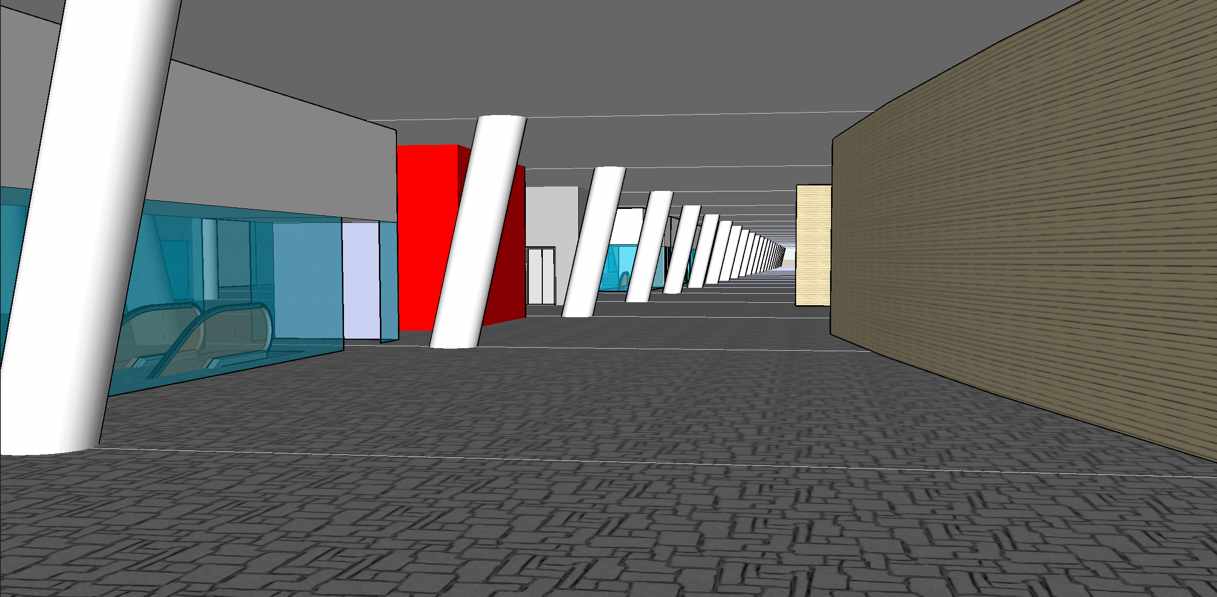
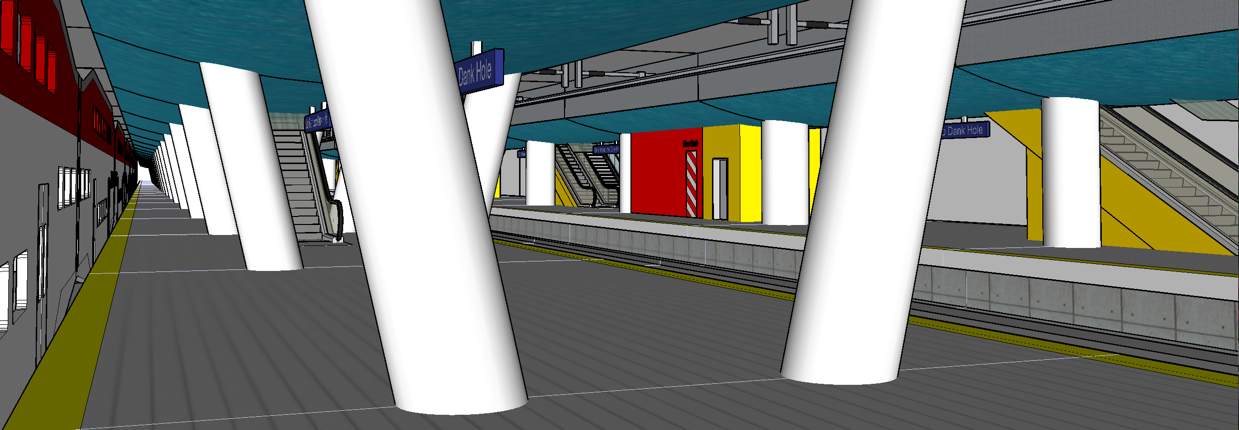
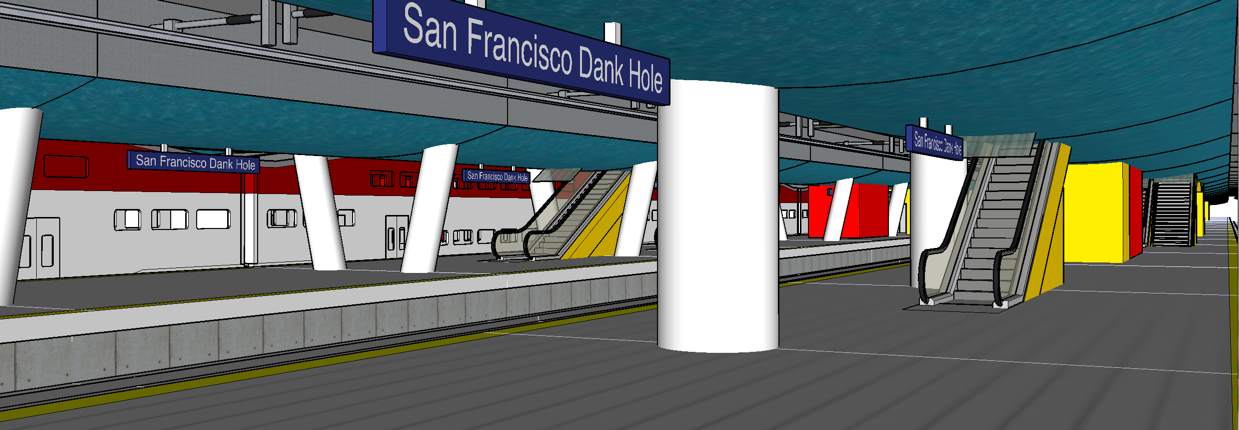
Unfortunately, San Francisco's TTC will feature an underground mezzanine level, an oppressive underground waiting space not unlike Penn Station in New York City. Passengers will navigate through vestibule doors to escalators hidden behind six-foot concrete columns, with no view of the trains, arriving on the platform squarely in front of another six-foot concrete column. The platform level will be a semi-finished, non air-conditioned space... in other words, a basement.

How visionary.

UPDATE 6/14/2009 - great material showing up in the comments section. First, Richard Mlynarik takes the TTC architectural blueprints and whips up some 3D renderings of what the oppressive underground environment will actually look like:


Mezzanine LevelCenter PlatformSide Platform


Architectural design values are often rooted in cultural habits, developed over many decades. When it's time to do something differently, we Americans can't-- and commenter arcady puts his finger on why:
There's a big difference in philosophy between European and American station design. In Europe, the trains are within the overall architectural space defined by the station, in the grandest examples a big steel and glass arch covering the tracks and platforms. In America, the station is separate and distinct from the tracks, which are off to the side in what is basically a train yard. In Europe, passengers wait on the platform, and it's not unusual to see, say, a coffee shop right on the platform. In America, probably because of the tradition of low platforms and train-yard style stations, trains and passengers are kept separate until it's actually time for boarding, at which point the passengers go out of the station and to the train, oftentimes walking directly across other tracks. Hence, in even the grandest of US stations (Grand Central for example), the track area is generally ugly and utilitarian.
Excellent socio-architectural analysis. Can we break out of the mold?

06 June 2009

Build Me A Train Box

The San Francisco Transbay Joint Powers Authority (TJPA), charged with building the new Transbay Transit Center, is now pursuing $400 million of federal stimulus funds to build the underground "train box" that will eventually serve as a downtown station for HSR and Caltrain.

The train box had been descoped in a phased approach adopted in June 2006, whereby the above-ground bus terminal would be built first in Phase 1, followed by a "top down" excavation of the train box below in Phase 2. This plan deferred the greatest expense until later: Phase 1 was estimated at $1.2 billion, compared to Phase 2 at $3 billion--for which few funding sources were identified. The availability of stimulus funding, and in particular an $8 billion slice allocated to high speed rail, has altered the TJPA's equation.

In its next board meeting on June 14th, the TJPA board will formally direct the design team to proceed with the train box included in Phase 1. Train box finishes (tracks, platforms, escalators, etc.) will be added later in Phase 2.

Thinking Inside the Box

The good news is that building the train box now undeniably saves money in the long run, since digging a cavernous hole underneath a fully operational bus station is no mean feat of engineering. Advantages of building the train box in Phase 1 include:
  • $100 million of construction costs saved
  • The opportunity to locate HVAC systems below grade, freeing up ground-level space and circulation
  • No difficulty with shifting foundations as the train box is built
  • Easier waterproofing (in an area with a high water table)
  • Faster construction timeline
  • $12 million of design costs and 4 months of design schedule saved by carrying only one option forward (dropping the "top down" option) allowing the project to reach "shovel readiness" before the stimulus funding deadline
  • More jobs in a time of economic recession
The bad news is that rushing the train box component of the project to achieve "shovel readiness" threatens to lock in certain detailed design features that may later turn out to be ill-advised when someone actually tries to build an efficient, functioning, workable train station inside the box in Phase 2.

The problem basically boils down to reinforced concrete columns. The entire weight of the above-ground portion of the terminal building is carried into the train box foundations through a dense forest of concrete columns, typically 5 to 6 feet in diameter, spaced every 42 feet. These columns were placed in such as way as to prevent a reasonable layout of the tracks entering the station. As discussed in Focus on SF Transbay Transit Center, the TJPA's design for the station's "throat" is a disaster that urgently needs review by competent rail professionals before any concrete is poured... and the columns peppered throughout (see diagram at left) will literally set the design in concrete.

Building the train box and its concrete columns now, while deferring the detailed design of the train station to phase 2, presents a high risk of permanently screwing up the station design. By the time the TJPA gets serious about rectifying the design of the train station, it will be too late.

A Coordinated Plan?

The TJPA's agenda item mentions a Peninsula Corridor Investment Strategy, presumably hammered out among the TJPA, the Metropolitan Transportation Commission (MTC), Caltrain and the CHSRA, to keep inter-agency conflict at a minimum in the methodical pursuit of stimulus funding. This strategy was likely included in the Bay Area Council's Economic Recovery Work Plan, which is said to request $3.4 billion for Bay Area high speed rail improvements under the following headings:

192: Caltrain electrification (~ $1.5 billion)
193: Caltrain positive train control
194: Caltrain San Bruno grade separation (told you so! ~ $300 million)
195: Caltrain North Terminal station improvements
199: City of San Jose, Diridon Station "Grand Central of the West" (~ $500 million)
205: TJPA Phase 1 train box (~ $400 million)

The dollar amounts are rough estimates, since they are not mentioned in the Recovery Work Plan. If the Bay Area secures even a fraction of this funding, get ready for quite a bit of construction, undertaken without a single cent of Proposition 1A high speed rail funds. Who would have guessed, last November?