26 November 2010

Future EMU

The newest automobiles are shown in Paris, Tokyo and Detroit. The latest aircraft are shown at Farnborough and Le Bourget. What about the newest passenger trains? That show, in Berlin, is known as Innotrans and provides a window on the latest evolution in the type of EMU (electric multiple unit) trains that Caltrain is pursuing. One of the future train concepts shown at the recently-concluded Innotrans 2010 is Bombardier's Omneo product platform, ordered in large quantities by French regional transportation authorities and due to enter service in mid-2013. That order is in itself noteworthy, because Bombardier beat French firm Alstom, the incumbent provider of the previous generation of double-deck regional trains, on its home turf.


Tailored slightly for U.S. dimensions, a possible Caltrain Omneo concept is shown in the sketch above. The following key features set it apart from the 1990s-vintage EMUs that feature in Caltrain's electrification plans--the very EMUs that the Omneo is set to replace:
  • Articulated design. The wheels are placed between, rather than under each train car, leading to a smoother ride. Gangways between cars, traditionally cramped, dark, loud, shaky and unwelcoming places, are transformed into full-width, seamless passages that turn the train into one continuous space. Vehicle systems (traction equipment, air conditioning, etc. shown in dark gray in the figure) are moved entirely out of passenger spaces, below the floor and above the ceiling. With inter-car gangways and systems cabinets gone, open sight lines promote a sense of space and safety inside the train.

  • A usable amount of high-floor space. Bi-level EMU cars are always a configuration challenge, since passenger spaces must fit around numerous vehicle systems while still providing full ADA accessibility. Accessibility means that wheelchair spaces, bike spaces and accessible toilets must all be provided on the door entry level. Traditional bi-level cars do not provide sufficient room for all these amenities in the high-floor vestibule areas over the wheels, and thus typically board on the lower level where more contiguous space is available. Articulation gets rid of this design constraint.

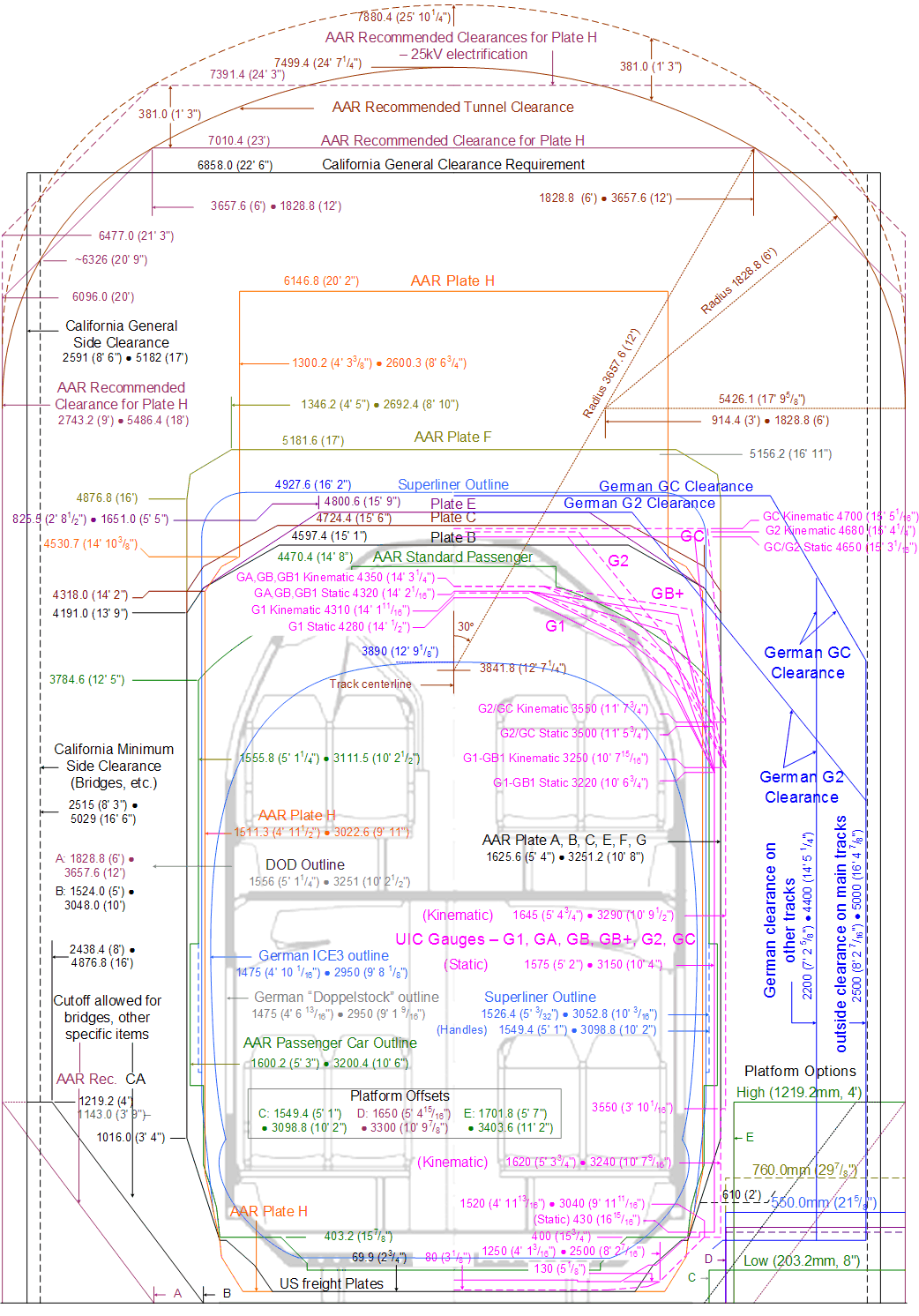
  • High-level boarding. While the traditional bi-level EMU architecture tends to allow boarding only on the lower floor, this concept features a 1220 mm (48 inch) boarding height that would be compatible with high-speed rail platforms. The Omneo is offered in 550 mm, 760 mm and 920 mm boarding heights, but additional vertical clearance available in the U.S. makes a 1220 mm floor height feasible. A shared platform interface between Caltrain and HSR presents enormous operational advantages by allowing any train to access any platform, especially at San Francisco Transbay.

  • Dual, High-Low Doors. To allow a gradual transition from today's 8-inch platforms to 48-inch HSR-compatible platforms, each vestibule features two doors, one for each height. While this temporarily restricts door capacity during the transition period, the modular door assemblies provide for easy reconfiguration to 100% high platforms once the transition is complete. Dual height doors are not unprecedented.

  • Extra wide interiors. The articulated design shortens car bodies from the traditional 26 m (85 feet) to just 10 or 15 meters. Shorter cars, for a given loading gauge, can be made wider than longer cars. A U.S. spec Omneo car body could be 3.1 m (122 inches) wide in the 15-meter double deck section, and 3.15 m (124 inches) wide in the 10-meter single deck section, all within AAR Plate F. That's 4 and 6 inches wider, respectively, than today's Bombardier bi-level cars used in Baby Bullet service. Such wide interiors might enable comfortable 5-abreast seating.
Bombardier vs. Bombardier

It's instructive to compare the Omneo EMU concept to another product in Bombardier's portfolio, the bi-level commuter cars that Caltrain operates for its Baby Bullet service. The diagram at right shows a direct comparison of a Caltrain car to a pair of Omneo cars of roughly equivalent length.

At three seats abreast, an 11-unit Omneo train measuring 145 m (475 ft, a bit shorter than a 493 ft Baby Bullet train) accommodates 695 seats and 48 bikes, compared to 674 seats and 48 bikes for a Baby Bullet. With a two-abreast seating plan making use of the extra width for aisles and standees, the Omneo would still accommodate 590 seats (not counting 48 flip-down seats.) Using a metric that Caltrain is fond of, seats per unit length of train, here's how it stacks up:
  • Baby Bullet: 1.37 seats/ft or 4.5 seats/m (including locomotive)
  • Omneo 3+2 seating: 1.46 seats/ft or 4.8 seats/m
  • Omneo 2+2 seating: 1.24 seats/ft or 4.1 seats/m
These figures show that an Omneo-like EMU would achieve rough parity with the Baby Bullet in terms of seating density. Of course, as we've discussed before, it's not all about seats... standees are passengers too, if you give them somewhere comfortable to stand.

Innovative Design Enables Platform Height Compatibility

This article is not intended as an endorsement of Bombardier's products; their Omneo train merely serves as an illustrative example. Other manufacturers (Alstom, Siemens and Stadler) aren't standing still, and are also increasingly focused on articulated EMU designs with innovative and flexible interior packaging. In light of these new technological developments, Caltrain's relentless pursuit of 20-year-old double-deck EMU designs locked into a low-platform architecture seems downright archaic.

Cutting-edge European vehicle designs will not compromise the basis of Caltrain's FRA waiver, and might help achieve one of the key tenets of compatibility: a common platform interface for HSR and Caltrain, without billions of dollars and years of platform reconstruction up front. The trains can come now, as part of the electrification project, and the rest can follow later as time and money allows. What is required is a little bit of forward thinking to future-proof the system and enable any train to use any track to access any platform.

18 November 2010

Still No Compatibility In Sight

The high-speed rail authority's program management team, of Parsons Brinckerhoff Quade & Douglas, recently published an Operations & Maintenance Concept for peer review by the many foreign HSR operators with which the California High-Speed Rail Authority has signed collaboration agreements.

Besides regurgitating much of the same information already available in the various EIRs and technical memoranda, the peer review document states a number of operational assumptions that have far-reaching implications for the peninsula rail corridor. The first one on the list:
1. The HST system is assumed to operate on dedicated tracks, independent of any other passenger or freight rail services, except in the following locations:

a. Peninsula Corridor – approach tracks leading to the two terminals at Transbay and 4th and King Streets (shared between CHST and Caltrain commuter trains)
Note the added emphasis, that only the approach tracks would be shared, namely north of Brisbane. And then, this:
8. (...) Train operations at the San Francisco end of the network will be complex, linking the two terminal stations, each with mixed HST and commuter traffic, with the San Francisco‐area storage and maintenance yard, as well as the four‐track main line that has high‐speed trains on two dedicated tracks and commuter trains on the other two tracks.
While the document does briefly entertain the alien notion of shared platforms, as well as a "proof-of-payment" fare system where POP must be provided in the paid area of the station (talk about not getting the concept!), what is abundantly clear here is that high-speed rail is being planned on the peninsula without regard to integrating operations with Caltrain--in flagrant disregard of the MOU with Caltrain, and of many successful shared corridors around the world, including even in New Jersey. In this vision, Caltrain is confined to two tracks, and relegated to the role of an operational nuisance on the approach into San Francisco. Any synergy that might arise from Caltrain express trains sharing tracks with high-speed trains is wasted.

Change The Assumptions, Before It's Too Late!

These operating assumptions have dire implications for local commuter rail service on the peninsula.

Caltrain has so far demonstrated a total lack of ambition on the operations front, and has utterly failed, ever since Proposition 1A passed in 2008, to think outside of the two-track box known as Caltrain 2025. There are ways to provide better service with fewer trains, provided that integrated planning is performed up-front by the Peninsula Rail Program, pursuant to the memorandum of understanding (which the above operating assumptions directly contradict).

The high-speed rail program management team is also uninterested, in the first place because their charter is to provide high-speed long-distance service, not commuter service, and secondly, because the same firm built BART. While this can only be alleged, Parsons Brinckerhoff Quade & Douglas likely has zero interest in improving Caltrain, and every financial interest in receiving another several billion dollars of taxpayer's money to complete BART's manifest destiny to ring the Bay.

Foreign peer reviewers will have little interest in questioning the operational assumptions, since doing so might rock the boat and compromise their future ability to obtain contracts to build and operate California's system.

So just who does that leave to do the right thing, hopefully before any concrete is poured?

Residents and city governments should push hard for Caltrain to integrate its operations with the high-speed rail system, going for maximum flexibility, striking the appropriate balance between local and long-distance services, and enabling the optimal allocation of scarce resources, (such as track capacity at rush hour, platform space at terminal stations, station area footprints in developed areas, etc.) in response to actual demand patterns as they develop. For planning purposes, that means any train should be able to use any track, and stop at any platform.

If peninsula communities are going to bear the considerable disruption of HSR construction and operation, they should have every interest in getting at least a little bit of trickle-down service benefits in return. Otherwise, they may become the rail equivalent of fly-over country.

(thanks to CARRD for obtaining the O&M peer review document)

01 November 2010

News Roundup, World Series Edition

Supplemental AA Supplement: The CHSRA posts the latest round of tweaks to the peninsula alternatives analysis. The updated report is due in November. (Note: this briefing was abridged by the CHSRA, shortly after being posted. The link is to the original slides that were removed from the CHSRA website.)

The Money Goes Poof: since the Feds have specifically ear-marked $715 million in HSIPR funding for the Central Valley, the winner-take-all, four-way horse race between Merced - Fresno, Fresno - Bakersfield, Los Angeles - Anaheim, and San Francisco - San Jose is for all intents and purposes decided before the CHSRA board even gets to vote. Bottom line: SF - SJ is out of the running and will not receive any of the $2.25 billion in ARRA stimulus funds. That has huge implications on process: the rush to beat a 2012 shovels-in-the-dirt deadline is gone.

Ray Writes Anna: the Secretary of Transportation writes a letter to assure Congresswoman Eshoo and concerned peninsula residents that "no final decision has been made regarding the design of this segment, and DOT must approve any final alternative in order for it to receive Federal funds. As long as this process is underway, we cannot prejudge the final outcome." In short, he claims there is adult supervision and the mad rush (now moot--see above) for early federal funding will not preempt due environmental process.

Anna Writes Ray: the Congresswoman
replies, profusely thanking the Feds for their oversight and the few crumbs thrown our way (a paltry $16 million, nominally ear-marked for re-arranging the platforms at San Francisco's 4th & King station) ...

... and asks for CBOSS Pork: Eshoo asks that the $16 million be re-allocated to the CBOSS project. She pointedly states "We can assure you that the PTC project is not a "throwaway" that would benefit only Caltrain and require replacement or costly upgrade when HSR is built."

If only that were true.

If only the secretary could hear from people who didn't drink the CBOSS Kool-Aid... for example, by reading Caltrain's own crystal-clear statements that the design of CBOSS will not take HSR into account. Or simply typing "CBOSS Caltrain" into Google. Recall that CBOSS is (a) an overlay system (that's what the 'O' stands for) that cannot function on its own as a stand-alone HSR-capable signaling system, (b) is designed primarily for freight trains, not HSR, and (c) is currently vaporware. For the $230 million they are trying to marshall for this science project (a massive sum with an elastic upper bound, to be exercised via contractual engineering change orders) they could simply install ERTMS, the emerging worldwide HSR standard, at very little cost or schedule risk.

Message to LaHood and Eshoo: now that wouldn't be a throwaway.

16 October 2010

Station Design 101


If you're the poor sucker in charge of designing a mid-peninsula high-speed rail station, here's what you must do: start with the ridership estimates for full 2035 system build-out, and apply Technical Memo 2.2.2 (station design policy) as handed down from above by Parsons Brinckerhoff, the firm in charge of the HSR system design. Table 6.1 has all the relevant formulas that you'll need to size the outer concourse, controlled waiting areas, how many restrooms, etc. All that remains is to plug and chug the formulas and presto, you've got yourself a station.

The result of this formulaic approach to station design can be seen in the recent sizing study for a potential mid-peninsula station at Mountain View, which is very similar to the notions also being entertained for Palo Alto or Redwood City. Key statistics: about 8000 daily HSR boardings, 67000 square feet of floor area (not including platforms), and 3000 parking spaces.

Implicit Requirements

While the technical policy and system requirements do contain a variety of clearly stated requirements concerning station design, many of the requirements are not stated, but instead taken for granted. They are implicit requirements. The following is an attempt to make them explicit:
  • The station shall funnel every passenger through a sequence of functional spaces that broadly mimic an airport.

  • The station shall be divided into a public concourse and an access-controlled area requiring possession of a valid ticket.

  • The station shall have a mezzanine, a large access concourse located above or below the platforms that provides the "necessary" floor area to funnel passengers from a grand station entrance (complete with "entry plaza") through "check-in", shops and restaurants, and possibly "security" to a "gate".

  • The HSR platforms shall be used exclusively by high speed trains, and may not under any circumstance be shared with Caltrain. The same track and platform edge may not be served by both HSR and Caltrain. The same platform at opposite platform edges may not be served by both HSR and Caltrain.

  • The HSR platforms shall be fully access controlled with high fences, even if such fence is used to segregate the HSR platform from an adjacent Caltrain platform.

  • Passengers transferring between HSR and Caltrain shall use escalators and transit via the mezzanine. Maximum vertical circulation is encouraged, and convenient cross-platform or same-platform transfers are explicitly disallowed.

  • The station shall have gargantuan amounts of automobile parking (1000 spaces at the station, and another 2000 spaces within 3 miles).
None of these "requirements" make any sense, except to maximize the size and cost (and profit) of building such grandiose but operationally dismal infrastructure. What is being envisioned here is not an integrated rail network, but well and truly a flight-level zero airline.

Another Way

It doesn't have to be this way. In France or Germany, any bum off the street can drag a large suitcase onto a high-speed train five minutes before departure without ever passing through a security check or a fare gate. Tickets are checked on board, using what's known as proof-of-payment or POP: if you can't produce a valid ticket when asked, you are issued a citation. POP obviates all this sterile-area gated fare-paid-only nonsense, with enormous simplification of the process of getting from point A to point B.

Is POP a gaping security hole? Not if you consider that bombs brought on board high-speed trains are a rather unreliable way to achieve mass carnage. That's why over several decades, such an attack has only been carried out once, and then rather unsuccessfully. The target environment will necessarily be far richer over on the Caltrain platform. Terrorists in Madrid knew this when they attacked at Madrid's main HSR terminal; all their bombs went off on packed commuter trains. So, a rational evaluation of threats (one not based on security theater) leads to the conclusion that HSR need not look like a BART fortress on steroids.

In Europe, land of POP, commuter rail and HSR routinely share platforms, leading to far more efficient use of space inside stations. For example: Paris, Berlin, Karlsruhe, Hamburg (on a sacrilegious curved platform, no less!), Brussels, and dozens more.

The graphic below shows the differences between the gargantuan mid-peninsula dial-a-station proposed by the CHSRA (and rightly rejected by Mountain View, Palo Alto and Redwood City) and a mid-peninsula station of far more modest proportions, that could be achieved without any loss of functionality provided that the following simple requirements are adopted:
  • HSR shall use barrier-free fare control
  • Caltrain shall use the same platform height as HSR
  • Stations shall allow any train to use any track to access any platform
  • Stations shall minimize vertical and horizontal circulation needed to access any train
Appropriate station design requirements have an enormous effect on the resulting designs, with overall width dropping from an elephantine 265 feet (as depicted in the sizing study) to a more manageable 122 feet.

At a time when the HSR project is increasingly under attack for being insensitive to peninsula communities, perhaps a reevaluation of station requirements would improve the chances of someday achieving a context-sensitive solution. Mountain View, for example, could have the highly-effective, low-impact intermodal station previously described in this space.

06 October 2010

Juicy CBOSS Tidbits

UPDATE: the Q&A with prospective bidders continues. The latest round includes these gems:
Q #31: The RFP addresses HSR. What assumptions should the proposer make in order to address HSR requirements?

A: Evaluation of the potential for the proposed solution to meet future HSR needs will not be part of the proposal evaluation.

Q #43: [Caltrain] states that "the system will be required to be interoperable with the train control system selected for HSR operation throughout the California High Speed network." Since this train control system has not been identified, how can the contractor ensure that their system will be interoperable by the 2015 implementation date?

A: The Caltrain PTC system must be interoperable with existing tenant railroads by Dec 2015. HSR is not an existing tenant railroad.
There. Just in case there remained even the shadow of a doubt: Caltrain couldn't care less about interoperability with HSR, but is focused like a laser on interoperability with Union Pacific freight trains, a.k.a. "tenant railroad."

Caltrain is betting all its chips on the AAR's Interoperable Train Control (ITC) project, an industry-wide consortium effort to stonewall and delay the federal PTC mandate. If there is any doubt about what the AAR (representing the big freight railroads) thinks about PTC, read their litany of complaints and ask yourself just how likely it is that ITC will be completed on time--regardless of the law. Expect the AAR to slow-walk PTC just as the Europeans run rings around us worldwide!

ORIGINAL POST: Caltrain's planned Positive Train Control system (known as CBOSS) has been out to bid for a little while now, and the Request For Proposal process is continuing with some back-and-forth Q&A between Caltrain and prospective bidders in advance of the November 3rd deadline.

The latest volley of questions and answers includes question #20 from an astute prospective bidder:
What assumptions should me made in terms of HSR? (Interoperability, Operations, sharing track, etc.)
Caltrain's official response:
Under current RFP Scope of work, HSR Operations is not considered for this phase of PTC implementation. Public information is available via HSR webisite. (sic)
It's October 2010, and Caltrain still considers high-speed rail as an afterthought. Shall we give them another raise?

Also, just where is the funding for CBOSS going to come from, and is the undetermined funding source why Caltrain refuses to change the wording of the contract payment terms from "will endeavor to pay" to "shall pay" (see question #11) ?