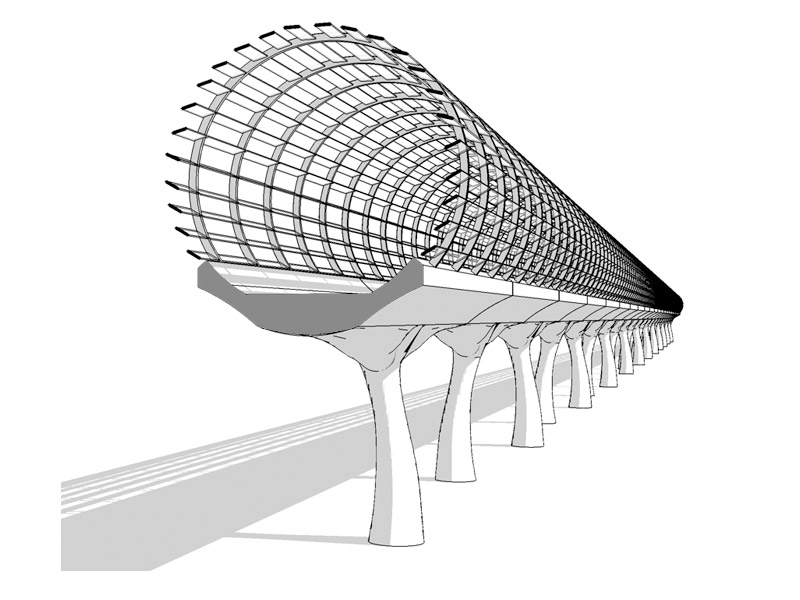
 Another creative proposal (see also PDF brochure) has emerged from Palo Alto architect Joseph Bellomo, this time for an elevated high-speed rail line built down the middle of the Caltrain right of way, partially enclosed in a tubular structure with sound baffles, solar panels, and if one believes the sketches, optional LED lighting. More broadly, Bellomo is calling for an international design competition to come up with the best world-class design; he laments that the design has so far been dominated by teams of engineers working separately on each segment of the line.
Design is nice, but what about engineering function? For something as utilitarian as rail transportation infrastructure, function obviously trumps form. That inevitably leads one to ask the most obvious question about Bellomo's concept.
Why Elevate?
It is a useful exercise to identify the reasons for elevating the tracks.
- because it looks sexy and futuristic, just like the Disneyland monorail or other gadgetbahn concepts like maglev or Tubular Rail. These are so often depicted on elevated guideways that elevation itself has become associated with modernity and speed. The average American, who has little or no exposure to high-speed rail, is especially vulnerable to this pop-culture association--and it's a terrible reason to build elevated tracks.
- because it allows the tracks to collect solar energy, as envisioned by Bellomo. Solar panels sure are green and trendy, but they are far from proven as an optimal way to power a peaky and very high electrical load (a single accelerating train can draw about 10 megawatts). If renewable energy is used to power the trains, its source should be a choice that is not locked in by design of the infrastructure. The problem of powering the trains is adequately decoupled (through the electrical grid) from the problem of how to generate the power.
- because of a need to fit more tracks into a constrained right of way. If you can't spread out horizontally, then go vertical. Again, this is a solution to a problem that mostly doesn't exist on the peninsula: the vast majority of the railroad right of way, including the portion through downtown Palo Alto, has ample width for as many tracks as would ever be required to provide both commuter and HSR services. Even in those few locations that are constrained, acquiring additional land is far cheaper than the construction cost and ongoing maintenance cost of elevated structures or tunnels. That available width is why they chose the Caltrain corridor in the first place. Where Bellomo's renderings show an elevated across University Avenue, the railroad right of way is over 160 feet wide!
- because it provides unimpeded access from one side of the tracks to the other for pedestrians, bicycles and motor vehicles--something that is better known as grade separation. This is the only good reason ever to elevate the tracks. Unfortunately, the Bellomo proposal falls short on this as well: the existing commuter tracks stay at grade, forming the same community barrier that they already are today. Worse, elevating HSR over Caltrain would severely curtail the options for later removing grade crossings.
Missing the Point
While Bellomo's HSR concept has obviously been polished from an architectural design standpoint, the basic premise of an elevated HSR is not rooted in any realistic functional or engineering need. That flaw makes Bellomo's complaints that engineers are in charge ring a bit hollow.
While he can be lauded for proposing fresh solutions, Bellomo clearly needs to review his concept with civil engineers who have direct experience with high-speed rail infrastructure. (Hint: there are precious few of them in California.) In the meantime, we can easily state...
The Three Rules of Elevation
- Don't elevate the tracks if you can avoid it.
- If you can't avoid it, then elevate solely to provide access from one side of the tracks to the other, i.e. grade separation, and return to ground level as quickly as possible.
- Keep all tracks at the same elevation, to provide operational flexibility--allowing trains to easily switch from one track to another as dictated by operational service needs.


 Posts
Posts